

For decades, the global canon of Japanese photography has been dominated by a select group of names: Daido Moriyama, Nobuyoshi Araki, and Hiroshi Sugimoto. These figures, while undeniably brilliant, have cast a long, singular shadow, defining the world’s perception of Japan’s visual culture through a decidedly male lens. The grit of urban decay, the transgressive nature of eroticism, and the cool detachment of minimalism have long been considered the pillars of the Japanese photographic tradition. However, a landmark retrospective currently occupying Tokyo’s Hikarie Hall is dismantling this narrow narrative, asserting that the story of Japanese photography is not merely a fraternity, but a complex, multifaceted tapestry woven by both genders.
“I’m So Happy You Are Here: Japanese Women Photographers From the 1950s to Now” has arrived in Shibuya as a triumphant homecoming. Having already captivated over 140,000 visitors across Europe, the exhibition is a corrective force, reclaiming the legacy of thirty women artists whose contributions have been, until recently, largely relegated to the margins of international discourse.
A Historical Correction: From the Archives to the Gallery
The exhibition finds its origins in a 2024 publication by Aperture, which sought to address a glaring blind spot in art history. While Western institutions have spent the better part of a century curating the works of Japan’s male masters, the innovations of their female contemporaries were often left untranslated, unarchived, and overlooked.
Curator Mariko Takeuchi, who spearheaded the Japanese iteration of the project, is careful to frame the exhibition not as a gesture of tokenism, but as a long-overdue act of historical accuracy. “This isn’t simply about ‘because they are women,’” Takeuchi remarked at the exhibition’s opening. “Japan has a wealth of extraordinary photographers, and a great many of them happen to be women. Instead of treating them as a monolith, I felt compelled to honor them as individuals, highlighting how each artist commands a completely distinct worldview and approach to the medium.”
The exhibition begins with a deliberate nod to the past, grounding the viewer in the historical reality that women have been instrumental in the development of the medium in Japan for well over a century. The entrance features a rare 1864 portrait by Shima Ryu of her husband, Shima Kakoku—the earliest documented evidence of a Japanese woman practicing photography as a profession. This is presented alongside the vibrant, experimental color studies of 1920s pioneer Eiko Yamazawa. By framing the exhibition with these figures, the curators make a definitive statement: women were not latecomers to the Japanese photographic scene; they were architects of its foundational evolution.
Chronology of Influence: Sculpting Fantasy and Identity
The exhibition is organized into thematic threads that trace the evolution of creative intent. Many of the featured artists moved beyond the camera as a passive recording tool, choosing instead to use it as a device for construction, performance, and psychological projection.
In the 1950s, Toshiko Okanoue was a vanguard of this approach. Working in the rigid, patriarchal domestic landscape of post-war Japan, she utilized Western fashion magazines like Vogue and Harper’s Bazaar to create surrealist, allegorical collages. These works, which share a thematic kinship with the European avant-garde of Max Ernst or Hannah Höch, served as a form of "psychological escape."
Decades later, Michiko Kon pushed the boundaries of the still-life genre into the realm of the uncanny. Kon creates sculptures from perishable, often visceral materials—fish scales pinned to fabric, vegetables arranged in alien geometries, or high heels wrapped in chicken skin. Her gelatin silver prints document these ephemeral creations at the precise moment they teeter between artistic beauty and organic decay, challenging the viewer’s relationship with the objects of the everyday.
Identity, too, has been a central site of investigation. Miwa Yanagi’s Elevator Girls series (1994–99) turned the camera toward the hyper-feminized, service-oriented roles of the Japanese department store. By placing her subjects in highly controlled, stage-like environments, Yanagi highlighted the pressures of conformity and social hierarchy. As she noted in a recent interview, the series functions as a mirror to societal friction—a struggle to fit into a pre-defined mold that many continue to grapple with today.

Similarly, Tomoko Sawada’s ID400 (1998–2001) serves as a profound commentary on the performance of self. Using a public photo booth, Sawada transformed herself into hundreds of distinct personas through meticulous adjustments of hair, makeup, and expression. By effectively erasing her own identity, she forced an examination of the fixity of the self and the ease with which society consumes labels and archetypes.
Real Life in Plain Sight: The Documentary Shift
Beyond the studio, the exhibition documents a shift toward capturing the complex, sometimes painful, intersection of history and daily existence. Mao Ishikawa’s work is perhaps the most visceral example of this. For over fifty years, Ishikawa has documented the social rhythms of her native Okinawa. Her seminal series, Red Flower (1975–77), captured the lived experience of local women working in bars catering to Black American GIs. Unlike the objective, often detached gaze of male photojournalists who frequented the island, Ishikawa’s lens was one of intimacy and camaraderie. She captured the unvarnished reality of raising children and finding joy amidst the political volatility of an occupied territory.
Aya Fujioka offers a different, yet equally poignant, perspective in her series Here Goes River (2013–17). Avoiding the tropes of traditional photojournalism surrounding Hiroshima, Fujioka turns her focus to the mundane—the shopping arcades, the trolley cars, and the rivers that flow through the city. By documenting the "living" Hiroshima that exists decades after the atomic tragedy, she maps the city’s memory not through monuments, but through the quiet, iterative movements of daily life.
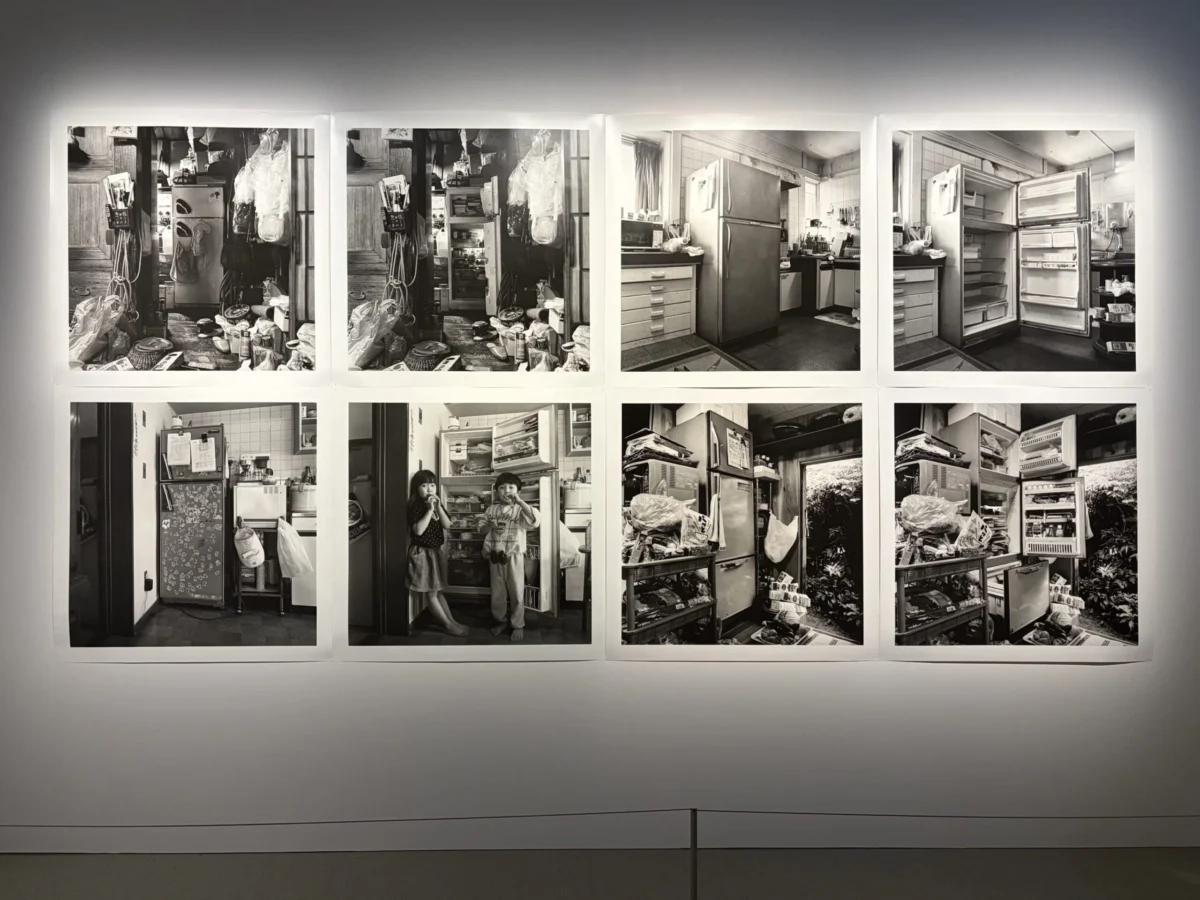
Domesticity, too, becomes a subject of historical gravity in the work of Tokuko Ushioda. Her Ice Box series (1981–2001) began in 1978 as a record of her own life in a sparse apartment in Setagaya. The refrigerator, the only piece of furniture she possessed at the time, became the focal point of her documentation. “Despite our poverty, every day felt strangely peaceful,” Ushioda reflected. What started as a record of survival evolved into a wider social project, documenting the refrigerators—and by extension, the private lives—of her neighbors and friends, creating a quiet, domestic archive of the late 20th century.
The Transcendence of the Ordinary
The exhibition culminates with the work of Rinko Kawauchi, whose photography operates on a scale that feels simultaneously microscopic and universal. Eschewing geographic or historical markers, Kawauchi’s work finds the sublime in the mundane: the splash of a puddle, the shadow of a leaf, or the subtle shift in natural light. Her installation, Illuminance (2001–2026), uses video to weave these fragments into a cohesive narrative that feels both intimately familiar and grandly expansive, signaling a shift in Japanese photography toward a more personal, poetic sensibility.
Implications and Future Impact
The significance of "I’m So Happy You Are Here" extends far beyond the walls of Hikarie Hall. By gathering 200 works from 30 artists, the exhibition forces a necessary recalibration of the history of photography. It posits that the "grit and conceptual genius" previously attributed almost exclusively to men were qualities shared by their female contemporaries, albeit applied to different contexts and through different mediums.
For the international art community, the exhibition serves as a call to re-evaluate the archives. It highlights that the "blind spot" mentioned by the curators is not merely a lack of representation, but a loss of nuance in our understanding of Japanese culture. As the exhibition continues its run in Tokyo through August 26, it stands as a testament to the fact that the history of photography is a living, breathing entity—one that is constantly being rewritten by those who have the courage to step behind the lens and claim their own narrative.
In the words of the curators, this is not a revisionist project; it is an inclusionary one. By recognizing the individual brilliance of artists like Yamazawa, Okanoue, Kon, Ishikawa, and Kawauchi, we aren’t just adding names to a list—we are gaining a more complete, and ultimately more accurate, picture of the world.
Exhibition Details:
- I’m So Happy You Are Here: Japanese Women Photographers from the 1950s to Now
- Venue: Hikarie Hall, Shibuya, Tokyo
- Dates: July 4 – August 26, 2026
- Participating Artists: Aya Fujioka, Mikiko Hara, Hiromix, Toshie Imai, Miyako Ishiuchi, Mao Ishikawa, Ai Iwane, Mari Katayama, Rinko Kawauchi, Hiroko Komatsu, Michiko Kon, Yurie Nagashima, Asako Narahashi, Mika Ninagawa, Tamiko Nishimura, Rika Noguchi, Sakiko Nomura, Toshiko Okanoue, Yuki Onodera, Momo Okabe, Tomoko Sawada, Rieko Shiga, Kunie Sugiura, Yuki Tawada, Toyoko Tokiwa, Tokuko Ushioda, Hitomi Watanabe, Eiko Yamazawa, Miwa Yanagi, and Tomoko Yoneda. (Special exhibit: Shima Ryu).











