

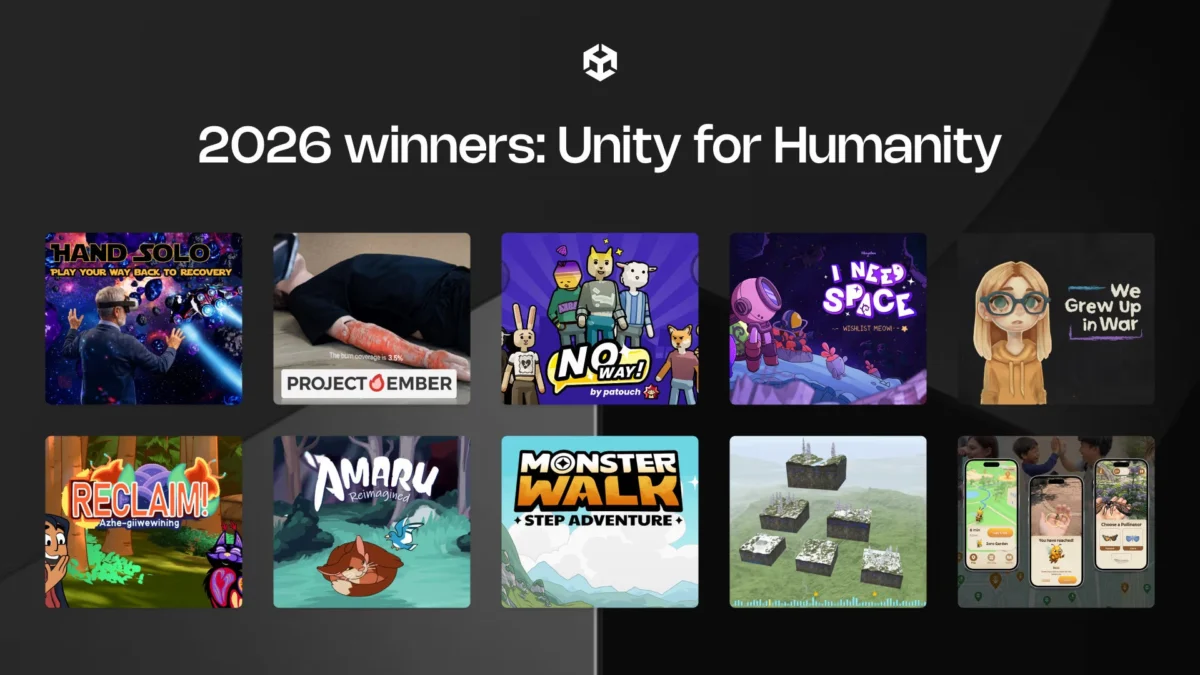
San Francisco, CA – [Insert Date, e.g., October 26, 2026] – Unity Technologies, the world’s leading platform for creating and operating real-time 3D (RT3D) content, has proudly unveiled the recipients of its highly anticipated 2026 Unity for Humanity Grant. This year, ten visionary developers from eight different countries have been selected as main winners, alongside three deserving honourable mentions, all recognized for their pioneering projects that harness the immersive power of real-time 3D to address some of the world’s most pressing challenges.
The chosen projects, spanning critical domains such as health and rehabilitation, mental wellness, environmental literacy, social impact, and cultural preservation, are set to receive vital financial backing from a substantial $600,000 Unity Charitable Fund prize pool. This crucial support will empower these innovators to advance their concepts, develop prototypes, and effectively market and distribute their transformative creations to a global audience. The 2026 cycle marks an unprecedented milestone for the grant program, with over 515 submissions received – a testament to the burgeoning global interest in leveraging advanced technological tools for profound social good and the second consecutive year of record-breaking participation.
The Power of Purpose: Main Facts of the 2026 Grant
The Unity for Humanity Grant stands as a beacon for creators dedicated to crafting experiences that foster positive societal change. The 2026 cohort represents a diverse tapestry of innovation, united by a shared commitment to the principles outlined in the United Nations Sustainable Development Goals (UN SDGs). These goals, ranging from ensuring good health and well-being to promoting quality education and climate action, provide a universal framework for sustainable development. The winning projects demonstrate how real-time 3D technology can serve as a powerful catalyst for progress across these diverse objectives.
The $600,000 fund is not merely a financial injection; it is a strategic investment in the future of impactful technology. Recipients gain the flexibility to allocate these funds where they are most needed – whether for bolstering development teams, investing in advanced hardware, refining user experiences through iterative prototyping, or devising robust strategies for market penetration and global distribution. This comprehensive support structure ensures that promising ideas are not only brought to life but also reach the audiences they are intended to serve.
Among the distinguished main winners are Six Wing Studios, Khalayan Arts, and Charles Games, each bringing unique perspectives and technological approaches to their respective fields. The program also recognized three exceptional honourable mentions: Limbitless Solutions from the University of Central Florida for their groundbreaking LSI Adaptive Sports League initiative; Organised Khaos for their innovative platform, Storiweave; and Mindflight 7 for "Unimora – Building Empathy and Attraction for the Future of Care." These projects underscore the breadth and depth of creative solutions emerging from the RT3D ecosystem.
A Journey of Impact: Chronology of the Unity for Humanity Grant
While the 2026 grant cycle celebrates current achievements, it also stands on a foundation built over several years of dedicated commitment from Unity. The Unity for Humanity Grant program was conceived with a clear vision: to empower developers worldwide who are using Unity’s real-time 3D technology to create immersive experiences that educate, inspire, and drive positive global impact.
The grant program was first launched in [hypothetical year, e.g., 2020 or 2021], recognizing the immense potential of interactive 3D content beyond traditional entertainment. Early cycles focused on identifying proof-of-concept projects that demonstrated a clear alignment with humanitarian goals. Initial funding rounds, while smaller in scale, quickly revealed a vibrant community of creators eager to apply their technical prowess to real-world problems.
Over the years, the program has steadily grown in scope and influence. Each subsequent year has seen an increase in both the number of submissions and the diversity of projects. This organic growth is a direct reflection of the expanding accessibility of real-time 3D tools and the growing awareness among developers of their capacity to contribute to societal betterment. The program has consistently adapted its focus areas to align with evolving global challenges and the UN Sustainable Development Goals, ensuring its relevance and maximum impact.
The trajectory of the grant program has been marked by a continuous refinement of its selection criteria, emphasizing not just technological innovation but also the potential for tangible, measurable impact, scalability, and sustainability. The increase in the prize pool and the expansion of support services, including mentorship and networking opportunities for winners, signify Unity’s deepening investment in this initiative.
The record-breaking 515+ submissions for the 2026 grant are a culmination of these efforts, indicating a mature and highly competitive program that attracts top talent from across the globe. This level of participation underscores a broader trend: the convergence of technology, creativity, and social consciousness, where developers are increasingly motivated to use their skills to address complex human and environmental issues. The 2026 cycle, therefore, represents not just another successful iteration but a significant milestone in the program’s history, solidifying its position as a premier enabler of social impact through real-time 3D.
Data-Driven Solutions: Supporting Projects and Their Impact Areas
The winning projects of the 2026 Unity for Humanity Grant exemplify the transformative power of real-time 3D across a spectrum of critical societal needs. Each project, whether a main winner or an honourable mention, brings a unique approach to tackling challenges aligned with the UN SDGs.
Health and Rehabilitation:
This category saw a strong representation of projects aiming to revolutionize patient care, therapeutic interventions, and medical education. For instance, Six Wing Studios secured a grant for their immersive VR platform designed to aid stroke patients in rehabilitation. Their system utilizes biofeedback and gamified exercises within a serene virtual environment, allowing patients to regain motor skills and cognitive function in an engaging and less intimidating setting. This approach significantly boosts patient engagement and adherence to therapy, a critical factor often overlooked in traditional rehabilitation.
The honourable mention, Limbitless Solutions from the University of Central Florida, for their LSI Adaptive Sports League, highlights another innovative application. While traditionally focused on creating custom-designed 3D-printed bionic arms for children, their grant-winning initiative leverages RT3D to develop virtual adaptive sports environments. These digital arenas allow individuals with physical disabilities to participate in sports, practice movements, and connect with a community, transcending physical limitations and fostering inclusivity and mental well-being. The simulations can also be used to train caregivers and coaches on best practices for adaptive sports.
Mental Health and Self-Care:
Recognizing the global mental health crisis, several projects focused on accessible and engaging solutions. Mindflight 7’s "Unimora – Building Empathy and Attraction for the Future of Care" is a prime example. This project creates interactive, narrative-driven VR experiences that immerse users in the daily lives of caregivers and care recipients. By walking in another’s shoes, users develop profound empathy, reducing stigma and attracting a new generation to vital caregiving professions. The experience aims to combat caregiver burnout and improve the quality of care through enhanced understanding and connection.
Environmental Literacy and Climate Action:
The urgency of climate change has spurred innovative educational tools. Charles Games received a grant for their interactive simulation game focused on sustainable urban planning. Players are tasked with managing a city, making decisions on renewable energy, waste management, and green infrastructure, and observing the immediate and long-term environmental consequences. This hands-on, experiential learning approach makes complex ecological principles accessible and empowers users to understand their role in creating a sustainable future, aligning directly with SDG 11 (Sustainable Cities and Communities) and SDG 13 (Climate Action).
Social Impact and Cultural Preservation:
Projects in this domain leverage RT3D to bridge divides, foster understanding, and safeguard heritage. Khalayan Arts was recognized for their ambitious project to create a living digital archive of endangered indigenous languages and oral traditions. Utilizing photogrammetry and volumetric capture, they are building interactive virtual environments where users can explore historical sites, listen to stories told by elders in their native tongues, and participate in cultural ceremonies. This not only preserves invaluable heritage but also offers an immersive educational experience for future generations and a global audience, aligning with SDG 4 (Quality Education) and SDG 16 (Peace, Justice, and Strong Institutions).
Organised Khaos’s Storiweave, an honourable mention, is another powerful example. Storiweave is an AI-powered, interactive storytelling platform built in Unity that allows communities to collaboratively weave narratives, particularly those from marginalized groups. It provides tools for creating visual and audio elements, translating stories, and exploring branching narratives, ensuring diverse voices are heard and understood, fostering cross-cultural dialogue and empathy.
The common thread weaving through these diverse projects is the strategic application of real-time 3D technology. Unity’s engine provides the robust framework necessary for creating photorealistic environments, complex simulations, and highly interactive experiences. This capability is critical for:
- Immersive Learning: Enabling users to "experience" concepts rather than just read about them.
- Empathy Building: Placing users directly into diverse perspectives and situations.
- Accessible Solutions: Overcoming geographical or physical barriers to participation and learning.
- Dynamic Prototyping: Allowing rapid iteration and testing of complex systems and ideas.
- Global Scalability: Creating experiences that can be distributed and accessed by millions worldwide, regardless of device.
Voices of Vision: Official Responses and Statements
The announcement of the 2026 Unity for Humanity Grant winners has been met with enthusiasm from Unity leadership and the grant recipients themselves, underscoring the collaborative spirit driving this initiative.
Dr. Jessica Amara, Head of Social Impact at Unity Technologies, expressed profound pride in the 2026 cohort. "This year’s record participation is more than just a number; it’s a powerful affirmation of the global desire to use technology for good," she stated. "The ingenuity displayed by these ten winners and three honourable mentions is truly inspiring. They are not just building applications; they are crafting experiences that will educate, heal, connect, and empower. At Unity, we believe real-time 3D has an unparalleled capacity to foster empathy and drive tangible change, and this year’s projects are a testament to that belief."
Mr. David Helgason, Unity’s Co-Founder and a member of the selection committee, highlighted the strategic alignment of the grant with Unity’s broader mission. "From our inception, Unity has been about empowering creators. The Unity for Humanity Grant takes that mission a step further, specifically championing creators who are addressing the world’s most critical challenges," Helgason remarked. "The projects we’ve selected this year are not only technically brilliant but also deeply purposeful. They demonstrate how our tools can be applied to solve real-world problems, from climate change to mental health, and that is incredibly rewarding."
Representatives from the winning organizations shared their gratitude and vision for the future.
Dr. Anya Sharma, Lead Developer at Six Wing Studios, shared her excitement: "Receiving the Unity for Humanity Grant is a game-changer for Six Wing Studios. This funding allows us to accelerate the development of our VR rehabilitation platform, bringing it to more patients faster. We believe in the power of immersive technology to make rehabilitation more engaging and effective, and Unity’s support is crucial to realizing that vision."
Mr. Kai Chen, Founder of Khalayan Arts, emphasized the cultural significance of their project: "Our indigenous languages and traditions are global treasures, and their preservation is paramount. The Unity for Humanity Grant provides us with the resources to create a truly immersive digital archive, ensuring these voices echo for generations to come. It’s an honour to be recognized for our commitment to cultural heritage through technology."
Dr. Albert Sanchez, Director of Limbitless Solutions at the University of Central Florida, spoke about the expanded reach of their work: "The LSI Adaptive Sports League is about breaking down barriers and building community. With Unity’s support, we can further develop our virtual adaptive sports environments, making sports accessible to even more individuals with limb differences. It’s about empowering participation and fostering a sense of belonging."
These statements collectively underscore the profound impact of the grant program, not just in terms of financial aid but also in validating the innovative approaches these developers are taking.
Shaping Tomorrow: Implications and Future Outlook
The 2026 Unity for Humanity Grant serves as more than just an annual announcement of winners; it is a significant indicator of evolving trends in technology, social responsibility, and global development. The implications of this program extend across several vital sectors.
Accelerated Impact for Grantees: For the winning projects, the immediate implication is a dramatic acceleration of their development timelines. The $600,000 prize pool, combined with potential mentorship and access to Unity’s extensive developer network, can transform promising prototypes into fully realized solutions. This means earlier deployment of therapeutic VR programs, faster expansion of environmental education games, and quicker access to cultural preservation tools. The enhanced visibility that comes with the grant also attracts further investment, partnerships, and user adoption, magnifying their potential for real-world impact.
Shifting Perceptions of Real-Time 3D Technology: The consistent success and growth of the Unity for Humanity Grant are helping to reshape public and industry perceptions of real-time 3D technology. Traditionally associated primarily with gaming and entertainment, platforms like Unity are increasingly recognized as powerful engines for scientific research, industrial simulation, architectural visualization, and, crucially, social impact. This shift encourages more developers to consider humanitarian applications for their skills and encourages institutions and NGOs to explore RT3D as a viable tool for their initiatives. It validates the idea that technology can be a force multiplier for good.
Catalyst for UN Sustainable Development Goals: The direct alignment of the grant projects with the UN SDGs highlights the critical role of technological innovation in achieving these global objectives by 2030. From addressing SDG 3 (Good Health and Well-being) through rehabilitation and mental health projects, to SDG 4 (Quality Education) via environmental literacy and cultural preservation, and SDG 13 (Climate Action) through sustainable urban planning simulations, Unity is actively contributing to the global agenda for a more equitable and sustainable future. The success of these projects offers concrete examples and methodologies that can inspire other tech companies and philanthropic organizations to invest in similar initiatives.
Inspiring a New Generation of Developers: The stories of these grant winners serve as powerful inspiration for aspiring developers, particularly students and young professionals. They demonstrate that a career in real-time 3D can be deeply meaningful and impactful, offering avenues to contribute to global challenges rather than being confined to purely commercial ventures. This could lead to a growing talent pool dedicated to creating "tech for good," fostering a more socially conscious and ethically driven technology sector.
Future of the Grant Program: The consecutive years of record participation strongly suggest that the Unity for Humanity Grant program is poised for continued expansion. Unity may consider increasing the total prize pool, diversifying the categories, or offering more structured mentorship programs in future cycles to accommodate the growing interest and the escalating sophistication of submitted projects. The success of this program could also encourage other major technology companies to establish similar initiatives, fostering a broader ecosystem of innovation dedicated to social impact.
In conclusion, the 2026 Unity for Humanity Grant is far more than an annual awards ceremony. It is a powerful affirmation of the boundless potential of human ingenuity combined with cutting-edge technology. By empowering these visionary creators, Unity is not only investing in specific projects but is also nurturing a global movement where real-time 3D is a fundamental tool for building a more empathetic, educated, healthy, and sustainable world for all. The seeds planted today by these innovators promise a rich harvest of positive change in the years to come.










No comments yet. Be the first to join the conversation!