Layla Zulfa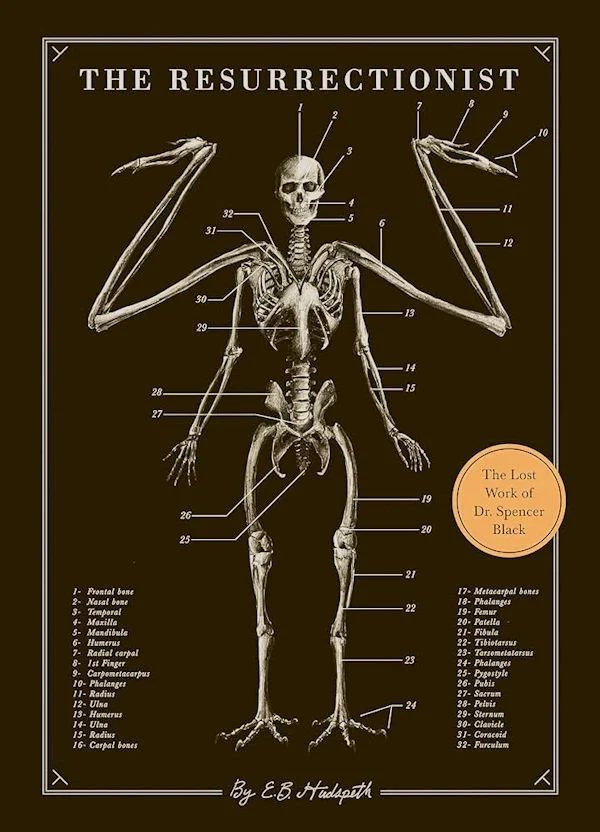
In the landscape of modern speculative fiction, few sub-genres possess the seductive power of "fictional non-fiction." There is an inherent thrill in the suspension of disbelief—the moment a reader holds a book that claims to be a historical artifact, a forged field guide, or a lost manuscript. Among the most striking examples of this literary craftsmanship is E. B. Hudspeth’s The Resurrectionist, a work that blurs the lines between Victorian medical history and dark, mythological fantasy. By pairing a harrowing biographical narrative with the cold, clinical precision of an anatomical textbook, Hudspeth has created a singular experience that continues to haunt the shelves of those who appreciate the intersection of genius and madness.
Main Facts: The Surgeon and the Myth
Set against the backdrop of late 1870s Philadelphia—a city defined by the flickering glow of gas lamps, the rhythmic clip-clop of horse-drawn carriages, and the encroaching grime of the Industrial Revolution—the story follows Dr. Spencer Black. The son of a grave robber, Black’s upbringing is rooted in the macabre, yet his intellect earns him a seat at the prestigious Academy of Medicine.
However, Dr. Black is not satisfied with the standard medical curriculum of his era. He develops a radical, controversial, and ultimately dangerous hypothesis: that the legendary creatures of antiquity—mermaids, minotaurs, sirens, and satyrs—were not mere figments of folklore. Instead, Black argues they are the evolutionary ancestors of humankind.
This premise serves as the engine for the novel’s two-part structure. The first half is a biographical account of a man’s descent from a brilliant, if unconventional, surgeon into a state of obsessive mania. The second half, titled The Codex Extinct Animalia, functions as the "proof" of his theory: a collection of breathtaking, meticulously rendered anatomical plates. These illustrations depict mythological beasts with the clinical detachment of a 19th-century medical journal, creating a sense of authenticity that is both fascinating and profoundly unsettling.
A Chronology of Descent: From Science to Seclusion
To understand the gravity of The Resurrectionist, one must track the trajectory of Dr. Spencer Black’s life, a timeline marked by incremental shifts in morality and sanity.
- The Formative Years: Born into the shadow of his father’s illicit trade, Black grows up with an intimate, if grisly, knowledge of human anatomy. His education at the Academy of Medicine provides him with the surgical tools to legitimize his dark curiosities.
- The Hypothesis: Driven by a desire to bridge the gap between human anatomy and the divine, Black begins to collect specimens. His initial research, while unorthodox, is framed as a scientific breakthrough.
- The Academic Schism: As his theories regarding evolutionary ancestry grow more radical, Black finds himself alienated from the medical establishment. His peers view his claims as heresy, pushing him further into isolation.
- The Unraveling: The middle act of the book captures the shift from surgeon to carnival showman. As Black’s obsession consumes his resources, his methods become increasingly erratic, culminating in the creation of his own "monstrosities."
- The Final Act: The narrative concludes in a haze of professional disgrace and personal ruin, as the line between the doctor’s reality and his delusions vanishes entirely.
Supporting Data: The Art of the Codex
The centerpiece of The Resurrectionist is undoubtedly the Codex Extinct Animalia. These plates are more than just illustrations; they are an act of visual storytelling. Rendered with the dry, sterile precision of a genuine textbook, they provide the empirical "evidence" for Black’s descent.
When viewed in isolation, the drawings are beautiful, albeit macabre, curiosities. However, when placed within the context of Black’s biography, they undergo a startling transformation. They cease to be merely anatomical drawings and become documents of a brilliant mind fracturing. Every line, every cross-section of muscle tissue, and every skeletal structure serves as a testament to the effort required to force nature to conform to a pre-existing delusion. This synergy between text and image is what elevates the work from a mere gimmick to a profound character study.
Official and Critical Perspectives: The Reader’s Response
While critics and readers have largely lauded the aesthetic achievement of The Resurrectionist, there remains a persistent critique regarding the narrative’s pacing. The descent of Dr. Black is undeniably compelling, yet many readers have noted that the transition from a respected medical professional to a social pariah happens with a velocity that occasionally sacrifices emotional depth.
"I wanted to feel each step of that unraveling in more detail," noted one early reader. "The book moves from clinical brilliance to total mania, but the spaces between those moments are where the most interesting questions lie."
The sentiment is echoed by literary analysts who argue that the book’s brevity—while keeping the prose tight—leaves the reader wanting more context regarding the social pressures of the 1870s. Was Black simply a genius ahead of his time, or was he a victim of the era’s inability to grasp the concept of radical evolutionary biology? The book leaves this open to interpretation, allowing the reader to decide whether Black was a visionary or a madman.
Implications: The Legacy of "Fictional Non-Fiction"
The success of The Resurrectionist speaks to a broader cultural fascination with the blurred lines between reality and fabrication. In an age of digital information where "truth" is often curated, the aesthetic of the forged document—the "lost archive"—has become a powerful literary device.
The Power of Reframing
The implication of Hudspeth’s work is that meaning is entirely dependent on context. Without the biography, the art is a curiosity; with it, the art is a tragedy. This suggests that history, much like biology, is subject to the observer’s bias. Dr. Black’s obsession is a mirror held up to the reader, asking how much of our own "rationality" is merely a performance maintained by the social structures around us.
The Role of the "Monster"
Furthermore, the book explores the inherent human need to categorize the unknown. By attempting to place mythological creatures within a scientific framework, Black is trying to control the uncontrollable. When the creatures refuse to fit, he begins to force them, leading to the creation of the very "monsters" he feared. It is a cautionary tale about the dangers of intellectual vanity and the arrogance of the scientific mind.
Conclusion: A Shelf-Defining Artifact
The Resurrectionist is a work that demands to be owned rather than merely read. It occupies a space on the bookshelf that feels distinct, heavy with the weight of its own imagined history. It is a testament to E. B. Hudspeth’s dedication to his craft—the ability to convince the reader that they are holding a piece of a forbidden, forgotten history.
For those who find themselves drawn to the intersection of scholarly pursuit and psychological decay, this book offers a rare experience. It is not merely a novel; it is a curated exhibit of a life lost to an idea. While the narrative might leave some craving a longer, more exhaustive account of the doctor’s later years, the brevity of the work ensures that the mystery remains intact. Dr. Spencer Black remains a figure of intense fascination—a cautionary emblem of what happens when the thirst for knowledge becomes a hunger that consumes the seeker. In the end, The Resurrectionist succeeds because it understands one fundamental truth: we are all, to some extent, building our own mythologies, one drawing at a time.


 Evan Lee Salim
 Sagoh
Sagoh