

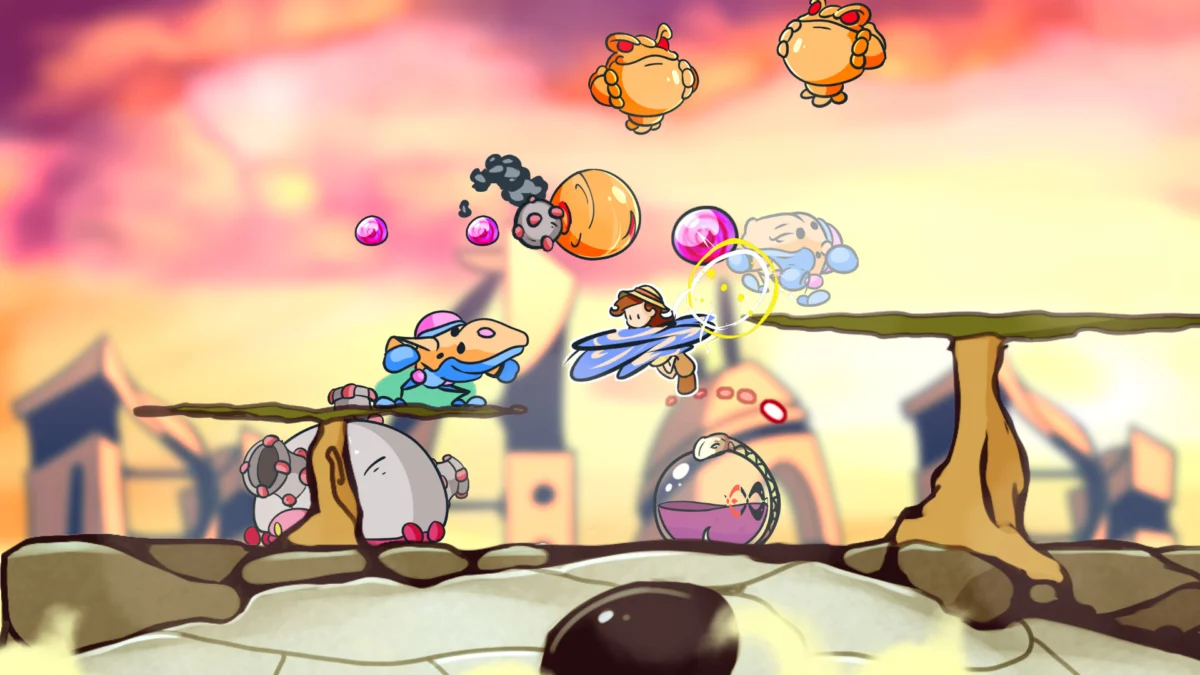
In the vast, ever-expanding ecosystem of independent gaming, few genres have remained as distinct and isolated as the "platform fighter" and the "side-scrolling adventure." Since the inception of Super Smash Bros., the fighting game sub-genre has primarily existed within the confines of closed arenas—fixed stages designed for competitive, multi-character skirmishes. However, a singular vision from Moulin aux Bulles Studio is challenging these conventions. Decline’s Drops, a project that blends the high-octane technicality of a platform fighter with the exploration-heavy flow of a traditional side-scrolling action game, has officially expanded its reach to Nintendo Switch and Xbox, bringing its unique brand of chaos to a wider console audience.
The Genesis of a Hybrid: From PC Roots to Console Expansion
The journey of Decline’s Drops began in 2024, when it first debuted on Steam. Developed by a lone creative force at Moulin aux Bulles Studio, the project immediately turned heads for its audacious premise: "What if the combat mechanics of Super Smash Bros. were the foundation for a complete, narrative-driven adventure?"
While many indie developers stick to proven formulas—be it Metroidvanias or precision platformers—Moulin aux Bulles Studio opted to refine the complex inputs of competitive fighters, such as Rivals of Aether, and transplant them into a sprawling world. Following its successful PC launch, the developer focused on optimizing the title for console hardware, ensuring that the precise button inputs required for complex combo strings remained responsive on the Nintendo Switch and Xbox controllers. The recent launch signifies a graduation for the title, moving from a niche PC curiosity to a cross-platform release that challenges players to rethink how combat should function in a platforming environment.
Combat Mechanics: Mastering the "Smash" DNA
At its core, Decline’s Drops is an exercise in mechanical depth. Most platformers rely on simple "jump-and-attack" logic, where a single button press results in a canned animation. Decline’s Drops eschews this simplicity, requiring players to master a suite of maneuvers that will feel instantly familiar to veterans of the Smash series.
The Toolkit of a Fighter
Players have access to a robust move set that includes:
- Jabs and Tilts: The bread and butter of your offensive output, useful for managing spacing and keeping encroaching enemies at bay.
- Aerial Attacks: Essential for controlling the verticality of the levels and punishing enemies that have been launched into the air.
- Smashes: High-risk, high-reward strikes designed to knock back even the most formidable mutated creatures.
- Combo Chains: A system that encourages rhythm and memorization, allowing skilled players to juggle enemies across the screen rather than simply button-mashing their way through encounters.
This complexity is not merely for show. The game actively rewards this technical prowess through an evaluation system. Much like the ranking systems found in classic character-action games, Decline’s Drops grades player performance from D to S. This encourages players to revisit levels, refining their combos and optimizing their movement to achieve that elusive S-rank, adding significant replayability to the experience.
A World of Whimsy and Melancholy
Beyond the mechanics, the game’s aesthetic and narrative framing are perhaps its most surprising elements. The visuals are vibrant, colorful, and ostensibly playful, filled with bizarre enemies like giant hydras, oversized chickens, and mutated frogs. However, beneath this cartoonish veneer lies a palpable, melancholic tone that defines the game’s atmosphere.
The narrative pits the player against the "Eternal Corp," a mysterious organization that serves as the primary antagonist. As players traverse the game’s overworld map, the contrast between the upbeat art style and the underlying themes of decline and loss creates a unique emotional resonance. It is a world that feels both alive and decaying, a juxtaposition that elevates the game from a simple "beat-em-up" to something with a distinct, authored voice.

Supporting Data: Economic and Mechanical Design
The success of Decline’s Drops can be measured not just in its critical reception, but in its economic design. The "drops" currency system, which populates the levels, acts as a primary motivator for exploration. Unlike games where currency is merely a secondary concern, "drops" are integral to the pacing of the game. They act as a reward for successful combat, effectively tying the quality of a player’s technical performance to their progression capabilities.
Furthermore, the game’s level design avoids the trap of repetitive corridors. By utilizing a full overworld map, the developer has created a structure that feels cohesive. Each stage presents unique hazards that require the player to adapt their "Smash-style" move set to different environments—a feat that, given the solo development status of the project, is a testament to the efficiency of the underlying game design.
Official Stance and Future Trajectories
Moulin aux Bulles Studio has not rested on the laurels of the console launch. In a move that highlights the studio’s commitment to iterating on its combat-first philosophy, the developer has already unveiled a new project: Dash’n’Drop.
Currently available as a demo on Steam, Dash’n’Drop represents the next evolution of the "Smash-as-a-Platformer" concept. If Decline’s Drops was the prototype for the combat system, Dash’n’Drop is the refinement. It aims to fuse the technical precision of platform fighters with the unpredictable, high-stakes progression of a modern roguelite.
By integrating procedural generation and roguelite elements, the developer is attempting to solve one of the biggest challenges in the platform-fighter genre: stagnant gameplay. In a roguelite environment, where every run is different, the need to master a complex, deep combat system becomes the central pillar of the player’s survival. It is a bold move that suggests Moulin aux Bulles Studio is carving out a specific niche within the indie scene—one where "fighting" is not just a mode, but a movement language.
Implications for the Indie Genre
The success and expansion of Decline’s Drops carry significant implications for the indie gaming landscape. For years, the "Smash-like" label was reserved for arena fighters like Brawlhalla or MultiVersus. By proving that these mechanics can sustain a single-player adventure game, Moulin aux Bulles Studio has opened a new design space.
- Genre Blending: This title serves as a proof-of-concept that complex, fighting-game-adjacent controls can translate to single-player progression without becoming frustrating.
- Solo-Dev Capability: In an era of massive AAA teams, the ambition of Decline’s Drops demonstrates that individual developers can create highly systemic, mechanically dense games that compete with traditional side-scrollers.
- The "High-Skill" Floor: The game forces a shift in player expectations. Players are no longer just "platforming"; they are engaging in a tactical dance that requires a high degree of input fidelity.
Conclusion: A New Standard for Side-Scrollers
Decline’s Drops is more than just a novelty; it is a serious exploration of what happens when two disparate genres collide. By taking the weight, impact, and technical satisfaction of a platform fighter and applying it to the environmental traversal of a side-scrolling adventure, Moulin aux Bulles Studio has created something that feels both fresh and nostalgic.
As the industry looks toward the future of indie development, titles like Decline’s Drops and the upcoming Dash’n’Drop serve as beacons for innovation. They remind us that the most exciting developments in gaming often occur at the edges—where developers aren’t afraid to take a well-known formula and turn it entirely on its head. Whether you are a fan of competitive fighters looking for a new challenge or a platformer enthusiast seeking more depth, Decline’s Drops offers a compelling, melancholic, and mechanically brilliant journey that is well worth the time.











No comments yet. Be the first to join the conversation!