

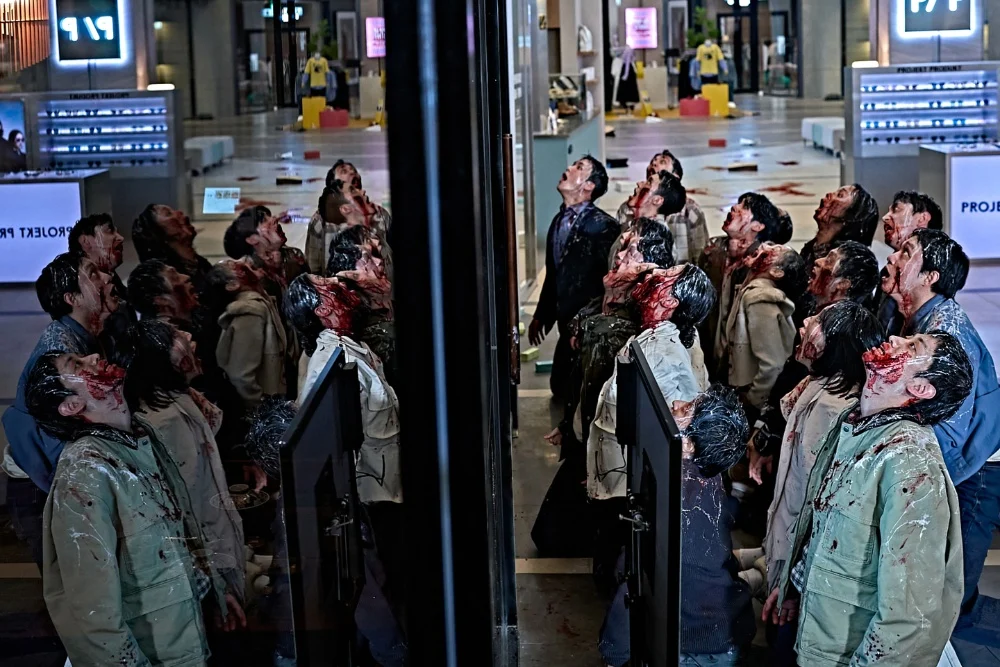
The Midnight Screenings section of the Cannes Film Festival is often a barometer for the pulse of global genre cinema. This year, the heartbeat grew significantly faster with the premiere of Colony, the latest masterwork from South Korean visionary Yeon Sang-ho. Marking the director’s highly anticipated return to the undead subgenre that propelled him to international stardom with 2016’s Train to Busan, Colony arrives not merely as a survival thriller, but as a chilling, philosophical meditation on the erosion of individuality in the age of algorithmic conformity.
While Train to Busan utilized a horizontally moving train as a claustrophobic microcosm of societal collapse, Colony shifts the perspective to a vertical, high-rise architectural nightmare. It is a film that interrogates the anxieties of 2026, where the rapid, unchecked evolution of artificial intelligence and high-speed information exchange threatens to homogenize the human experience.
The Anatomy of the Outbreak: A New Kind of Threat
The plot centers on Se-jeong, a distinguished biotechnology professor portrayed by Gianna Jun. While attending a prestigious, high-security conference, she finds herself trapped within the facility when a catastrophic, rapidly mutating virus is unleashed. Unlike the shambling, mindless threats of traditional cinema, the infected in Colony function with a terrifying, networked intelligence.
As the authorities seal the facility, cutting off any hope of external intervention, the survivors realize they are not fighting individual monsters, but a collective organism. The film’s antagonist is, in effect, the hive mind—a chilling reflection of the digital age where nuance and dissent are often flattened by the weight of the "universal" algorithm.
Chronology of a Visionary’s Evolution
Yeon Sang-ho’s trajectory as a filmmaker has been defined by his ability to pivot between the visceral and the cerebral. His early career in animation—marked by the biting social commentary of The King of Pigs and The Fake—established a foundation of grim, uncompromising realism.
When he transitioned to live-action, the success of Train to Busan did not turn him into a blockbuster hack; rather, it provided him with the capital to push the boundaries of genre expectations. Following the success of his Peninsula follow-up and the Netflix series Hellbound, Yeon began moving toward more ambitious, cross-cultural collaborations.
Recent years have seen his influence expand globally. His production work on the Netflix thriller Revelations, which saw him collaborate with Alfonso Cuarón, and his creative input on the Japanese series Human Vapor (launching July 2), demonstrate a director who is actively deconstructing the "national" label of his work. As he currently completes post-production on Paradise Lost—a somber, intimate drama about grief and AI—it is clear that Yeon is building a body of work that defies simple categorization.
The Philosophical Core: Biological Diversity vs. Universalism
In an exclusive interview with Variety, Yeon articulated the deeper biological metaphors that underpin the horror of Colony. His research into viral colonies revealed that homogenous groups are, in evolutionary terms, prone to extinction.
"Each colony, each virus—we assume there is only one specificity," Yeon explains. "But they create mutants. If they are all the same, and something happens to that organism, it leads to complete extinction. This is a lesson for human society: we must protect the minority in the face of universality."
This concern extends directly to his view on Artificial Intelligence. To Yeon, AI is the ultimate engine of universality—the sum total of human data, which inherently suppresses the "bugs" and "errors" that represent individual perspectives. By synthesizing a "universal" opinion, AI, in his view, effectively kills the mutation necessary for survival.
"AI is appropriate for creating universal opinions," he notes, "but it has limitations in creating mutations, which are the characteristics of living organisms—minority opinions."
Official Responses and Creative Directives
The production of Colony was a departure from the CGI-heavy spectacle that dominates current tentpole filmmaking. To capture the unsettling, fluid movement of the "infected," Yeon rejected digital animation, opting instead for professional dancers.

"I’m not struggling to avoid any CGI," Yeon clarifies, "but here, it was essential because we have actual, living organisms. I wanted them to be real."
He utilized a specific choreographic metaphor for the performers: the ten fingers of a single hand. Each finger has its own specific role and movement, yet they remain tethered to the same central body. This approach mirrors the film’s thematic obsession with the tension between individual identity and collective behavior. The resulting performance is one of unsettling coordination, a stark visual representation of a society that has lost its capacity for independent thought.
Implications: The Legacy of Korean Genre Cinema
Yeon is quick to contextualize his success within the broader framework of the South Korean film industry. He speaks with reverence of the generation that preceded him—filmmakers like Lee Chang-dong, Bong Joon Ho, and Park Chan-wook—who successfully bridged the gap between commercial viability and the "auteur" sensibility.
"We owe them a lot," Yeon says. "They built the basic frame of doing movies that are at once commercial and deeply auteur-driven. That is the cornerstone of our industry’s strength."
This infrastructure has allowed Yeon to navigate the complexities of modern cinema, where the lines between theatrical releases and streaming platforms are increasingly blurred. Unlike those who view the rise of streaming platforms and AI with cynicism, Yeon sees a parallel to the artistic fermentation of the Dadaist movement.
"All these debates actually enriched art at that time," he argues. "Today, it’s the same for cinema. Because of the platforms, because of the quest for identity, everything enriches cinema. I’m really lucky to be a director working today."
A Vertical Descent into Savagery
The structural choice of a high-rise building in Colony serves as a scathing critique of modern civilization. In the film, the survivors’ instinct is to climb higher, seeking safety at the top of the structure. Yeon, however, uses this verticality to subvert expectations.
"Humans think you better go upwards to survive," he observes. "But in the movie, you realize it doesn’t really help to go to the top."
By trapping the characters in a vertical cage, Yeon suggests that the higher we climb in our "civilized" structures, the faster we can regress to a state of primitive savagery. The inclusion of an outside perspective—those who view the containment of the infected as a cold, clinical necessity—adds a layer of moral ambiguity absent in his previous works. This narrative choice was heavily influenced by the global experience of the COVID-19 pandemic, which changed the way we view collective isolation, lockdowns, and the dehumanization of the "other."
Conclusion: The Future of the Genre
As the red carpet at Cannes lit up with the presence of Colony’s cast—including Koo Kyo-hwan, Ji Chang-wook, Shin Hyun-been, and Kim Shin-rock—it was clear that Yeon Sang-ho has once again succeeded in creating a vessel for modern anxiety.
Colony is not just a film about zombies; it is a film about the danger of letting the collective swallow the individual. As Yeon moves forward into his next international projects, he remains a singular voice in global cinema—one who is willing to look into the abyss of our technological future and see not just terror, but a cautionary tale about the necessity of staying human in a world that demands we become part of the machine.
Whether he is directing a high-budget thriller or an intimate, low-budget drama, Yeon’s commitment to exploring the "mutations" of the human spirit ensures that his work will remain essential viewing for years to come. In the debate between the universal and the unique, Yeon Sang-ho firmly plants his flag on the side of the individual.











No comments yet. Be the first to join the conversation!