

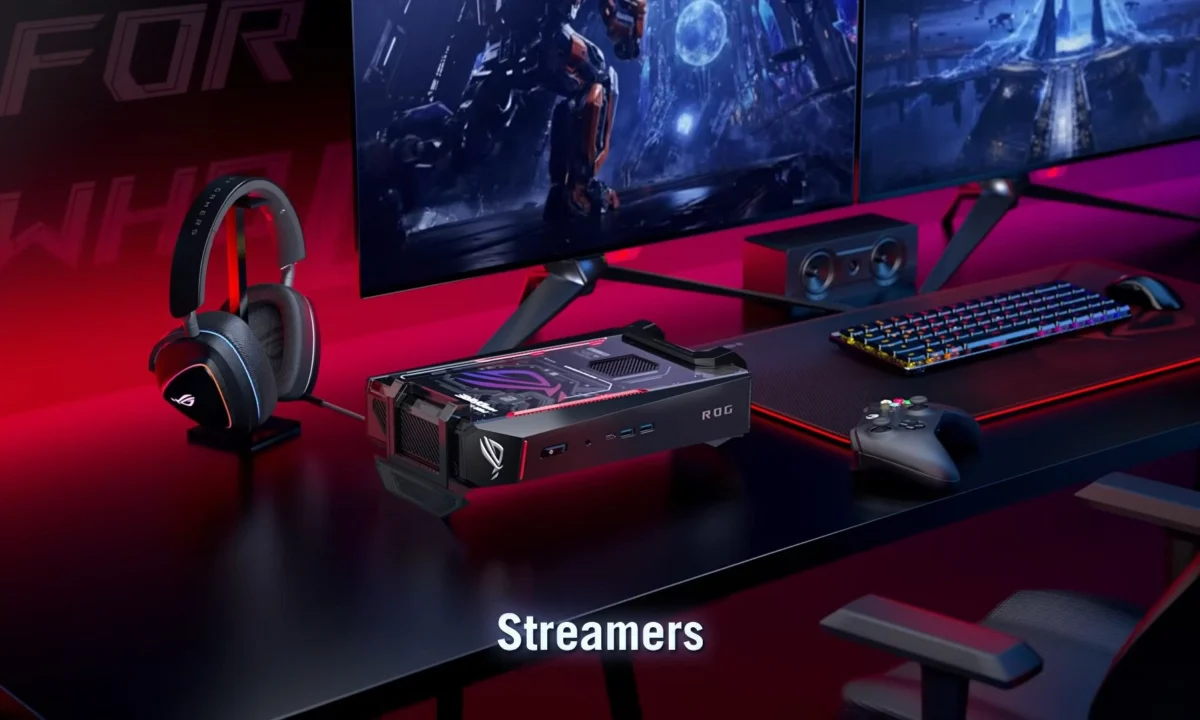
In the ever-evolving landscape of high-performance computing, the pursuit of power within a minimal footprint has become a holy grail for enthusiasts. Asus has long been a frontrunner in this niche, and with the official launch of the 2026 ROG NUC 16, the company is doubling down on its vision of the "ultimate small-form-factor (SFF) workstation." However, this iteration arrives at a price point that has sent shockwaves through the enthusiast community, raising critical questions about the value proposition of premium miniaturized hardware.
Main Facts: A Technical Powerhouse in Miniature
The 2026 Asus ROG NUC 16 is designed for users who demand top-tier performance but lack the desk real estate—or the aesthetic inclination—to accommodate a massive ATX tower. At its core, the device is a triumph of thermal engineering and component density.
The machine is headlined by Intel’s latest Core Ultra 9 290HX Plus processor, a chip that pushes the boundaries of mobile-class computing. When paired with Nvidia’s formidable GeForce RTX 5080 Laptop GPU, the system becomes a viable candidate for high-fidelity gaming, professional-grade creative rendering, and local artificial intelligence workloads.
The configuration currently listed in Chinese markets features 32GB of DDR5-6400 RAM and a 2TB NVMe SSD. For those needing more headroom, the system supports up to 128GB of memory, allowing for massive multitasking capabilities. A standout feature is the integration of DLSS 4.5, which utilizes Multi-Frame Generation to significantly enhance frame rates and visual fidelity in supported titles, bridging the gap between laptop-class silicon and desktop-grade performance.
Aesthetically, the ROG NUC 16 retains the modular, industrial elegance of its predecessors, available in both standard black and a pristine "Moonlight White" edition. It is designed for versatility, capable of being oriented vertically or horizontally to fit into almost any workspace configuration.
The Chronology of Escalation
To understand the current market position of the ROG NUC 16, one must look at the trajectory of the series. The evolution of the NUC (Next Unit of Computing) line, since it was transitioned under the Asus ROG banner, has been characterized by consistent price hikes.
- 2024: The NUC line begins its integration into the ROG ecosystem, establishing a premium reputation for reliability and performance.
- 2025: The ROG NUC 16’s predecessor, equipped with an Intel Core Ultra 9 Series 2 (275HX) processor, hit the market with an MSRP of approximately $3,200 in the United States. While expensive, it was viewed as a "luxury tax" for the extreme miniaturization of high-end components.
- May 2026: Asus officially unveils the refreshed ROG NUC 16. In China, the device is listed at CNY 29,999 (~$4,405) for the base model, with the Moonlight White version commanding a premium at CNY 31,999 (~$4,699).
- The Present: Asus has yet to provide a definitive global launch date or pricing, leaving international consumers to speculate on whether the domestic price will be reflected in North American and European markets.
This rapid, year-over-year price jump of approximately $1,200 represents a significant departure from standard hardware depreciation curves.
Supporting Data: Thermal Engineering and Performance
One of the primary challenges with SFF PCs is heat dissipation. Cramming a high-TDP processor and a top-tier GPU into a chassis of this size often results in thermal throttling, which negates the performance of the components.
Asus has addressed this in the 2026 model through a redesigned cooling architecture. The system now utilizes a sophisticated three-fan array supported by a dual vapor chamber, which is significantly more efficient at heat transfer than traditional heat pipes. Additionally, the inclusion of a dedicated SSD heatsink ensures that high-speed storage remains within safe operating temperatures during prolonged data transfers or high-intensity gaming sessions.
Despite the raw power packed inside, Asus claims the system operates at a noise floor below 38 dBA under full load. For context, this is roughly equivalent to a quiet library or a hushed conversation, making it one of the quietest high-performance PCs currently available. This efficiency is critical for users who intend to place the unit directly on their desk rather than tucking it away in a cabinet.

Official Responses and Market Context
Asus has positioned the ROG NUC 16 not just as a gaming machine, but as a "hybrid workstation" capable of handling the demands of modern AI-driven workflows. In official marketing materials, the company emphasizes the importance of local AI processing, noting that the combination of the Ultra 9 290HX Plus and the RTX 5080 creates a local sandbox for training and executing models without the latency or privacy concerns associated with cloud-based solutions.
However, industry analysts have been quick to point out the external factors complicating this launch. The global electronics industry is currently grappling with a severe supply chain crunch involving both RAM and NAND flash storage. These shortages, which began in late 2025 and are projected to persist well into 2027, have driven up the base costs of component sourcing for all OEMs. Asus, like its competitors, is passing these increased overhead costs directly to the consumer.
Implications: The "Portability Tax"
The release of the ROG NUC 16 brings a central dilemma to the forefront of the PC market: Is portability worth the performance-to-price sacrifice?
The Desktop Alternative
For the $4,500 asking price of the ROG NUC 16, a consumer could build or purchase a desktop PC featuring an Intel Core i9-14900K or a Ryzen 9 9950X, paired with a full-sized Nvidia GeForce RTX 5090. Such a system would not only outperform the NUC 16 in raw thermal headroom and clock speeds but would also offer full modularity. In a standard desktop, components can be swapped, upgraded, and maintained over the next five to seven years. The ROG NUC 16, by contrast, is a closed system; if the motherboard fails or the GPU reaches the end of its functional life, the entire investment is effectively rendered obsolete.
The Niche Appeal
Despite the grim fiscal analysis, the NUC 16 fills a specific, high-demand niche. For professionals who travel between offices or content creators who need a "studio-in-a-bag" setup that fits into a standard backpack, the NUC 16 is peerless. It offers a balance of power and space-saving that traditional laptops (which have smaller screens and different thermal constraints) and full towers cannot match.
The AI Factor
The focus on local AI is the defining differentiator for this generation. As software developers move toward integrated AI tools in creative suites like Adobe Creative Cloud or local LLM (Large Language Model) deployment, the demand for compact, high-VRAM, and high-compute machines will continue to grow. Asus is betting that enterprise users and affluent creative professionals will prioritize the convenience of the NUC form factor over the raw value of a custom-built desktop.
Final Thoughts: The Future of the ROG NUC
The 2026 Asus ROG NUC 16 is a testament to what is possible when engineering talent is pushed to its limits. It is a stunning, silent, and incredibly capable machine that pushes the boundaries of modern computing. However, it also serves as a warning sign for the industry.
When the price of a mini PC exceeds the cost of a high-end desktop workstation, the target demographic shifts from "enthusiasts" to "luxury buyers." While the build quality and the performance density are undeniably premium, the average consumer will find it difficult to justify a $1,200 increase over the previous generation for what amounts to an iterative upgrade in silicon.
As we look toward the remainder of 2026, the success of the ROG NUC 16 will depend on whether Asus can prove that its value lies not just in the components, but in the software ecosystem, the longevity of its cooling solution, and the unique utility of its form factor. For now, it remains a "halo product"—a device that demonstrates the pinnacle of Asus’s technical capabilities, even if it remains out of reach for the vast majority of the PC gaming community. Whether the market is willing to sustain this level of price escalation will ultimately be decided by the sales figures once the device hits Western shelves later this year.












No comments yet. Be the first to join the conversation!