Muslim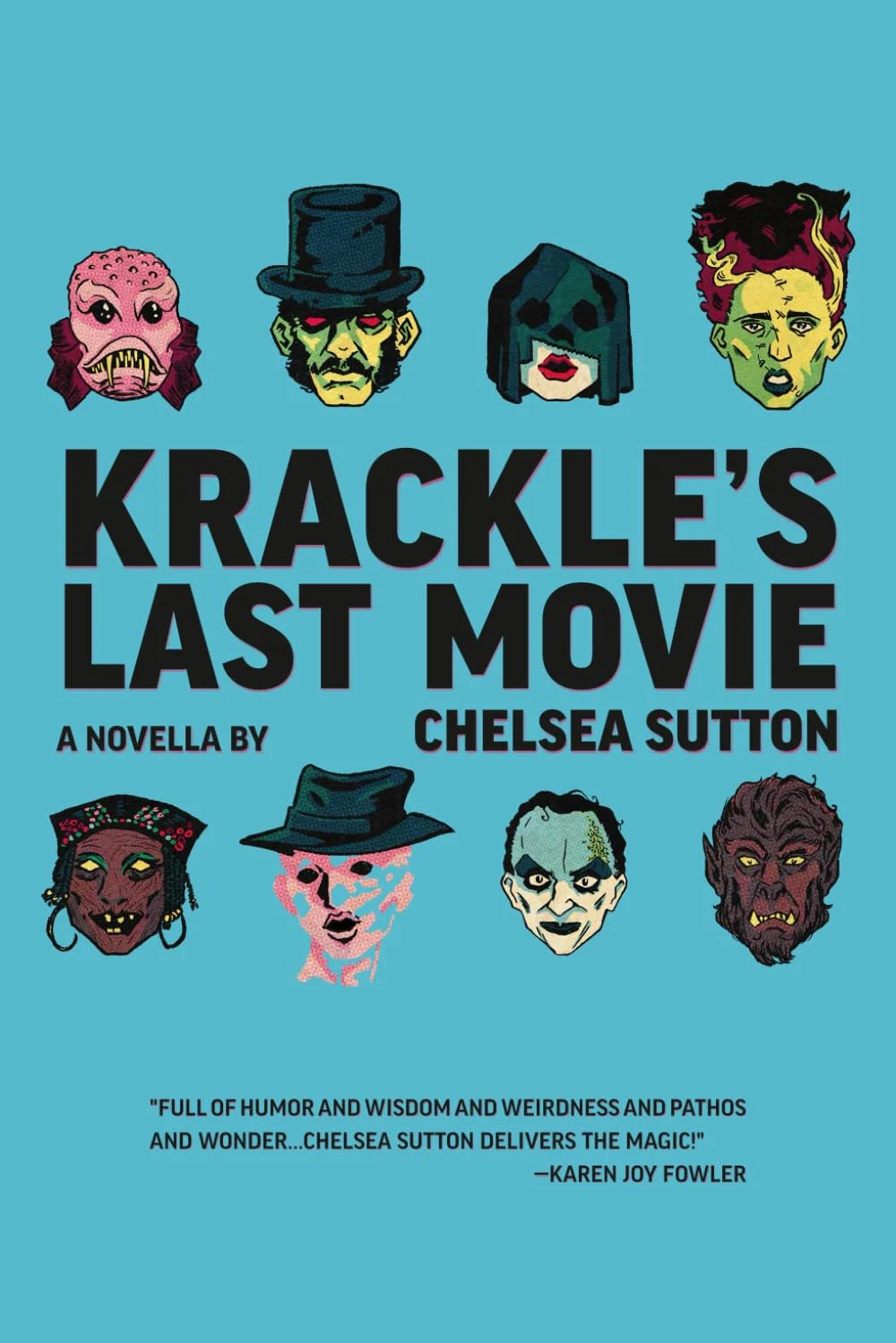
In the landscape of contemporary speculative fiction, few debut works have arrived with the intellectual density and stylistic flair of Chelsea Sutton’s Krackle’s Last Movie. Part character study, part meta-textual exploration of documentary ethics, the novella functions as a shimmering, melancholic interrogation of what it means to be perceived as "monstrous" in a world obsessed with categorization.
Sutton’s narrative centers on the aftermath of a professional and personal void: the disappearance of Minerva Krackle, a dedicated documentary filmmaker. Krackle had been mid-project, attempting to capture the "real face" of individuals living with Curious Monster Syndrome (CMS)—a nebulous, transformative phenomenon that leaves victims in a permanent state of physical or ontological flux. As her assistant, Harper, picks up the camera to complete the project for a festival submission, the reader is drawn into a hall of mirrors where the act of looking becomes as dangerous as the thing being looked at.
The Genesis of the Project: Fact and Fiction
The core premise of Krackle’s Last Movie rests on the "Curious Monster Syndrome," an event described by Sutton as an evolution, growth, or degeneration that renders individuals social outliers. Harper, tasked with editing hours of raw, chaotic footage, finds herself wading through the lives of the "monstrous": mermaids with sharp humor, a desert-dwelling aquatic being, a grieving werewolf, and an invisible dancer.
For Harper, this is not merely a job; it is a confrontation with her own identity. A closeted outcast herself, she hides a set of dwarfed, vestigial wings beneath baggy clothing. Her role as editor forces a painful negotiation between the legacy of her mentor and her own desire for self-preservation. By choosing what to keep and what to cut, Harper is essentially editing her own history, mirroring the physical act of "trimming" her own wings—a recurring motif of self-mutilation that serves as the book’s most haunting metaphor for the assimilation required by normative society.
A Chronology of Perception: From Subject to Spectacle
The narrative structure of the novella is non-linear, mirroring the fractured nature of the footage Harper is piecing together. The timeline is dictated by the editing process:
- The Disappearance: The story opens in the immediate wake of Minerva Krackle’s vanishing, establishing the urgency of the film’s completion.
- The Investigative Phase: Harper reviews the interviews, discovering the complex, often weary, perspectives of the CMS-affected.
- The Crisis of Representation: Harper faces the conflict between Krackle’s original, empathetic vision and the commercial pressures of a studio system that prefers to rebrand the subjects as caricatures for a mass-market comedy.
- The Internalization: The climax occurs as Harper recognizes that the act of filming the "other" is inherently an act of violence, leading to a personal reckoning with her own repressed nature.
Supporting Data: The Symbolism of the Monstrous
Sutton’s novella is deeply rooted in cultural criticism, specifically the theory of the "monster" as a harbinger of category crisis. As noted in the work of Jeffrey Jerome Cohen, monsters exist in the liminal spaces between human and animal, dead and alive. Sutton expands this definition to include race, sexuality, disability, and trauma.
The dialogue within the text is sharp and revelatory. When Harper describes her wings as "not natural," Krackle asks, "What does natural mean?" Harper’s response—"the thing that keeps you invisible"—crystallizes the book’s central argument: that "normalcy" is a defensive mechanism designed to suppress any form of visibility that threatens the status quo.
The characters themselves—the mermaids who are asked if they are cannibals for eating fish, or the invisible dancer whose talent is overlooked because of her lack of physical presence—are not mere props. They are conduits for a wider discussion on the "fetishization of difference." Sutton avoids moralizing; instead, she highlights the moral ambiguity of both the observer and the observed. Some characters embrace their oddity, while others, like the second Great Merlan, use their performance to reclaim their beauty in a world that views them as an aberration.
Institutional Responses: The Medicalization of Difference
One of the most harrowing aspects of Krackle’s Last Movie is its exploration of how society "manages" the monstrous. Sutton maps the pathologization of otherness through the twin pillars of medicalization and religion.
The story of Meggie, who transforms into a modern-day mummy, serves as a poignant allegory for the experience of chronic illness. Her sister, Liz, cuts off Meggie’s hands to keep her contained—a brutal, desperate act of "care" that reflects the ways in which society amputates parts of the "different" to make them fit into the spaces we are comfortable with. Sutton leaves this tension unresolved, refusing to offer the reader the comfort of a villain. The cruelty is not born of malice, but of a failure of comprehension—a systemic inability to accommodate lives that do not align with the standard narrative of human development.
The Meta-Narrative: Editing as Identity
Sutton utilizes the camera as a tool of both revelation and distortion. Drawing on the film theories of Siegfried Kracauer, the novella posits that the camera can extend human perception, making the invisible visible. However, Harper’s struggle with the edit highlights the dark side of this power.
The studio’s decision to strip Krackle’s documentary of its philosophical depth and rebrand it as a "fictional comedy" is a biting critique of commercial media. It underscores the reality that "for everyone" is often code for "for the majority," and that minority experiences are routinely cannibalized to satisfy the consumption habits of the mainstream.
Harper’s editing process, therefore, becomes a parallel to her own psychological development. By deciding which moments to include and which to discard, she is performing a form of surgery on the legacy of her mentor—and, by extension, on her own identity. The question Sutton leaves us with is whether it is possible to tell a story about someone else without consuming them, or whether representation is always, by its nature, an act of erasure.
Implications: A New Canon of Speculative Fiction
Krackle’s Last Movie is not a comfortable read, nor is it intended to be. Its aesthetic—reminiscent of the cabinet of curiosities, where taxidermy and pop culture artifacts collide—is designed to provoke a sense of wonder that is immediately undercut by the horror of the characters’ lived realities.
While the novella occasionally suffers from the constraints of its format—specifically, that the pacing of individual vignettes sometimes outshines the slow-burn development of Harper’s internal journey—it remains a formidable debut. Sutton’s refusal to provide easy answers or a neat resolution to the "monster" problem is its greatest strength.
By grounding the story in the specific, the local, and the personal, Sutton elevates the trope of the monster into a universal inquiry about visibility. The novella suggests that we are all, in some capacity, living alongside our own "imaginary selves"—the versions of us that society has constructed and the ones we have tried to hide.
In the final analysis, Krackle’s Last Movie is a profound meditation on the ethics of the gaze. Whether one is watching a film or interacting with a neighbor, the act of perception is fraught with the potential for misinterpretation and violence. Sutton’s debut is a call to look more closely, to sit with the discomfort of the "other," and to recognize that the categories we use to define our world are often the very things that prevent us from seeing it clearly. It is a work that demands not just to be read, but to be felt, dissected, and ultimately, held in the light of our own collective, messy humanity.

 Sagoh
Sagoh