

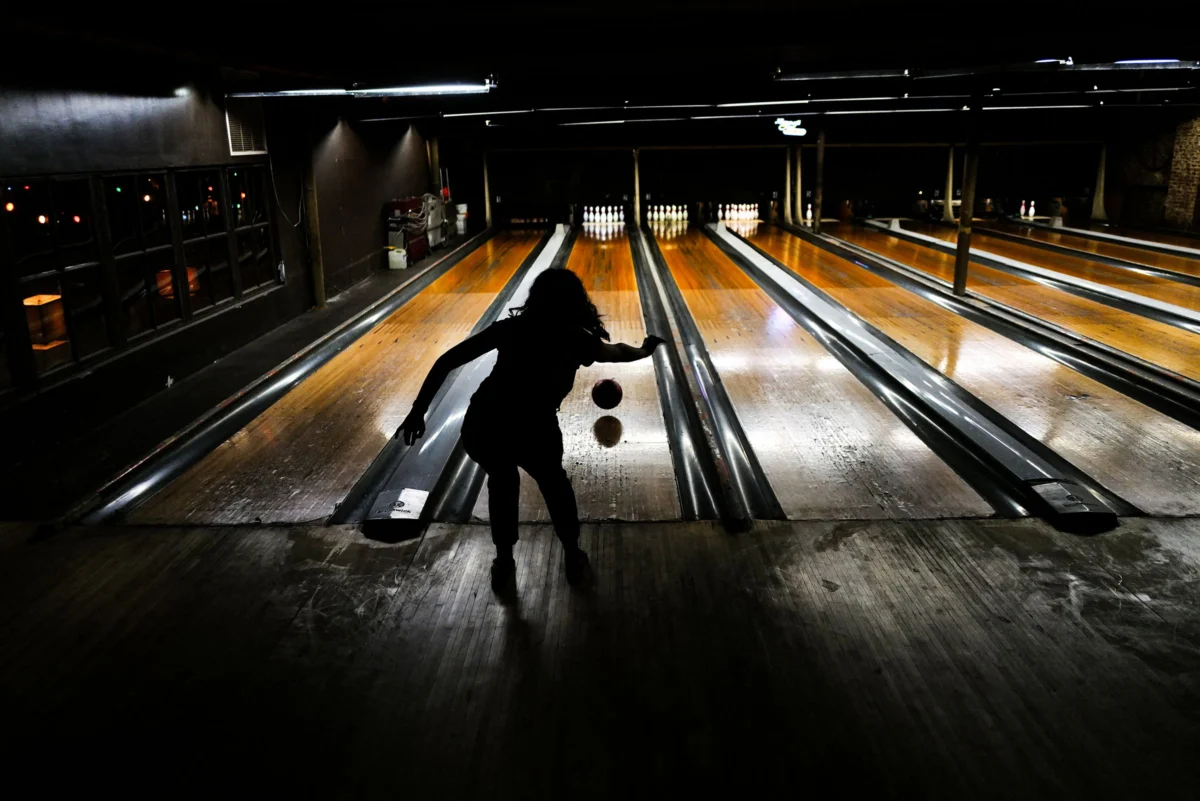
When EJ Tackett approaches the lane for the upcoming Professional Bowlers Association (PBA) World Championships, he isn’t just looking at the ten pins waiting at the end of the 60-foot stretch of synthetic wood. He is scanning a battlefield. For the man who has claimed the last three world titles—and is widely considered the finest bowler on the planet—the physical act of throwing a ball is merely the execution of a complex, silent calculation.
While the general public views bowling as a game of simple repetition, the professional circuit is a high-stakes tactical chess match. At the heart of this contest lies a thin, invisible layer of synthetic oil that dictates every hook, slide, and strike. Understanding the nuance of this oil is not just an advantage for modern pros; it is the fundamental requirement for survival at the elite level.
The Science of the "Hidden Hazard"
To the amateur bowler, lane oil is an afterthought, often associated only with the accidental spills that send casual players sliding across the approach. In reality, that oil is a highly engineered substance applied in specific, digitized patterns. It serves as the primary variable that dictates how a ball interacts with the lane’s surface.
The physics are elegant but unforgiving: oil reduces friction. By applying different volumes of oil to specific "boards" (the 39 individual planks that make up a lane), technicians can create zones where a ball will slide effortlessly, followed by dry zones where the ball’s coverstock will finally "grab" the surface, causing the ball to hook toward the pocket.
"All of us as professionals are playing a guessing game by watching our bowling ball go down the lane," Tackett explains. "We are constantly trying to figure out where the oil has moved from and where it has moved to."
A Chronological Evolution: From Wood to Automation
The history of lane maintenance is a story of transition from crude protection to surgical precision. In the mid-20th century, lanes were crafted from organic materials like maple and pine. Oil was used strictly for preservation—a lubricant to prevent the ball from scorching or splintering the wood.
The Era of Inconsistency (1970s–1980s)
During this period, lane oiling was a chaotic, manual process. Without standardized machinery, oil distribution was wildly uneven. Some sections of a lane might be heavily saturated, while others were nearly dry, leaving bowlers to play a game of "detective" until the middle of their second game. For the professionals of the era, this randomness was a source of constant frustration.
The Rise of Technology (1990s–Present)
The turning point arrived in the early 1980s, thanks to John Davis, a mechanic in Arizona who sought to solve the problem of inconsistent oil pooling. His invention of specialized lane cleaning and oiling tools laid the groundwork for what would eventually become Kegel, a company that revolutionized the sport.
Modern "Sanction" technology, used by industry giants like Kegel and Brunswick, operates with the precision of an inkjet printer. These machines, now fully automated and battery-powered, traverse the lane with microscopic accuracy, applying oil to specific boards with the exactitude required by the PBA. According to Chris Chartrand, CEO of Kegel, the technology has evolved from separate cleaning and oiling units into all-in-one autonomous robots that require zero human intervention to prep a world-class lane.
Understanding the "Ratio": Amateur vs. Pro
The divide between a local bowling alley and a PBA event is best explained by the "oil ratio." At a recreational bowling center, lanes are often oiled with a high ratio—sometimes 10:1—meaning the middle of the lane is ten times more saturated than the gutters. This acts as an "autocorrect" mechanism; if a ball drifts, the dry outer edges provide friction that pulls the ball back toward the pocket. It is a forgiving environment designed for high scores and casual fun.
Professional patterns are drastically different. The PBA utilizes ratios as low as 3:1 or even 1:1. These "flat" patterns offer no safety net. If a bowler’s release is off by a fraction of a degree, or if their speed varies by a hair, the ball will not find the pocket.
"It makes it easier to hit the pocket [at a local center]," Tackett notes. "But in the pros, you have to be a lot more precise—not only with where you’re placing the ball on the lane, but with your speed and the revolutions you’re applying."
The Tactical Landscape: Golf on 60 Feet
The PBA takes pride in the complexity of its playing conditions. Rather than seeking a uniform standard, the organization treats lane oil as a seasonal challenge. With a library of 20 distinct patterns, the PBA ensures that no two tournaments are the same.
"An oil pattern basically adds water and trees and bunkers," Tackett says, invoking a comparison to golf. "It’s adding obstacles to the lane."
Official Perspectives on Greatness
PBA Commissioner Tom Clark views these shifting conditions as the ultimate barometer of talent. "It forces players to think, adapt, and create, which is how we test greatness," Clark says. "It’s what makes the sport more exciting, interesting, and entertaining every single week."
Each event begins with the publication of an oil pattern graph, providing players with a blueprint. However, like a shifting sand dune, the lane conditions are never static. Every ball thrown acts as a vacuum, picking up oil and redistributing it down the lane. This "breakdown" means that the line a player takes in Game 1 will be useless by Game 6.
The Human Element: Why Intuition Still Wins
Despite the rise of sophisticated tracking tools like "Specto"—a system that uses lidar to map ball pathing—professional bowlers are left largely to their own devices. While spectators on TV can see the digital visualizations of the ball’s trajectory, the pros themselves are prohibited from using this data during actual matches.
They must rely on their eyes, their experience, and their intuition. They must account for the porous nature of their bowling balls, the microscopic scratches in the lane’s synthetic surface, and the ever-changing topography of the oil.
Tackett, who grew up in his parents’ bowling center, acknowledges that the learning curve has accelerated. "I didn’t really start considering lane oil patterns in my game until I was 15 or 16," he recalls. "Today, kids who are serious about the sport are learning about this variable by age 7 or 8."
Implications: The Margin of Victory
For EJ Tackett, the mastery of these invisible variables has been the difference between being a good bowler and an all-time great. His recent three-peat at the world level is, in his own estimation, the result of a singular focus on lane transition.
"I’ve been able to make a move or make a ball change just one or two shots faster than most everyone else," Tackett says. "But if you do that one or two shots faster every single game over the course of 40 games, that’s going to add up."
As the technology of lane oiling continues to advance, the sport of bowling is becoming less about the raw power of the throw and more about the intellectual capacity to read the invisible. In the high-stakes world of the PBA, the battle is won long before the ball reaches the pins—it is won in the mind of the bowler, adjusting to the oil, one frame at a time.












No comments yet. Be the first to join the conversation!