

For over eight decades, Marvel Comics has cultivated a legacy defined by hope, heroism, and the triumph of the human spirit. From the radioactive origin of Spider-Man to the soaring idealism of the X-Men, the publisher has long stood as the gold standard for aspirational storytelling. However, this August, Marvel is set to shatter that tradition. In a seismic shift for the industry, the publisher has officially announced the launch of the Midnight Universe—a dark, gritty, and profoundly unsettling publishing imprint that reimagines its most iconic characters through a lens of psychological horror, cosmic dread, and grotesque transformation.
The Midnight Genesis: A New Paradigm for Marvel
The Midnight Universe represents a radical departure from both the traditional 616-mainline continuity and the recent, modernized Ultimate Universe. While previous iterations of Marvel’s multiverse have explored “what if” scenarios or alternate timelines, the Midnight line is designed with a singular, unified mission: to lean into fear.
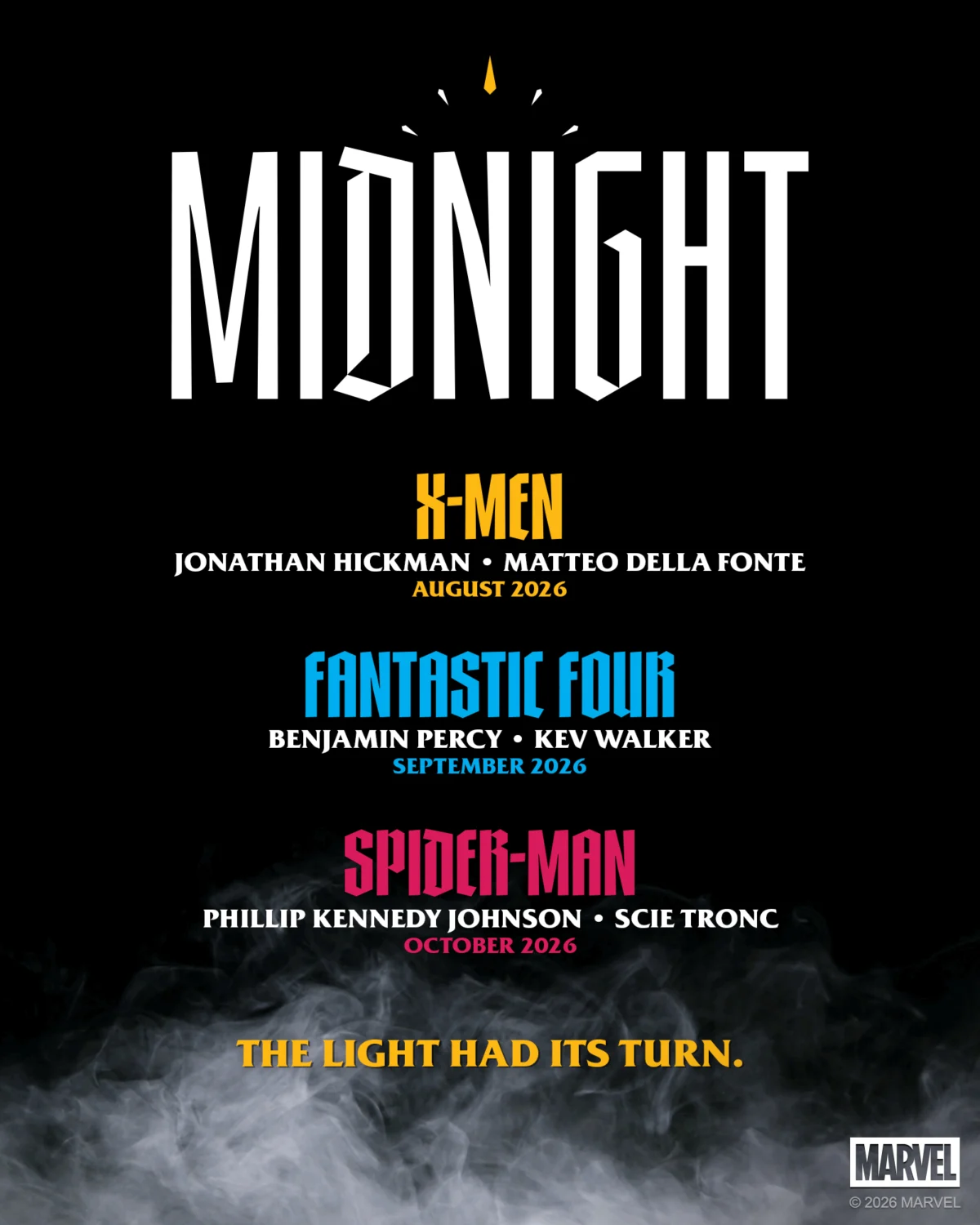
The initiative launches this August, spearheaded by three flagship titles that promise to deconstruct the very foundations of Marvel’s most beloved franchises. The lineup includes:
- Midnight X-Men: Written by Jonathan Hickman with art by Matteo Della Fonte.
- Midnight Fantastic Four: Written by Benjamin Percy with art by Kev Walker.
- Midnight Spider-Man: Written by Phillip Kennedy Johnson with debut artist Scie Tronc.
This shared world is not merely a cosmetic change; it is a fundamental alteration of the stakes. In this reality, the X-Men have ceased their long-standing struggle for integration and acceptance, opting instead for a survivalist, vampiric paradigm. The Fantastic Four, typically the heralds of discovery and wonder, find their cosmic explorations tainted by Lovecraftian horror. Perhaps most jarring is the new reality of Peter Parker, whose radioactive origin has been warped into a monstrous, dehumanizing mutation by the corporate machinery of Oscorp.
Chronology of the Midnight Rollout
The announcement of the Midnight Universe followed a week of cryptic marketing teasers that left fans speculating about a major creative pivot for the publisher. The rollout is meticulously planned to sustain momentum through the latter half of 2026:
- Early May 2026: Marvel begins the “Cloaked Cover” marketing campaign, featuring partially obscured art by Dike Ruan for Midnight X-Men #1. This interactive approach encourages fan engagement, as the full, unvarnished imagery will only be revealed to those who physically purchase the debut issue.
- August 5, 2026: The official launch of the Midnight Universe with the release of Midnight X-Men #1.
- September 2026: The expansion of the line with the premiere of Midnight Fantastic Four #1, shifting the horror focus from societal collapse to cosmic dread.
- October 2026: The debut of Midnight Spider-Man #1, bringing the horror down to a visceral, biological level as Peter Parker grapples with his identity as a spider-hybrid.
Supporting Data: Why Now?
The decision to pivot toward horror is not merely a creative whim; it is a calculated response to the evolving appetites of the modern comic book market. Data from the last three years suggests that “darker,” genre-bending superhero stories are experiencing a renaissance.
By utilizing a shared, interconnected universe, Marvel is attempting to replicate the success of the original New Universe and the early 2000s Ultimate line, while providing a sandbox for creators to bypass the rigid constraints of mainline continuity. According to early internal reports, the editorial team has granted the creative leads—Hickman, Percy, and Johnson—unprecedented autonomy. This “creator-owned sensibility” within a corporate-owned framework is designed to lure in readers who have grown weary of standard superhero tropes and are looking for stories with higher stakes and more permanent consequences.
Official Responses and Creative Vision
The architects of the Midnight Universe are unanimous in their enthusiasm for the project. Editor-in-Chief C.B. Cebulski frames the project as a necessary evolution of Marvel’s storytelling capacity.
“From the original New Universe to two Ultimate Universes, Marvel has a long history of creating and inspiring bold worlds filled with unforgettable characters and fresh ideas that feel new yet recognizable at the same time,” Cebulski stated. “With the new Midnight line, we’ve given some of our most outstanding creators the opportunity to delve into the darkest corners of their imaginations and birth some of the creepiest, most terrifying takes on the Marvel Universe you’ve ever seen.”
Jonathan Hickman on the X-Men
Jonathan Hickman, a central figure in the recent X-Men renaissance, returns to the franchise with a reinvigorated sense of purpose. “I’m so enthusiastic about this project—it’s the most excited I’ve been in years,” Hickman remarked. “The conceit of Midnight X-Men aligns perfectly with the kind of stories I like to tell. It has a rich, open-ended mythology that equally mixes old and new ideas into something that feels both familiar and original.”

Benjamin Percy’s Descent into Madness
Benjamin Percy, known for his work in horror-tinged fiction, approached the Fantastic Four with a sense of grim glee. Describing his initial call from Marvel as something out of a horror film—involving an abandoned house, cut wires, and pouring blood—Percy emphasized that this is a departure from his standard work.
“When I imagined this other version of Marvel—a terrifying, poisoned universe—my mind immediately went to the Fantastic Four,” Percy explained. “This is a title I have always loved, but would never be allowed to write otherwise. Now I could lean into my worst instincts and reimagine their story as one of cosmic, Lovecraftian dread. I am joined in this by the visionary Kev Walker, who is hard at work bringing a new origin story for Marvel’s ‘first family’ to screaming life.”
Phillip Kennedy Johnson on the Spider-Man Hybrid
Phillip Kennedy Johnson is acutely aware of the weight that comes with reinventing Spider-Man. In the Midnight Universe, Peter Parker is a victim of Oscorp’s grotesque experimentation, a far cry from the friendly neighborhood hero of the main timeline.
“The work we’re doing right now on the Midnight line feels like history being made,” Johnson said. “We’re all bringing creator-owned sensibilities to our projects; we’re redefining boundaries, we’re reinventing these timeless characters in a way that’s never been done. Midnight is nothing like the main line, nothing like the Ultimate line. You will see things in these books that shock you. You don’t take on a job like reinventing Spider-Man to go halfway. I’m leaving it all in the ring with Midnight Spider-Man.”
Implications for the Future of Marvel
The launch of the Midnight Universe poses significant questions about the future of the Marvel brand. Can a company built on the foundations of aspirational heroism survive, and thrive, by embracing nihilism and horror?
The Death of the “Safe” Hero
By stripping away the safety nets of morality and triumph, the Midnight Universe forces the reader to confront their favorite characters at their lowest points. The implications for the X-Men, specifically, suggest a future where mutants are no longer the protectors of humanity, but perhaps its most terrifying predators. This shift in power dynamics could permanently alter the perception of the X-Men in the eyes of the Marvel fanbase.
Cross-Media Potential
The “Midnight” branding bears a striking resemblance to the aesthetic of modern horror television and cinema. With the success of properties like The Last of Us or various A24-style horror films, Marvel is clearly positioning this line to appeal to a more mature, horror-literate audience. If successful, it is not difficult to envision a future where the Midnight Universe receives its own live-action or animated adaptations, distinct from the MCU.
The "Cloaked" Marketing Strategy
Marvel’s use of “Cloaked Covers” is a bold experiment in physical retail. By withholding the full visual experience until the point of sale, Marvel is betting on the loyalty of its collector base and the inherent curiosity that “fear of missing out” (FOMO) generates. If this strategy succeeds, it could set a new standard for how major comic events are marketed in an era dominated by digital leaks and early spoilers.
Final Thoughts
The Midnight Universe is more than just a new publishing line; it is a declaration of intent. Marvel is signaling that it is no longer content to simply iterate on the successes of the past. By inviting its most talented writers to explore the “darkest corners of their imaginations,” the publisher is daring its audience to step into the shadows.
Whether these stories will be remembered as a bold, necessary evolution or a temporary dalliance with the macabre remains to be seen. However, one thing is certain: as of August 2026, when the sun sets on the Marvel Universe, the Midnight line will be there to show us exactly what is lurking in the dark.









No comments yet. Be the first to join the conversation!