

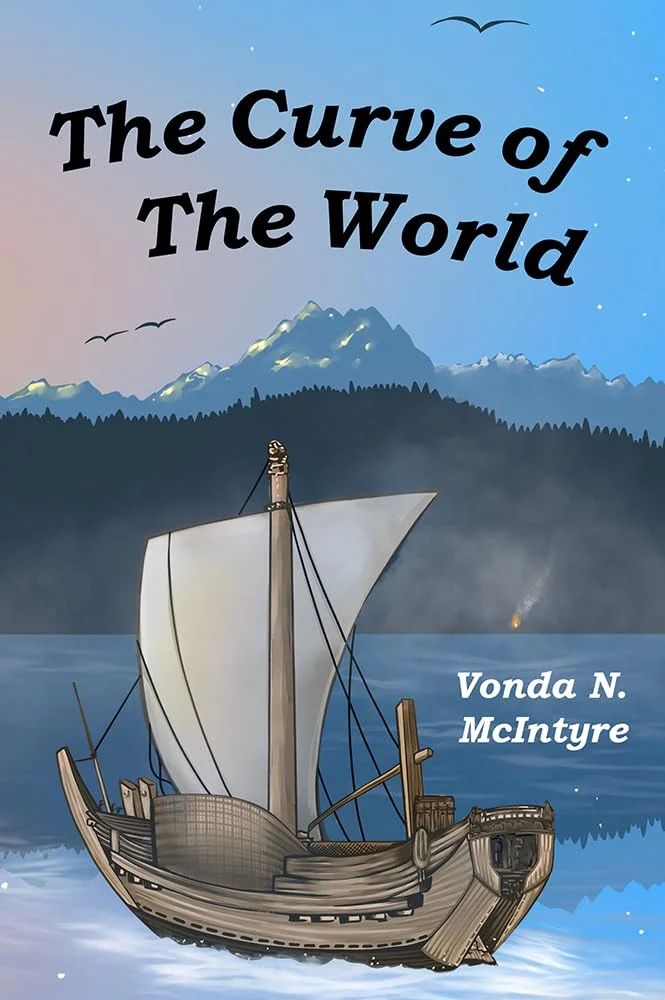
The literary world recently saw the release of a profound, bittersweet milestone: The Curve of the World, the final novel by the late Vonda N. McIntyre. A titan of speculative fiction, McIntyre passed away in 2019, leaving behind a legacy defined by her Hugo and Nebula award-winning prose, her fierce advocacy for feminist activism within the genre, and her pioneering role in online collective publishing.
Published by Aqueduct Press, The Curve of the World serves as both a grand valedictory for a legendary career and an enigmatic window into a world that exists just beyond the reach of our own history. The novel, painstakingly prepared for publication by a dedicated editorial team led by L. Timmel Duchamp and Nisi Shawl, stands as a complex, sprawling, and deeply atmospheric piece of alternate history.
A Legacy of Myth and Marine Biology
McIntyre’s fascination with the "sea people"—a race of aquatic humans—was a consistent thread throughout her career. From her early short stories like "The Genius Freaks" (1973) and "The End’s Beginning" (1976), to her 1997 novel The Moon and the Sun (recently adapted into the 2022 film The King’s Daughter), these creatures served as recurring motifs of the "other."
In The Curve of the World, the sea people are largely absent as active participants, yet their cultural and biological legacy acts as the primary catalyst for the narrative. They represent the novel’s only true "fantasy" element, grounding the story in a reality that feels remarkably close to our own, yet skewed by a faint, supernatural stardust.
Setting the Stage: The Idaean Civilization
The novel introduces readers to the Idaeans, a sophisticated Minoan-inspired bull-dancing society. Positioned at the eastern end of the "Sunset Sea"—a recognizable stand-in for the Mediterranean—the Idaeans dominate regional trade and diplomacy.
The setting defies easy categorization. While it mimics the technological capabilities of the Iron Age, it operates in a vacuum where major pillars of our historical timeline—the Roman Empire, the Persian Empire, the rise of the monotheistic religions—simply never occurred. Literacy and numeracy are guarded, specialized technologies, and the cultural landscape is dominated by a worship of the Moon goddess.
McIntyre herself cautioned against mapping this world too strictly onto our own, famously noting in the acknowledgements: "Do not try to match the Idaean timeline to ours because your head will explode." Despite her warning, the internal logic of the text creates an irresistible gravitational pull for readers to decode its historical echoes.
Chronology and the "Great Wave"
One of the novel’s most intriguing, if confounding, elements is its temporal placement. The protagonist, Iakinthu, serves as a Gephyra—a role encompassing the duties of trade manager, chief negotiator, and political operator. Her references to a conch-shell alarm system used during a catastrophic tsunami at Knossos a millennium prior suggest a setting around 500 BCE.
However, scholars and readers alike are left to wonder if this "great wave" references the 1600 BCE Thera eruption that reshaped the Aegean. The text leaves these threads intentionally frayed, reflecting the state of a manuscript that was in its fifth iteration at the time of the author’s death. While editors worked to ensure the novel’s "shape" remained smooth, certain inconsistencies—such as the slip between the name "Kunusu" and the recognizable "Knossos"—offer a glimpse into the unfinished nature of the work.
Structural Analysis: From Adventure to Travelogue
The narrative follows Iakinthu on an epic voyage. Her primary mission is to return her foster child, Renthizu, to his biological family. This journey turns perilous when the Flying Fish, Iakinthu’s ship, encounters the Dolphin, a companion vessel decimated by brutal, black-sailed barbarians.
The ensuing rescue of a young boy—whom Iakinthu names Bdarde—propels the crew into a desperate quest across the Sunset Sea. The journey is not merely a geographic expansion but a sociopolitical examination of gender and power. The world of the novel is largely matriarchal, with the Idaeans maintaining a moderate, female-led society. In stark contrast, their antagonists represent a hyper-patriarchal, violent culture that indoctrinates boys into a life of sexual violence and subjugation.
Supporting Data: The Mechanics of the World
- Technology: Iron Age, with no evidence of gunpowder or industrial metallurgy.
- Maritime Innovation: The existence of clinker-built ships with massive, year-to-weave sails indicates a labor-intensive economy focused on trade and slavery.
- The Supernatural: The character of Aranthau, captain of the Flying Fish, possesses a unique, sea-people-derived ability to "read" the currents and negotiate with monsters. However, the novel explores the limitations of these powers against the sheer force of nature.
Official Editorial Perspective
In the foreword to the volume, L. Timmel Duchamp details the monumental task of bringing the novel to print. Along with Nisi Shawl and other contributors, the editorial team faced the delicate challenge of shaping a text that was, by necessity, incomplete. Their goal was to preserve McIntyre’s voice while bridging the gaps inherent in a fifth-draft manuscript.
Critics have noted that while the editorial team succeeded in producing a coherent narrative, the pacing suffers as the novel progresses. The intense, high-stakes energy of the opening chapters slowly transitions into a more meditative, sometimes meandering, travelogue.
Implications: A Masterpiece in Transition
The Curve of the World is a testament to Vonda N. McIntyre’s undiminished creativity. Her ability to craft believable alternate technologies—such as the black-water reservoir jars used for hot baths—remains a hallmark of her genius. Even when the plot occasionally falters under the weight of excessive worldbuilding (such as the introduction of characters suspiciously named "Genji" and "Murasaki" on the North American coast), the ambition of the project is undeniable.
The novel’s exploration of gender dynamics—specifically the "slow-burn" repression of men in a matriarchal society—adds an urgent, almost ominous undercurrent to the adventure. As the characters sail toward the "Sunset Country" (the North American continent), they are plagued by the literal and metaphorical tremors of a world on the brink of collapse.
Ultimately, the novel serves as a mirror for the reader’s own expectations. It begins as a gripping, tight adventure story and concludes as an expansive, experimental reflection on civilization, language, and the nature of human discovery.
For fans of McIntyre, the book offers one last, beautiful voyage. It is a work that acknowledges the tragedy of its own incompletion while celebrating the boundless imagination of its creator. Despite the technical imperfections and the occasional narrative drift, The Curve of the World remains a magnificent achievement, ensuring that the legacy of one of science fiction’s most influential voices remains firmly anchored in the literary canon.
As we close the final chapter, we are left not with a sense of closure, but with a profound appreciation for the path McIntyre laid out—a path that winds, curves, and ultimately leads us to the realization that even in the absence of a "finished" ending, the journey itself is the prize.











No comments yet. Be the first to join the conversation!