

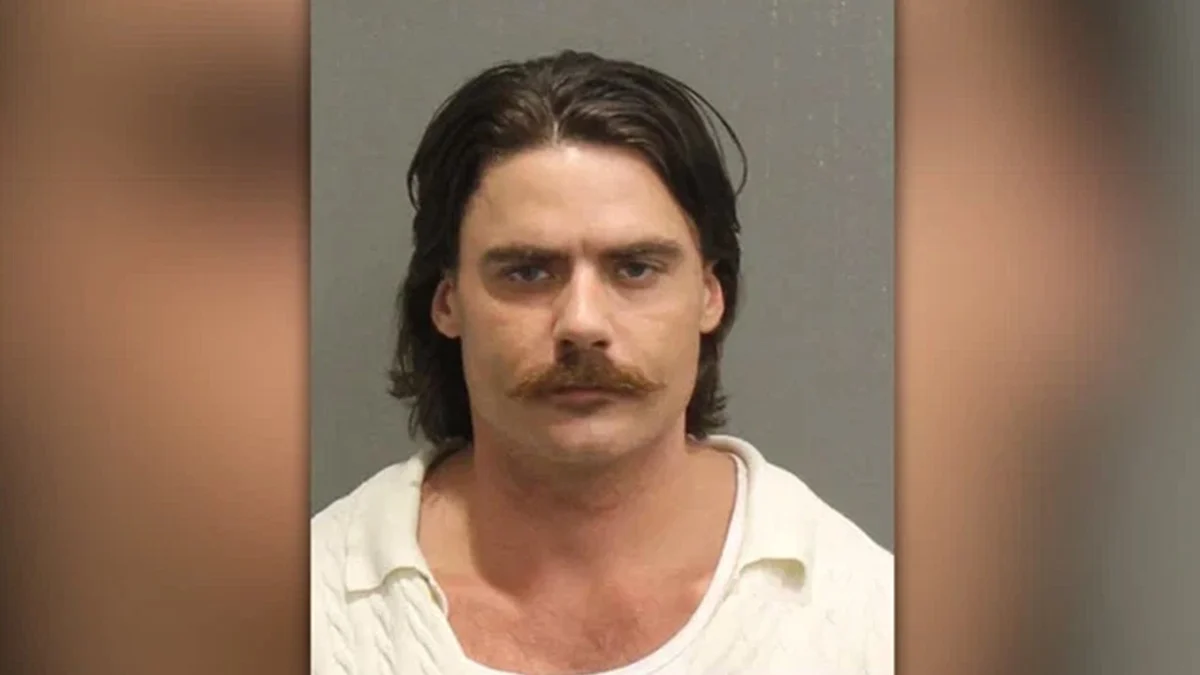
The legal defense of Dalton Eatherly, the controversial internet personality known to his online following as “Chud the Builder,” has devolved into a flashpoint of public outrage and professional hostility. As Eatherly remains incarcerated in Tennessee awaiting a pivotal bond hearing, his defense counsel, Jake Fendley, has publicly denounced a wave of vitriolic harassment directed at his firm. The situation underscores the volatile intersection of digital-age inflammatory content, the American judicial system, and the often-misunderstood role of the criminal defense attorney.
The Core Facts: A High-Stakes Legal Battle
Dalton Eatherly, 26, is currently held at the Montgomery County Jail in Clarksville, Tennessee. He is facing four serious felony charges following an incident on May 13, 2026, during which he allegedly shot a man outside the Montgomery County Courthouse. The charges against him include attempted murder, employment of a firearm during a dangerous felony, aggravated assault, and reckless endangerment with a deadly weapon.
Eatherly, whose online presence has been characterized by increasingly extremist rhetoric and inflammatory conduct, currently has his bail set at $1.25 million. Despite speculation regarding his financial resources and potential support from prominent figures in the streaming industry, Eatherly has failed to secure the funds necessary for release. He remains in custody as his legal team prepares for a crucial bond hearing scheduled for May 21, followed by a preliminary hearing on May 26.
Chronology of the Incident and Subsequent Fallout
The events leading to the current legal crisis began long before the May 13 shooting. Eatherly had built a platform on streaming services by engaging in provocative behavior, frequently utilizing racial slurs and inciting confrontations with minority groups.
- Pre-May 2026: Eatherly’s online content becomes increasingly radicalized, resulting in multiple controversies, including a prior arrest regarding a dispute over a restaurant bill, which drew national attention.
- May 13, 2026: A confrontation outside the Montgomery County Courthouse escalates into violence. Eatherly allegedly shoots a man; the incident resulted in injuries to both the victim and Eatherly himself.
- May 15, 2026: Following his medical treatment, Eatherly is processed into the Montgomery County Jail. His mugshot, taken during the booking process, goes viral, further fueling public discourse.
- May 19, 2026: Jake Fendley, Eatherly’s defense attorney, releases a formal statement to the media detailing the “hateful” harassment his firm has endured since taking the case.
- May 21, 2026: Scheduled date for the bond hearing, where the defense will attempt to argue for a reduction or modification of the $1.25 million bail.
The Professional Crisis: Attorney Harassment
Jake Fendley, a seasoned criminal defense attorney based in Clarksville, has found himself and his firm at the center of a national debate. In an era where digital accountability often spills over into real-world vigilantism, Fendley’s decision to represent a client as polarizing as Eatherly has resulted in a deluge of hostile communications.
In his public statement, Fendley revealed that his staff has been subjected to relentless phone calls and emails from individuals labeling his firm as “racist” for taking on the case. For Fendley, these accusations are not only unfounded but deeply insulting to his professional track record.
Fendley’s Defense of the Defense
Fendley’s response to the public backlash has been to emphasize the foundational principles of the U.S. Constitution. He argues that the right to legal counsel is absolute, regardless of the public perception of the accused or the severity of the allegations.
“It seems that now that some of the people, who we have so fervently defended, now turn against one of its defenders because we are not afraid to stand up and represent someone who is unpopular,” Fendley wrote. He further provided a historical context regarding his family’s long-standing commitment to civil rights and the protection of marginalized communities, effectively challenging the narrative that his defense of Eatherly is an endorsement of the streamer’s reported ideology.
“The role of a criminal defense attorney is to represent people regardless of their race, religion, ideology, or allegations against them,” Fendley asserted. “To assume an attorney agrees with the actions of the accused is preposterous.”
Supporting Data: Legal Implications and Public Backlash
The legal stakes for Eatherly are immense. If convicted of attempted murder, he faces a significant prison sentence, potentially spanning decades. The prosecution is expected to lean heavily on the digital footprint left by the defendant, utilizing his own live streams as evidence of premeditation or intent.

The public outcry, while largely centered on social media platforms, has had tangible consequences. The refusal of high-profile streamers—notably Adin Ross, who publicly shut down requests to assist with the $1.25 million bail—suggests that Eatherly has become a liability even within the often-edgy streaming ecosystem.
Furthermore, the legal community has largely rallied in support of Fendley’s stance on professional ethics. Legal commentators and figures like Robbie Harvey have used their platforms to remind the public that the Sixth Amendment right to counsel is a cornerstone of a functioning democracy. The argument is that if defense attorneys are intimidated into refusing cases for unpopular clients, the integrity of the entire judicial process is compromised.
Broader Implications: Where Streaming Meets the Law
The case of “Chud the Builder” serves as a grim case study for the consequences of the “content-at-all-costs” culture. Eatherly’s transition from an online provocateur to a defendant in a major criminal trial illustrates the blurring lines between digital performance and physical reality.
1. The Erosion of Due Process
The harassment of Fendley’s firm highlights a growing trend of “trial by public opinion.” When the court of public opinion decides that a defendant is beyond the pale of legal representation, it creates a dangerous environment where defense attorneys are seen as accomplices rather than advocates. This sentiment threatens the ability of the judiciary to provide fair trials for even the most reviled individuals.
2. The Responsibility of Platforms
Critics have long argued that streaming platforms bear some responsibility for the radicalization of creators like Eatherly. By incentivizing extreme behavior through monetization and algorithm prioritization, platforms may be inadvertently fostering environments that eventually culminate in criminal acts. The legal proceedings against Eatherly may force a broader conversation about platform liability and the moderation of extremist content.
3. The Future of the Trial
As the preliminary hearing on May 26 approaches, the court will begin to parse the facts of the May 13 shooting. The prosecution will face the challenge of proving that the shooting was not a result of self-defense, while Fendley will be tasked with navigating the intense public pressure while mounting a vigorous defense.
The outcome of this trial will likely be viewed as a litmus test for how the legal system handles individuals whose online personas are inextricably linked to their alleged crimes. For Jake Fendley, the goal remains singular: to ensure that the process, not the personality, dictates the outcome.
“When I have been chosen to defend a fellow citizen, I will not back down,” Fendley concluded in his statement. “I will not cower in the face of adversity. I will not be silenced by popular opinion. It is a right entitled to each one of us by the Constitution. I will fight for the people of our nation until I cannot fight anymore.”
As the town of Clarksville waits for the upcoming hearings, the case of Dalton Eatherly remains a stark reminder of the complexities inherent in balancing public safety, constitutional rights, and the volatile nature of modern digital celebrity.











No comments yet. Be the first to join the conversation!