

In the bustling heart of Tokyo’s Ginza district, a district synonymous with high-end luxury and architectural grandeur, the line between a commercial shopping complex and a world-class art gallery is blurring. While many global retail centers treat art as a peripheral amenity—a sterile bronze statue in a lobby or a static mural tucked away in a transit corridor—Ginza Six has adopted a radically different philosophy. Since its inception in 2017, the complex has functioned less as a store and more as a sophisticated cultural platform, utilizing its sprawling architecture to house cutting-edge contemporary commissions.
Under the overarching curatorial theme of "From Ginza to the World," the complex has hosted legendary figures of the contemporary art scene, including Yayoi Kusama, Kohei Nawa, and Kenji Yanobe. However, its latest initiative marks a significant evolution in this mission. By collaborating with renowned British artist Julian Opie, Ginza Six is not merely placing art within its walls; it is integrating movement, technology, and human presence into the very fabric of the building’s circulation.
The Chronology of a Cultural Landmark
Ginza Six opened in April 2017, rising from the footprint of the former Matsuzakaya department store. From its inaugural days, the developers made a conscious decision to move away from the traditional model of retail display. By dedicating its central atrium—a massive, soaring void that serves as the building’s aesthetic lung—to rotating, monumental art installations, the complex established itself as a must-visit destination for the art-literate public, not just the luxury shopper.
The timeline of the current collaboration with Julian Opie represents the culmination of this strategy. While the atrium has been occupied by Opie’s mesmerizing Marathon. Women. since September 2025, the addition of the rooftop and ground-floor installations in April 2026 transformed the entire building into a cohesive, multi-sensory exhibition space. This three-point activation strategy effectively "bookends" the visitor experience, guiding them from the street level to the sky.
The Atrium: The Kinetic Marathon
The central atrium is arguably the most dramatic stage in Tokyo’s private architectural landscape. Currently, it hosts Marathon. Women., an ambitious LED film installation that captures the essence of perpetual motion. Seven figures, modeled after British sprinters, move across a floating rectangular screen. Each runner operates at a distinct pace and is rendered in a unique, vibrant color, creating a hypnotic procession that defies the stillness usually associated with building interiors.
The installation serves as an architectural anchor. Because it is suspended in the void, it is visible from multiple vantage points: the ground floor looking up, the upper levels looking down, and from the shifting perspective of the escalators. This design choice rewards the active viewer. As one travels through the building, the relationship between the art and the viewer changes, mimicking the fluid, shifting nature of a modern city.
The Rooftop Garden: A Sculptural Playground
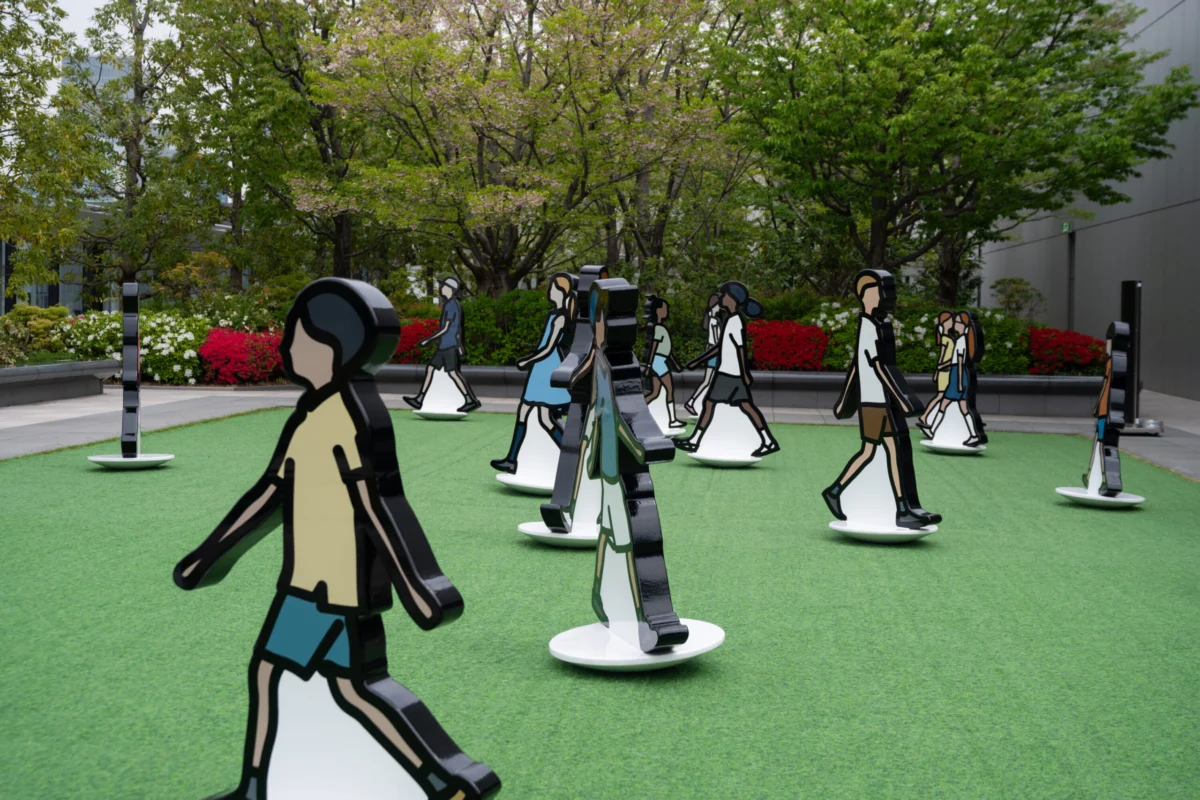
Ascending to the rooftop, the visitor encounters 20 Children, a sculptural installation that provides a sharp, serene contrast to the frantic energy of the streets below. Displayed from April 10 through June 30, 2026, these 20 figures are scattered across the open-air garden, creating an immersive, interactive environment.

The sculptures are modeled after real children and are designed to be tactile. When pushed, they sway, simulating the natural rhythm of walking. Placed against the backdrop of the Ginza skyline, these figures create a surreal juxtaposition between the permanence of the city and the ephemeral, unhurried nature of childhood. The garden, already one of the most tranquil spots in central Tokyo, becomes a "playground of the mind." The scale is human, the interaction is unforced, and the overall effect is one of profound, quiet tenderness.
The Ground Floor: Animating the Streetscape
At the street level, the collaboration takes a technological turn. Utilizing advanced mesh LED technology, Opie has installed Playground—a digital work displayed across the glass windows above the main entrance. Here, the artist bridges the gap between the building’s interior and the public thoroughfare of Ginza.
Minimal, line-drawn figures traverse the digital screen, mirroring the actual pace of pedestrians on the sidewalk below. It is a subtle commentary on urban life: the distilled, artistic version of the human figure coexisting with the real-world crowds. By projecting this work onto the facade, Ginza Six invites the passerby to engage with art without the barrier of entry fees or gallery walls.
Supporting Data and Technical Innovation
The success of these installations relies on a synthesis of art and cutting-edge display technology. The use of mesh LED technology in the ground-floor installation represents a significant shift in how art is integrated into architectural facades. Unlike traditional solid LED boards, the mesh structure allows for transparency, ensuring that the installation does not feel like an aggressive billboard, but rather a layer of light integrated into the building’s envelope.
The scale of the Marathon. Women. installation—spanning multiple floors—also demonstrates a sophisticated understanding of public space design. By calculating sightlines and movement patterns, the curators have ensured that the art acts as a "wayfinding" element, encouraging foot traffic to flow through the commercial floors naturally.
Official Perspectives: The Artist’s Intent
In an interview conducted in June 2025, Julian Opie offered insight into his philosophy regarding public art. "I am quite careful with public art projects," Opie stated. "They should be engaging but not annoying. Galleries and museums are like a row of white rooms, but the real world is not like that. Taking art outside and attempting to bring it to the attention of more people in a space like Ginza Six is an interesting task."
Opie’s approach is one of humility, viewing his role not as a high-minded authority, but as a participant in a larger urban experiment. "I am often asked what I think people will take away from looking at my work," he noted. "I don’t have a clear answer, but to be honest, it’s not really my business. I see myself as a toddler playing in a sandpit or an explorer discovering a new world… Showing my work is more like an invitation to join me in playing, investigating or simply looking at things."

The Legacy of Julian Opie
To understand the significance of this collaboration, one must look at Opie’s career trajectory. Emerging in the early 1980s, just prior to the rise of the Young British Artists (YBA), Opie developed a visual language characterized by bold outlines, flat colors, and the total removal of superfluous detail. His work occupies a compelling middle ground: it reads as accessible as a road sign or a pictogram, yet it possesses the emotional resonance and gravitas of traditional portraiture.
His work, perhaps most famously recognized by the general public through his iconic cover for the Blur Best Of album, has consistently sought to collapse the distance between "high art" and the everyday world. From London to New York, and from Switzerland to Takamatsu, his commissions have become global landmarks. His presence at Ginza Six validates the complex’s status as a serious cultural player in the global art market.
Implications for Modern Retail and Urbanism
The "Ginza Six model" offers a roadmap for the future of urban retail. As the rise of e-commerce continues to threaten the relevance of physical shopping centers, spaces that offer "experience" rather than just "inventory" are becoming the only ones that thrive. By treating the building as a cultural platform, Ginza Six has secured its relevance as a destination.
The implication is clear: the future of the city is one where commerce and culture are inextricably linked. By providing a stage for an artist like Julian Opie, Ginza Six transforms the act of shopping into an act of cultural consumption. The visitor who comes to see the art is the same visitor who stops for coffee, browses the shops, and lingers on the rooftop garden.
Ultimately, this initiative is a testament to the idea that architecture and art should not exist in silos. Whether it is the rhythmic sprint of the women in the atrium or the swaying, childlike figures on the roof, the art at Ginza Six reminds us that we are all, in our own way, in motion—and that sometimes, the best way to see the city is to stop, look, and join the game.
Visitor Information
For those planning to visit the installation or explore the ongoing art program:
- Location: Ginza Six, 6-10-1 Ginza, Chuo-ku, Tokyo 104-0061
- Inquiries: 03-6891-3390 (Available daily 10:30 – 20:30)
- Retail/Cafe Hours: 10:30 – 20:30
- Restaurant Hours: 11:00 – 23:00
- Digital Resource: Ginza Six Art Program Official Website
Note: Operating hours may vary by individual establishment. It is recommended to check the official website for updates on specific exhibitions or changes to gallery accessibility.












No comments yet. Be the first to join the conversation!