Jia Lissa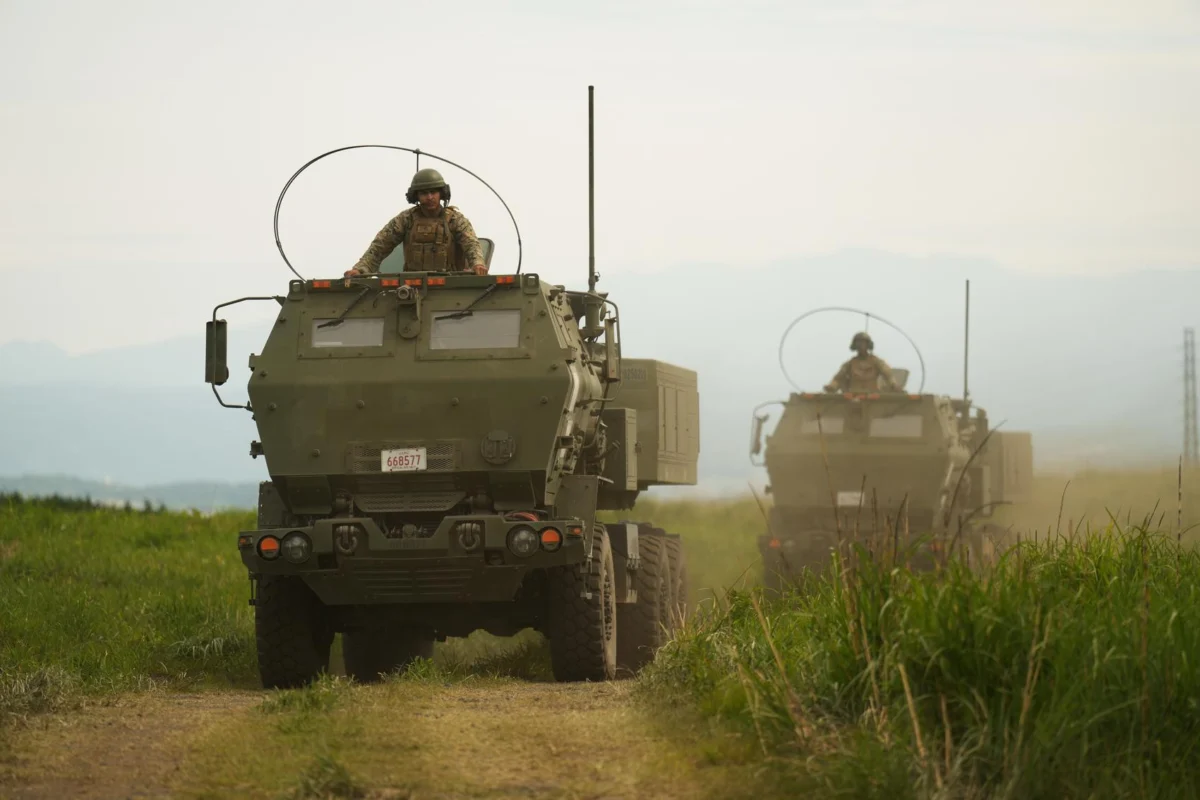
CAMP FUJI, JAPAN — The bucolic serenity of the foothills surrounding Mount Fuji was shattered this week by the rhythmic, thunderous roar of precision artillery. In a display of rapid-response firepower, U.S. Marines demonstrated the lethal efficiency of the High Mobility Artillery Rocket System (HIMARS), painting streaks of orange fire across the crisp blue sky. As the rockets arched toward their distant targets, the exercise served as a visceral reminder of a fundamental shift in American military strategy: moving away from massive, vulnerable capital ships toward a decentralized, highly mobile force designed to counter the modernization of the Chinese People’s Liberation Army (PLA).
The Mechanics of Modern Conflict
The exercise at Camp Fuji was brief, lasting only a few minutes, yet its geopolitical resonance was profound. Two HIMARS launchers, emerging from the deep shadows of an evergreen copse, unleashed a salvo of six rockets each before vanishing back into the concealment of the forest. This "shoot-and-scoot" tactic—a doctrine where launchers strike and relocate before enemy counter-battery fire can triangulate their position—has become the gold standard for survival in an era dominated by ubiquitous drone surveillance and satellite-linked targeting.
Sgt. Kevin Alvarez, section chief of the Fox Battery, 3rd Battalion, 12th Marines, emphasized the urgency of the maneuver. "It depends on the crew, but it can get as fast as four minutes, sometimes even two," Alvarez noted. In a real-world combat scenario, those minutes are the difference between a successful strike and a catastrophic loss of equipment.
Chronology and Evolution of a Battlefield Game-Changer
The HIMARS, introduced roughly two decades ago, spent years as a reliable workhorse in the asymmetrical battlefields of Iraq and Afghanistan. However, it was not until the conflict in Ukraine that the system achieved global recognition. The Ukrainian military’s ability to use HIMARS to disrupt Russian logistics and command centers effectively transformed the weapon from a support asset into a strategic cornerstone.
This evolution is now being applied to the Pacific theater. Lt. Col. Ryan Anness, commander of the 3rd Battalion, highlights that the lessons learned in Eastern Europe are being baked into Pacific training. "They’re much quicker, much faster, and much easier to hide than traditional cannon artillery," Anness explained. "Having precision-fire weapons and the ability to hide easily is why it’s so important for us to have the HIMARS."
The system’s versatility has also expanded. Initially limited to shorter-range munitions, the platform now utilizes the Army Tactical Missile System (ATACMS), capable of striking targets at 300 kilometers (180 miles). Even more significant is the integration of the Precision Strike Missile (PrSM), which can engage targets at ranges exceeding 500 kilometers (310 miles). Recent combat testing during the U.S.-led response to the conflict with Iran showcased these capabilities, where the PrSM was credited with sinking multiple Iranian surface ships and a submarine while still in port—a debut that has undoubtedly caught the attention of military planners in Beijing.
Supporting Data: The Geography of Deterrence
The strategic value of the HIMARS is best understood through the lens of the Indo-Pacific’s unique geography. Defense analysts point to the "tyranny of distance" as the primary challenge in any potential conflict over Taiwan.
Euan Graham, a senior defense analyst with the Australian Strategic Policy Institute, argues that the era of relying solely on massive aircraft carrier strike groups is nearing its twilight. "In conflict with China, the vulnerability of a carrier wing would be much greater than in past conflicts," Graham noted. "That is why we are seeing the U.S. emphasizing these smaller, dispersed units."
When paired with the Army’s Typhon system—a truck-based launcher capable of firing long-range Tomahawk missiles—the HIMARS provides a layered defensive umbrella. If deployed across the "First Island Chain," which includes the Philippines, Taiwan, and Japan, these mobile systems could effectively create "no-go zones" for hostile naval forces. The Taiwan Strait and the Luzon Strait, both critical chokepoints for any maritime blockade or invasion force, fall within the reach of these distributed batteries.
Official Responses and Strategic Intent
The Pentagon’s latest report to Congress clarifies the U.S. posture: the objective is to "deny the ability of any country in the Indo-Pacific to dominate us or our allies." This is not a strategy of naked aggression, but one of "deterrence through strength."
The maneuvers at Camp Fuji were conducted under the watchful eyes of Japanese military officials. While the exercise utilized concrete-filled dummy rockets for safety, the signaling was clear. Japan, having recently relaxed its own self-defense guidelines, views the integration of U.S. mobile rocket systems as a vital component of regional security. The closure of local roads and the strict adherence to safety protocols during the exercise underscored the seriousness of the integration between U.S. and Japanese forces.
"Being able to have long-range precision-fire weapons provides deterrence here in the Pacific," Lt. Col. Anness added. "We train with our Japanese partners as much as we can to make sure we’re ready."
Implications: A New Era of Decentralized Warfare
The pivot toward mobile, land-based missile systems represents a departure from the "big ship, big air wing" paradigm that has defined American power projection since World War II. In the event of a Taiwan-related conflict, the U.S. military anticipates that its larger surface assets would be forced to operate outside the envelope of China’s formidable anti-access/area-denial (A2/AD) missile capabilities.
In this scenario, the burden of deterrence falls to the "hiders": submarines and small, mobile, land-based units. By turning islands into "unsinkable aircraft carriers" equipped with long-range precision fire, the U.S. and its allies aim to make the cost of aggression prohibitive for the PLA.
However, this strategy is not without its risks. The reliance on dispersed, mobile units requires a complex logistical tail and seamless coordination with host nations. It also necessitates a degree of political resolve from regional partners who must accept the risk of hosting such assets on their soil.
As the smoke cleared at Camp Fuji, the message to the Pacific theater was unmistakable: the U.S. is not preparing to fight the wars of the last century. By decentralizing its firepower and focusing on mobility, the Marine Corps is signaling that in the contested waters of the Pacific, the ability to strike quickly and disappear is the ultimate insurance policy against the shifting tides of geopolitical ambition. The Pacific, now more than ever, is a game of hide-and-seek, and the U.S. is investing heavily in being the one that cannot be found—until it is too late for an adversary to respond.


 Neng Nana
 Asro
Asro