

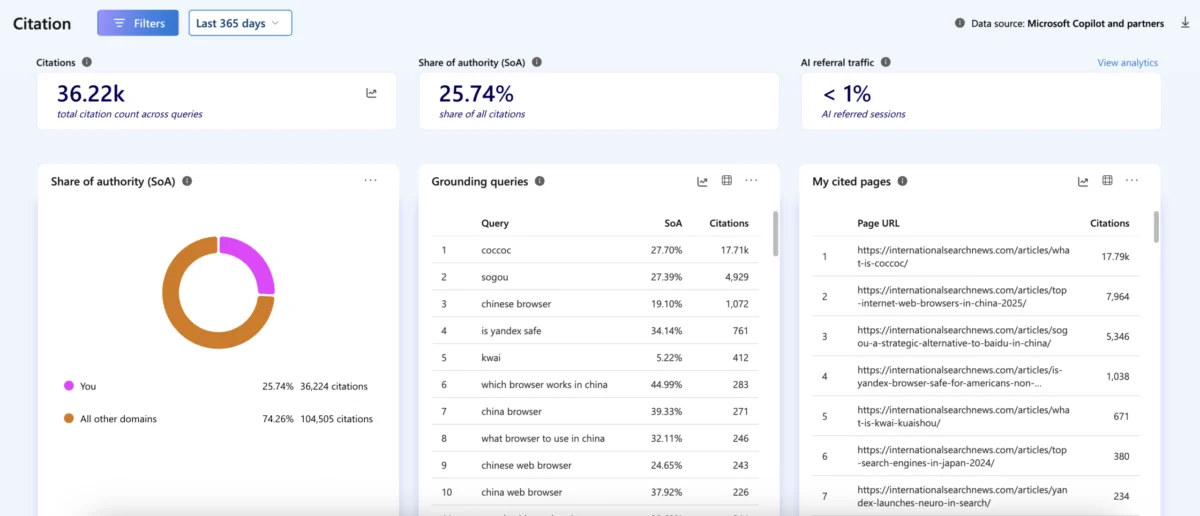
The landscape of search engine optimization (SEO) is undergoing its most significant paradigm shift in two decades. As generative AI transforms from a novelty into a primary interface for information retrieval, the traditional “blue link” paradigm is being supplanted by synthesized, citation-heavy responses. At the heart of this transition is Microsoft Clarity’s new AI Citations dashboard—a tool that has finally pulled back the curtain on how AI engines perceive, process, and prioritize web content.
For SEO professionals, this tool offers more than just vanity metrics; it provides a direct line into the “grounding queries” that trigger AI to cite specific websites. However, a lingering debate has emerged: If your audience primarily utilizes Google or ChatGPT rather than the Microsoft/Bing ecosystem, does this data hold any real-world value?
The Mechanics of Grounding: How AI Finds You
To understand the utility of Microsoft Clarity, one must first understand how Large Language Models (LLMs) operate in a search context. When a user inputs a question into Copilot, the system does not simply “think” of an answer. Instead, it employs a Retrieval-Augmented Generation (RAG) framework.
The process follows a specific sequence:
- Query Translation: The AI parses the user’s natural language prompt into a series of optimized search terms, known as "grounding queries."
- Index Retrieval: The engine queries its index (in this case, Bing’s massive web index) to find the most relevant, high-authority content that addresses the grounding query.
- Synthesis: The AI extracts facts, lists, and data points from the retrieved pages to construct a coherent, human-readable response, complete with citations.
Microsoft Clarity’s new feature allows site owners to see exactly which grounding queries successfully triggered a citation for their content. This is a game-changer. For the first time, we aren’t guessing why a page was chosen; we are looking at the specific search intent that led an AI to trust a particular piece of content.
Chronology: The Evolution of AI Visibility Data
- Late 2023: The industry begins to acknowledge the "Black Box" nature of AI search. SEOs struggle to differentiate between traditional search traffic and AI-driven traffic.
- Early 2025: RAG becomes the industry standard for search-integrated LLMs. Google pushes Gemini’s integration with Search, while Microsoft doubles down on Copilot’s reliance on the Bing Index.
- May 2026: Microsoft Clarity officially rolls out its AI Citations dashboard to all users. This marks the first time a major tech player has provided a transparent look at the "grounding" phase of the AI retrieval process.
- Present Day: SEOs are currently conducting comparative analyses to determine if insights gleaned from Microsoft’s ecosystem are transferable to Google Gemini and other emerging AI agents.
Copilot vs. Gemini: A Comparative Breakdown
While both engines utilize retrieval-augmented approaches, their architectural nuances create different outcomes for content creators.

| Feature | Microsoft Copilot | Google Gemini |
|---|---|---|
| Structure | Query translator, Bing index, OpenAI models. | Query translator, Google Search, Gemini models. |
| Source Retrieval | Scans web pages, Microsoft Graph, and M365. | Scans web pages, Google Drive, and Gmail. |
| Synthesis Style | Direct, fact-heavy, list-oriented. | Creative, multimodal (text/images/code). |
The fundamental difference lies in the "synthesis" phase. Copilot is engineered to be a utility-first assistant, prioritizing structured data and bulleted facts. Gemini, conversely, is built for creative fluidity. Understanding these differences is crucial for any SEO strategy that aims to dominate both platforms simultaneously.
Data-Driven Insights: The Correlation Study
One of the most compelling arguments for using Clarity data comes from recent field tests. In a case study involving a site with over 1,000 articles—a site that historically struggled with Google rankings—the site enjoyed 36,000 citations in Copilot.
When the author tracked the 147 unique grounding queries used by Copilot to cite this site, a startling pattern emerged:
- Bing Performance: The site ranked in the top 20 for nearly all 147 queries.
- Google Performance: The site ranked for zero of the 147 queries.
This creates a paradox. If a site is invisible on Google but thriving in AI-driven search, is the data "useless"? The consensus among experts is a resounding "no." The data proves that the site’s content is perfectly optimized for the way AI "reads" the web, even if the traditional search algorithm of Google has yet to catch up.
The Transferability Argument: Why Platform-Agnosticism Matters
Critics argue that because the data is sourced from Microsoft’s ecosystem, it is siloed. However, this view ignores the universal nature of RAG. Whether an engine is Bing-based or Google-based, they all face the same challenge: how to distill a complex user intent into a search query that can be answered by existing web documents.
If your content is being cited in Copilot, it means your site has achieved a high "Share of Authority" for those specific topics. This is not a coincidence; it is a result of structural excellence. AI engines crave:

- Semantic Clarity: Clear, H2-subheaded sections that define concepts.
- Data Density: Tables and bulleted lists that allow for easy extraction.
- Direct Answers: Content that avoids fluff and gets straight to the query’s core.
These are not "Bing-only" requirements. They are fundamental to how all LLMs process information. By optimizing for the structures that Copilot likes, you are effectively "future-proofing" your content for any AI agent that uses a retrieval-based model.
Implications for the Future of SEO
What happens when a site ranks for a term in a traditional search index but fails to appear as a grounding query? This is perhaps the most actionable insight provided by the Clarity dashboard. It signals a fundamental mismatch in content architecture.
The implication is clear: Traditional SEO is no longer sufficient. You can have a high-ranking page in the blue links, but if that page is not "AI-readable," you will lose out on the growing share of traffic moving to conversational AI interfaces.
Strategic Recommendations:
- Audit for "Grounding Potential": Review your highest-traffic pages and identify if they contain clear, concise definitions that an AI could easily extract.
- Close the Gap: If you have high-traffic pages that never appear as citations, restructure those sections into "Q&A" blocks or tabular data to see if citation frequency increases.
- Treat Clarity as a Laboratory: Don’t view the dashboard as a measure of "success" or "failure" in traffic. View it as a sandbox where you can test which structural changes trigger more citations.
- Acknowledge the Fallbacks: Remember that models like ChatGPT are increasingly using Google Search as a fallback. While your Clarity data is Bing-centric, the structural lessons you learn are universal.
Conclusion: A New Era of Visibility
Microsoft Clarity has provided the SEO industry with a diagnostic tool that is long overdue. While the grounding queries are specific to the Bing index, the patterns they reveal—how LLMs chunk, synthesize, and value content—are universal.
The industry has historically been neglectful of Bing, viewing it as a secondary player to Google. That era must end. By treating the Clarity dashboard as a "lab environment," marketers can gain a competitive advantage in the AI-search era. The goal is no longer just to rank for a keyword; the goal is to become the primary source of truth for the AI agents that are increasingly becoming the gatekeepers of the internet.
As we move further into 2026 and beyond, the winners in the search landscape will not necessarily be those with the most backlinks or the highest domain authority. They will be the ones who best understand how to speak the language of the machine—a language defined by grounding queries, structured data, and the relentless pursuit of information clarity.












No comments yet. Be the first to join the conversation!