Dwi Wanna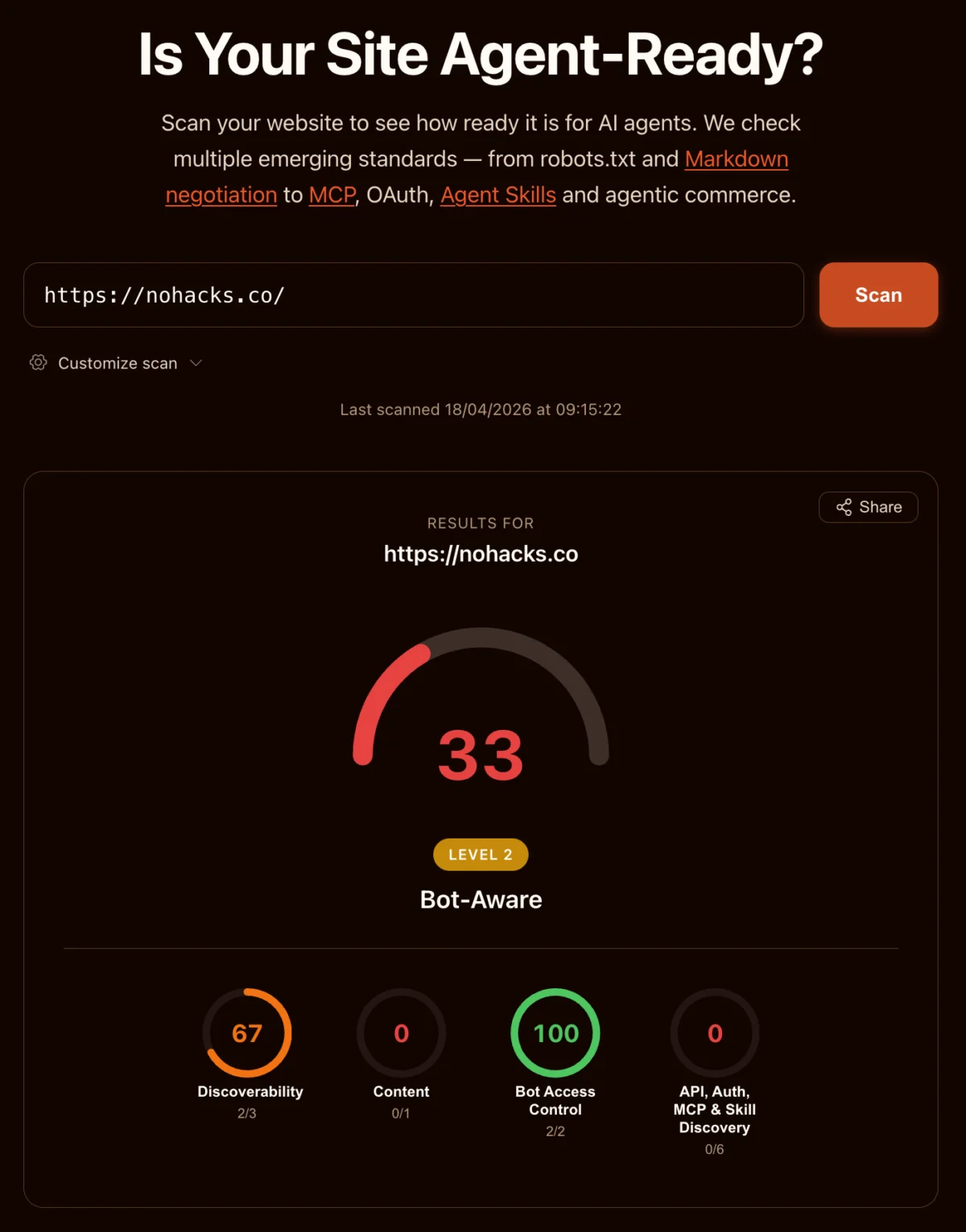
The landscape of the internet is undergoing a structural shift. For decades, the primary "consumer" of the web was the human user, followed closely by the traditional search engine crawler. Today, a new, more demanding visitor has arrived: the AI agent. These autonomous entities do not merely index pages; they interact, authenticate, execute functions, and retrieve data to perform tasks on behalf of users.
This week, Cloudflare marked a critical milestone in this transition by launching isitagentready.com, a public diagnostic tool designed to quantify how "legible" a website is to the growing ecosystem of AI agents. By providing a standardized score, Cloudflare has transitioned the conversation from abstract theories about AI compatibility to a measurable, technical infrastructure challenge.
The Chronology of an Infrastructure Shift
The launch of the Agent Readiness Score on April 17 was not an isolated event; it served as the capstone to "Cloudflare Agents Week." Over the course of six days, the company systematically rolled out a suite of tools designed to bridge the gap between human-centric web design and machine-first architecture.
Earlier in the week, Cloudflare introduced Project Think, an SDK for building agents, which was met with an immediate response from OpenAI, who released their own competing agents framework within hours. This "Agent Runtime War" underscores the reality that browser engines are no longer the only layer that matters. The "agent runtime" is becoming the new browser, and website owners are currently flying blind regarding their site’s compatibility with these autonomous visitors.
The scanner arrives alongside a portfolio of supporting technologies: Agent Memory, Shared Dictionaries, Redirects for AI Training, and "Unweight" (an LLM compression technique). By providing a tool that audits site readiness, Cloudflare is effectively attempting to define the standards by which these new runtimes will operate.

Dissecting the Scanner: What Are You Actually Measuring?
The Agent Readiness tool functions as a diagnostic audit. When a user inputs a URL, the scanner probes the site across 16 distinct checks grouped into five primary categories. Each category evaluates a different facet of "agent-legibility":
- Discoverability: Does the site provide the necessary metadata—such as
robots.txtand sitemaps—to help agents find content? - Content Accessibility: Does the site support modern, machine-readable formats, specifically through content negotiation (e.g., providing Markdown versions of pages)?
- Bot Access Control: Does the site explicitly define rules for AI crawlers, including the newly proposed "Content Signals" directives?
- API, Auth, and MCP Discovery: Perhaps the most critical category for advanced agents, this checks for the presence of Model Context Protocol (MCP) endpoints and API catalogs that allow an agent to "do" things on the site rather than just "read" it.
- Commerce (Optional): Checks for protocols that enable agents to facilitate transactions or retrieve pricing and inventory data.
Notably, the scanner is not just for passive monitoring; it is also available as an API. This allows agents to self-audit a website before deciding how to interact with it. In this emerging paradigm, the measurement and the measured are beginning to exist on the same functional plane.
The "Goodhart" Trap: Why Your Composite Score is Misleading
Despite the utility of the data, the "composite score" (e.g., 33/100) carries significant risk. This is a classic case of Goodhart’s Law: "When a measure becomes a target, it ceases to be a good measure."
For example, when the author tested their own site, nohacks.co, the initial score was a discouraging 33 out of 100, labeled as "Level 2: Bot-Aware." However, this number was structurally misleading. The site, a content-focused blog, was being penalized for lacking features—such as commerce protocols or complex API endpoints—that it has no functional need to possess.
When the author switched the scanner’s preset from "All Checks" to "Content Site," the score jumped to 67. This discrepancy reveals a fundamental truth: the composite score is a marketing layer. It is a single number designed to be shared on social media, but it obscures the nuances of the underlying architecture. Web professionals should be wary of chasing a "100" score, as this can lead to "performance theater"—implementing empty protocols just to satisfy a diagnostic algorithm.

Implications for the Future of the Web
The release of this scanner has profound implications for the future of digital strategy. We are witnessing the decoupling of content and delivery.
1. Delivery vs. Message
Classical SEO and CRO (Conversion Rate Optimization) are focused on the "message"—the quality, clarity, and persuasiveness of the content. Agent-readiness, by contrast, is entirely about "delivery." A website can have world-class SEO content but be entirely illegible to an AI agent if its transport layer is poorly configured.
2. The Fragmentation of Standards
Cloudflare is making a bet on specific protocols, such as MCP and Content Signals. However, as other vendors (like Google, OpenAI, or Perplexity) inevitably release their own scanners, we should expect a divergence in which standards they prioritize. The "true" standard will not be what one vendor measures, but rather the intersection of what all vendors measure.
3. The Shift in Web Development
For developers, the mandate is clear: the focus must move toward machine-readable transport protocols. Implementing RFC 8288 Link headers, configuring proper API catalogs, and enabling content negotiation are no longer "optional" backend tasks. They are the new baseline for ensuring a website remains a first-class citizen in an agent-driven web.
A Strategic Path Forward
For web professionals tasked with navigating this transition, the following steps are recommended:

- Audit with Context: When using the Cloudflare scanner, always select the preset that aligns with your site type. Do not rely on the "All Checks" default for benchmarking.
- Prioritize Real Runtimes: Focus on fixes that map to existing agent-runtime behaviors. For example, configuring HTTP Link headers for discovery is a high-leverage action that provides immediate value to crawlers, regardless of whether the "score" increases.
- Ignore the Score, Watch the Signals: Instead of obsessing over the final number, look at the individual check failures. Use the scanner to identify genuine gaps in your infrastructure rather than chasing an arbitrary 100/100.
- Track the Consensus: Over the next six months, monitor which checks remain consistent across multiple vendor scanners. These common denominators will define the future of the open web.
Conclusion
Cloudflare’s Agent Readiness Score is a powerful, if potentially misunderstood, tool. It correctly identifies that the web is moving toward a machine-first future where autonomous agents will be the primary gatekeepers of information.
While the composite score may tempt users into "score-chasing," the true value of the tool lies in its granular audit of transport and protocol layers. The internet is being rebuilt to accommodate non-human readers, and those who treat agent-readiness as a core architectural requirement—rather than just a metric to be optimized—will be the ones who define the next generation of the web. As we move forward, the goal should not be to game the scanner, but to build a site that is inherently, structurally, and functionally prepared for the agents of tomorrow.


 Basiran
 Siti Muinah