

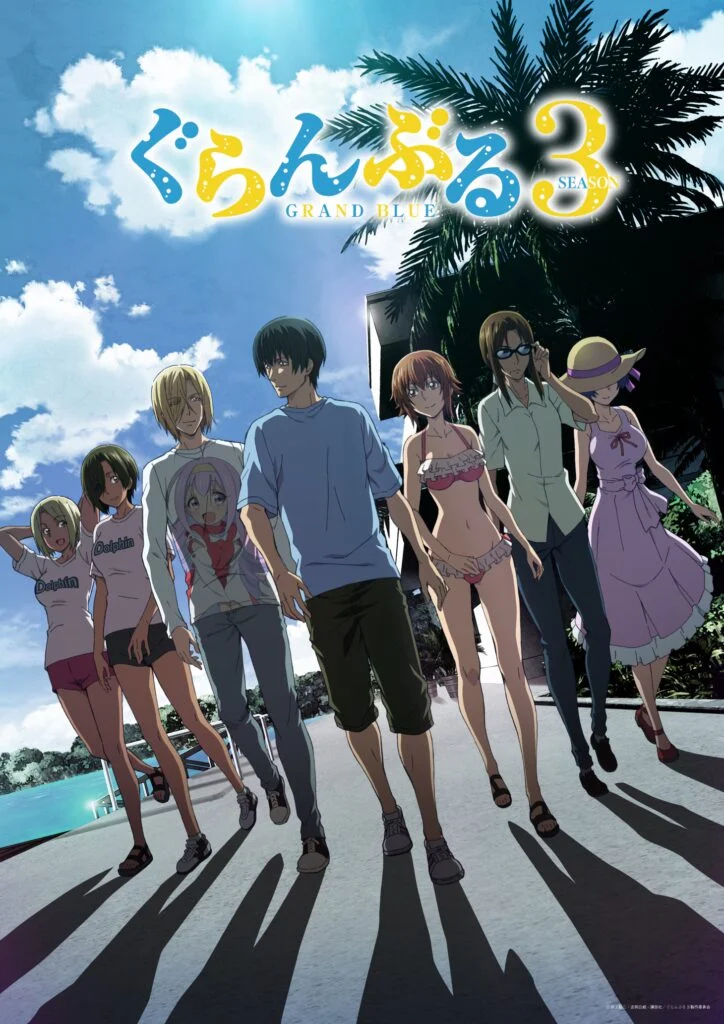
The raucous, alcohol-fueled, and surprisingly aquatic world of Grand Blue Dreaming is set to make a triumphant return. On May 24, 2026—a date celebrated in Japan as "Scuba Diving Day" due to the linguistic pun Go (5), To (2), Shi (4), or "Go To Sea"—the production committee behind the cult-classic anime series unveiled a vibrant new key visual and confirmed the musical talent set to front the show’s highly anticipated third season.
As the series prepares to leave the familiar shores of Japan for an international excursion, fans are bracing for a summer defined by the series’ trademark blend of absurdity, genuine friendship, and, of course, a staggering amount of beverages.
The Return of the Diving Club: Main Facts and Production Details
Grand Blue Dreaming Season 3 is officially slated for a July 2026 premiere. The production sees a collaborative effort between studios Zero-G and Saber Works, who are tasked with adapting the high-energy hijinks of Kenji Inoue and Kimitake Yoshioka’s beloved manga.
The announcement, strategically timed to align with Scuba Diving Day, signals a significant shift in scope for the series. While previous seasons were firmly anchored in the coastal beauty of the Izu Peninsula, Season 3 will see the core cast of the Peek-a-Boo Diving Club taking their chaotic brand of camaraderie to the tropical paradise of Palau. This marks the first time the franchise has ventured beyond Japanese borders, promising a fresh visual aesthetic to complement the series’ signature comedic timing.
The new key visual, released alongside the announcement, features the familiar, disheveled, and often half-dressed protagonists set against the backdrop of an idyllic, sun-drenched oceanic landscape, perfectly capturing the dichotomy between the characters’ idiotic tendencies and their earnest love for the sea.
A Chronology of Chaos: From Iori’s Awakening to the Palau Expedition
To understand the weight of this announcement, one must look back at the trajectory of the series. Grand Blue began as a manga in 2014, quickly gaining a reputation for its unflinching, and often hilarious, depiction of college life.
- 2014: Kenji Inoue and Kimitake Yoshioka launch Grand Blue in Good! Afternoon magazine.
- 2018: The first season of the anime adaptation, produced by Zero-G, airs to critical acclaim, praised for its sharp comedic pacing and the faithful transition of Yoshioka’s expressive character designs.
- 2020–2025: A period of relative silence on the television front, though the manga continued to thrive, expanding the lore of the diving club and deepening the character arcs of Iori Kitahara and his companions.
- May 2026: The official announcement of Season 3, accompanied by the "Go To Sea" campaign, confirms that the long wait for a television return is finally coming to an end.
The progression from local dives in Izu to the international waters of Palau serves as a metaphor for the characters’ growth. While the "shenanigans"—the heavy drinking, the competitive spirit, and the perpetual state of undress—remain a core pillar of the narrative, the move to Palau suggests a maturation of the plot, pushing the characters out of their comfort zone and into a global setting.
Supporting Data: The Cultural Impact of Grand Blue
The enduring popularity of Grand Blue is not merely a product of its humor. The series occupies a unique niche in the "slice-of-life" genre. Unlike traditional series that focus on school clubs or romantic tension, Grand Blue leans heavily into the "drunken comedy" subgenre, a rarity in mainstream anime.
According to industry metrics, the series consistently ranks among the highest in "engagement and rewatchability" within the comedy demographic. The combination of intense, beautifully animated diving sequences and the juxtaposition of those sequences with slapstick comedy creates a rhythmic pacing that keeps audiences hooked. The decision to bring in a high-profile musical act like FUNKY MONKEY BΛBY’S further underscores the production committee’s confidence in the show’s commercial viability for the 2026 summer season.
Official Responses and Musical Direction
The inclusion of the legendary J-pop group FUNKY MONKEY BΛBY’S to perform the opening theme, titled "Natsuko," is perhaps the most significant piece of supplementary news. The band, known for their emotionally resonant and high-energy tracks, released a formal statement that frames the anime not just as a comedy, but as a nostalgic reflection on youth.

"We have been entrusted with the main theme song for the amazing anime Grand Blue," the band noted in their official release. "Youth, friendship, and nudity… treasures we’d left behind one summer. We wrote the song with the desire to recapture these feelings."
They concluded with a poignant question that seems to cut to the core of the show’s appeal: "In the time remaining, how many more times are we allowed to relive this season?"
The band’s input suggests that while Season 3 will maintain the series’ status as a comedy, it will also likely lean into the bittersweet reality of college summers—the fleeting nature of those friendships and the intensity of the experiences that define one’s formative years.
Implications: What to Expect from Season 3
The move to Palau is more than a change of scenery; it is an implication of higher stakes. International travel in the Grand Blue universe rarely goes smoothly. Fans can expect a heightened level of logistical disaster, language barriers, and, undoubtedly, a significant escalation in the series’ iconic "drinking games."
Furthermore, the production partnership between Zero-G and Saber Works suggests an increase in the budget for water-based sequences. Palau is world-renowned for its biodiversity and pristine diving conditions; if the production team maintains the visual standard established in previous seasons, the audience can expect the most visually stunning underwater segments in the history of the franchise.
Narrative Shifts
The transition to Palau also provides a unique opportunity for character development. By removing the cast from their home turf—the Grand Blue shop and their respective universities—the story will be forced to rely entirely on the dynamics between the characters. This isolation often brings out the best in the writing, as it forces the ensemble cast to confront their codependency and their shared, albeit dysfunctional, bond.
The Summer of 2026
The anime industry is currently in a state of high competition, with numerous sequels and high-budget originals vying for attention in the July window. However, Grand Blue has a "stickiness" that few shows can replicate. By tapping into the nostalgia of "sparkling summer memories," as FUNKY MONKEY BΛBY’S put it, the series is positioning itself to be more than just a comedy—it is positioning itself to be a cultural touchstone for the summer of 2026.
Conclusion
As the countdown to July begins, the excitement surrounding Grand Blue Dreaming Season 3 is palpable. The combination of an exotic new location, a seasoned production team, and an evocative, nostalgia-driven opening theme suggests that the series is not resting on its laurels.
Whether you are a long-time fan of the manga who has been waiting for the adaptation of the Palau arc, or a newcomer curious about what "drunk diving" anime entails, the return of the Peek-a-Boo Diving Club promises to be one of the highlights of the year. The producers have made it clear: it is time to "Go To Sea," and if history is any indication, it will be a trip that none of us will soon forget.
Prepare your drinks, sharpen your sense of humor, and get ready for a summer that—true to the spirit of the series—will likely be as messy as it is memorable.












No comments yet. Be the first to join the conversation!