


In the treacherous, expansive oceans of Subnautica 2, survival is not merely about managing oxygen levels or evading gargantuan leviathans; it is about ingenuity. As players descend further into the abyss, the limitations of basic gathering tools become painfully apparent. To conquer the game’s more complex biomes and progress through its narrative, players must acquire the Sonic Resonator—a specialized piece of technology designed to shatter dense mineral deposits and clear structural obstructions.
This guide provides a deep dive into the function of the Sonic Resonator, the precise locations of its required blueprints, and the logistics of its fabrication.
The Essential Utility of the Sonic Resonator
In the Subnautica series, players often find themselves blocked by environmental puzzles that require specific technological breakthroughs. Unlike the traditional Laser Cutter of the original title, the Sonic Resonator is engineered for the unique geological challenges presented in Subnautica 2.

The tool serves two primary purposes:
- Resource Extraction: As players reach the mid-to-late game, they will encounter massive mineral deposits that are impervious to standard knives or thermal blades. The Sonic Resonator emits high-frequency vibrations that destabilize these formations, allowing for efficient mining of rare materials.
- Narrative Progression: The tool is a "key" in the metaphorical and literal sense. Certain story-critical areas, such as the path toward obtaining the vital Heat Resilience Adaptation, are cordoned off by reinforced environmental barriers that only the Sonic Resonator can breach.
Without this tool, players will find themselves effectively locked out of the game’s more volatile, high-temperature regions, rendering the exploration of the Angel Comb and surrounding volcanic zones nearly impossible.
Chronology of Discovery: Finding the Blueprints
The acquisition of the Sonic Resonator is a multi-stage process. Unlike simpler items, you cannot craft this tool from a single schematic; you must synthesize data from two distinct, remote locations.

Stage 1: The Spider Dome (Southwest Sector)
The initial blueprint is located in a region often overlooked by players focusing on the northern narrative markers. Approximately 240 meters west-southwest of your starting Lifepod, you will find a peculiar reef formation that resembles a giant spider.
To locate the data pad:
- Navigate toward the Angel Comb region.
- Locate the small wreckage situated just south of the main formation.
- Continue heading south until you reach the "Spider Dome" reef.
- The blueprint is not hidden inside the structure but is instead contained within a storage box placed on an external observation platform above the primary breach point.
Stage 2: The Old Habitat (Northern Sector)
Once you have secured the first piece of data, your path leads north. The second, more elusive blueprint is located roughly 400 meters north of the Lifepod at a site designated as the "Old Habitat."
- Approach Strategy: You will encounter a multi-room, abandoned research structure. It is highly recommended to enter via the northern entrance, which offers the most direct route to the primary laboratory.
- The Collection: Upon entering, you will find yourself in a specimen hall. On the walls, various local flora and fauna samples are displayed. Scan the opposite wall—the Sonic Resonator blueprint is resting on a reinforced storage shelf.
Fabrication Requirements: Engineering the Device
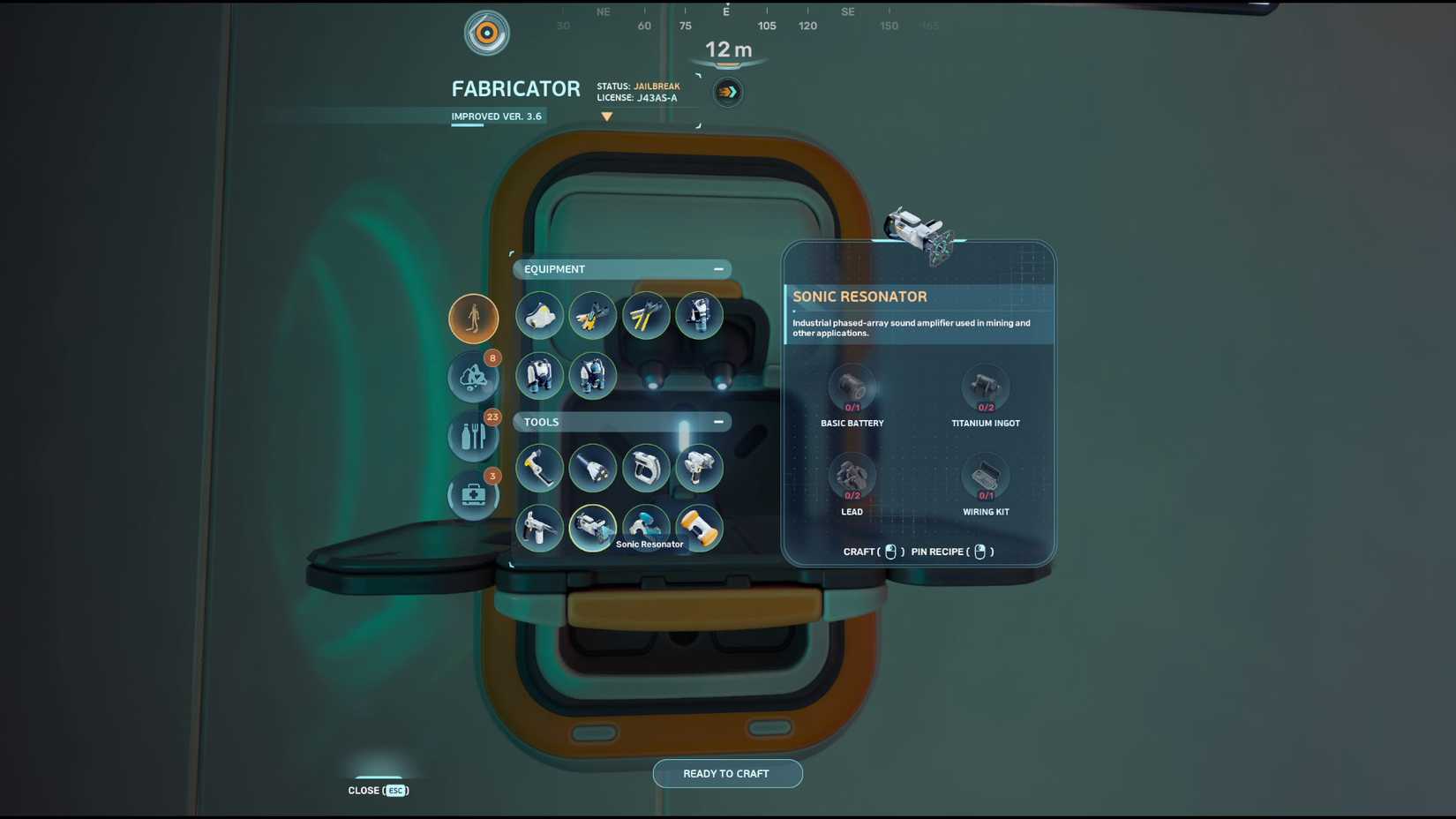
Once both blueprints are in your possession, you must return to a secondary base equipped with a standard Fabricator. The Lifepod’s internal equipment is insufficiently powered to handle the complex assembly required for the Sonic Resonator.
Required Materials
To assemble the tool, you will need to gather the following components:
- Titanium Ingot: Unlike standard scrap, this requires a Processor to refine.
- Basic Batteries: These are crafted using Copper and Acidic Raion Pouches.
- Lead: Found in deep-sea outcroppings.
- Wiring Kit: Requires refined Silver and Copper Wire.
Technical Note: Players often struggle with the acquisition of the Titanium Ingot. Ensure you have unlocked the Processor at your base, as this is the only way to convert raw metal salvage into the high-density ingots necessary for the tool’s chassis.
Implications for Exploration and Survival
The introduction of the Sonic Resonator fundamentally changes how a player interacts with the game world. In Subnautica 2, the environment is more than just a backdrop; it is a dynamic, shifting entity.
Overcoming Environmental Hazards
Once the Sonic Resonator is equipped, the "Heat Resilience Adaptation" becomes the player’s primary goal. This adaptation is crucial for surviving the thermal vents near the Angel Comb. Without the resonator, the player is forced to take sub-optimal paths that increase exposure to high-temperature damage, often leading to equipment failure or death.
By clearing the path through the Spider Dome and the Old Habitat, players open up "fast-travel" style shortcuts through the cave systems. This not only saves time but significantly reduces oxygen consumption during deep-sea dives.

Strategic Resource Management
The Sonic Resonator’s ability to break down larger mineral deposits is a game-changer for base building. Players who prioritize finding this tool early in their playthrough will find themselves with a surplus of rare minerals—such as Lithium and Crystalline Sulfur—that are otherwise difficult to farm in large quantities. This allows for the construction of more advanced, high-tier habitat modules much earlier in the game cycle.
Official Developer Insights and Game Context
According to information provided by Unknown Worlds Entertainment, Subnautica 2 operates on a more complex iteration of the Unreal Engine 5, allowing for more intricate physics-based environmental interactions. The Sonic Resonator is the primary tool that highlights this technical upgrade.
The developers have noted that the "gatekeeping" of certain areas behind tools like the Resonator is a design choice intended to pace the player’s experience. By preventing access to the northern and volcanic biomes until the player has successfully scavenged the necessary blueprints, the game ensures that players are adequately prepared for the increased difficulty of these zones.
Community Reception
The community has largely praised the shift toward "exploration-based crafting." Players have noted that the scavenger hunt for the two blueprints feels like a natural extension of the game’s survival mechanics, rewarding curiosity over simple progression.
Conclusion: The Path Forward
The Sonic Resonator is more than just a tool; it is a symbol of the player’s mastery over the ocean floor. By following the trail from the Lifepod to the Spider Dome and finally to the Old Habitat, you transition from a survivor clinging to life to an explorer capable of uncovering the darkest secrets of the planet.
As you venture forth with your new tool, remember: the ocean is vast, and the technology you build is the only thing keeping you safe. Keep your batteries charged, monitor your depth, and ensure your base is well-supplied before attempting the deeper, more dangerous excavations that the Resonator makes possible.

Whether you are playing on PC or Xbox, the mechanics remain consistent. The path to the Sonic Resonator is challenging, but for those who succeed, the rewards of the deep await.












No comments yet. Be the first to join the conversation!