

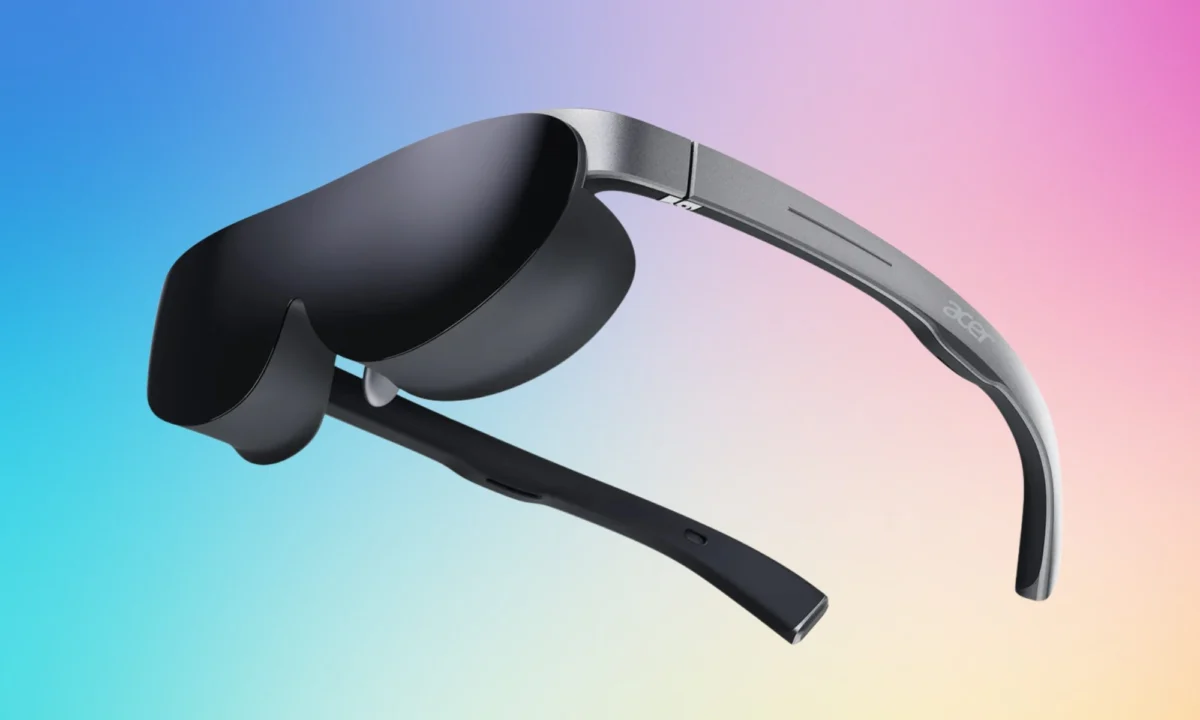
The wearable technology market has spent the last few years operating as a high-stakes arena dominated by a predictable trio: Meta, Samsung, and Google. While these tech giants have funneled billions into convincing the public that AI belongs on our faces or wrists, the segment has often felt like an exclusive club. However, the status quo was upended just days before the 2026 Computex trade show, as PC powerhouse Acer made a surprise entrance into the smart eyewear sector.
Rather than dipping a toe in with a singular, experimental concept, Acer has launched two distinct, market-ready products: the AR Vision GR0, a high-fidelity wired display headset, and the GI0 AI Glasses, a direct competitor to the popular Ray-Ban Meta frames. By bridging the gap between laptop-tethered productivity and on-the-go AI assistance, Acer is signaling that it intends to be a major player in the next generation of personal computing.
The Strategic Shift: Acer’s Evolution Beyond the Laptop
For decades, Acer has been a cornerstone of the computing industry, known for its reliable laptops and desktop ecosystems. The decision to enter the smart glasses market is not merely a diversification tactic; it is a fundamental shift in how the company views the "personal computer."
In 2026, the traditional monitor-and-keyboard setup is becoming increasingly portable. By introducing these two devices, Acer is acknowledging that the "workstation" of the future is no longer a physical desk, but a set of lenses. The timing—just ahead of Computex, one of the world’s most significant tech expos—indicates that Acer is positioning these wearables as core components of its hardware roadmap, not just experimental side projects.

The AR Vision GR0: A New Benchmark for Wired Immersion
The flagship of this new lineup, the AR Vision GR0, is designed for the power user. Unlike wireless headsets that often sacrifice visual fidelity to save on battery weight, the GR0 opts for a wired connection to smartphones, tablets, or laptops.
Technical Specifications and Visual Fidelity
The core of the GR0’s appeal is its display technology. It utilizes dual micro-OLED panels—one for each eye—capable of outputting 1920 x 1080 resolution in 2D mode. For those seeking a deeper, more spatial experience, the glasses can scale up to 3840 x 1080 in 3D.
The optical engineering creates the illusion of a massive 172-inch display viewed from a distance of roughly 20 feet. For professionals who travel frequently or students living in cramped environments, this device effectively replaces the need for a bulky external monitor.
Comfort and Practicality
One of the primary barriers to adoption for smart glasses has been weight. Acer has managed to keep the GR0 at a remarkably low 69 grams. This puts it in a sweet spot for comfort, allowing for extended wear during long commutes or flight-based work sessions. Furthermore, the device offers:

- Detachable Light Shields: Allowing users to choose between full-immersion AR and a semi-transparent mode.
- Myopia Magnetic Lens Support: Addressing the needs of users who require prescription correction without sacrificing the sleek profile of the headset.
- Platform Agnostic Design: Unlike some competitors that lock users into specific ecosystems, the GR0 is fully compatible with Android, iOS, and Windows, ensuring it functions as a universal display accessory.
The AR Vision GR0 is priced at $499.99, a competitive entry point for the high-end AR market.
The GI0 AI Glasses: Challenging the Social Wearable
If the GR0 is for the heavy-duty professional, the GI0 AI Glasses are designed for the daily urban dweller. These frames are visually indistinguishable from high-end eyewear, yet they pack a suite of intelligent features that mimic—and in some ways challenge—the functionality of the Meta Ray-Bans.
Intelligent Integration
The GI0 glasses rely on Bluetooth and Wi-Fi to sync with the user’s smartphone via the proprietary Acer AspireSync companion app. The intelligence is powered by Google’s Gemini AI, allowing users to interact with their surroundings in real time.
Key features include:

- First-Person Capture: A 12MP camera allows for quick, point-of-view photography and video recording, perfect for capturing moments without the social friction of holding up a phone.
- Real-Time AI Translation: A transformative tool for travelers, the glasses can display live captions for foreign languages directly in the user’s field of view.
- Voice Assistance and Transcription: Beyond simple commands, the GI0 can record meetings or lectures, storing them securely on the 32GB of onboard memory.
At 46 grams, the GI0 frames are remarkably light, making them suitable for all-day wear. Priced at $299.99, they offer a compelling alternative to Meta’s current offerings, particularly for those who already live within the broader Android or Windows software ecosystem.
Chronology of Development
The arrival of these products follows a quiet period of R&D at Acer. While the company has historically focused on core computing, industry analysts have noted a gradual acquisition of IP related to optical hardware and AI integration over the last 24 months.
- Mid-2024: Acer begins consolidating its wearable research teams under a new "Next-Gen Computing" umbrella.
- Early 2025: Initial patent filings emerge regarding compact, high-resolution micro-OLED projection systems.
- Q4 2025: Acer quietly partners with AI firms to integrate large language models into its existing software suite.
- May 2026: Official announcement of the Vision GR0 and GI0 glasses, timed to generate buzz just days before the Computex global stage.
Official Responses and Market Positioning
Acer’s executive leadership has remained tight-lipped regarding specific sales targets, but the company’s messaging is clear: these glasses are intended to expand "on-the-go capabilities."
In an official statement released alongside the launch, an Acer spokesperson noted: "We believe the future of productivity is fluid. By providing hardware that serves as an extension of your existing laptop or phone, we aren’t asking our users to change their workflows; we are simply giving them a bigger, more intelligent window through which to view their work."

Analysts have pointed out that by leveraging existing partnerships with OS providers like Microsoft and Google, Acer is avoiding the "walled garden" trap that has hampered other hardware manufacturers.
Broader Implications: The Future of the "Face-Computer"
The entry of a legacy manufacturer like Acer changes the competitive landscape significantly.
1. The Death of the "Gimmick" Era
For years, smart glasses were viewed as a tech-enthusiast toy. By pricing these units at $299 and $499 and ensuring cross-platform compatibility, Acer is moving these products firmly into the "productivity tool" category. This transition is essential for the normalization of wearable technology.
2. Ecosystem Wars
As companies like Meta push for a "pendant" or "all-in-one" AI future, the market is fragmenting. Meta wants to own the social AI experience, while Apple and Samsung are focusing on proprietary AR/VR ecosystems. Acer’s approach—acting as the "neutral" hardware provider—could attract a significant segment of users who want the utility of AI without the restrictive ecosystem locks.

3. Privacy and Adoption
The introduction of 12MP cameras and "always-listening" AI features in the GI0 frames will inevitably reignite debates regarding privacy. As these devices become more common, both in the workplace and in public, society will need to develop new etiquette regarding when it is acceptable to record or use AI-assisted analysis. Acer’s onboard storage policy—storing data locally rather than strictly in the cloud—is a subtle nod to these growing security concerns.
Final Thoughts: A Calculated Risk
Acer’s entry into the smart glasses market is not an attempt to displace the smartphone, but rather an effort to redefine the peripheral. By offering a high-performance wired option and a stylish, AI-driven daily driver, the company has effectively covered both ends of the consumer spectrum.
As Computex 2026 kicks off, all eyes will be on whether these devices can perform as well in the real world as they do on paper. If they prove to be the practical, reliable tools Acer claims they are, we may be looking at the beginning of the end for the traditional, screen-bound work lifestyle. The era of the "face-computer" has officially arrived, and it is more accessible than ever before.












No comments yet. Be the first to join the conversation!