

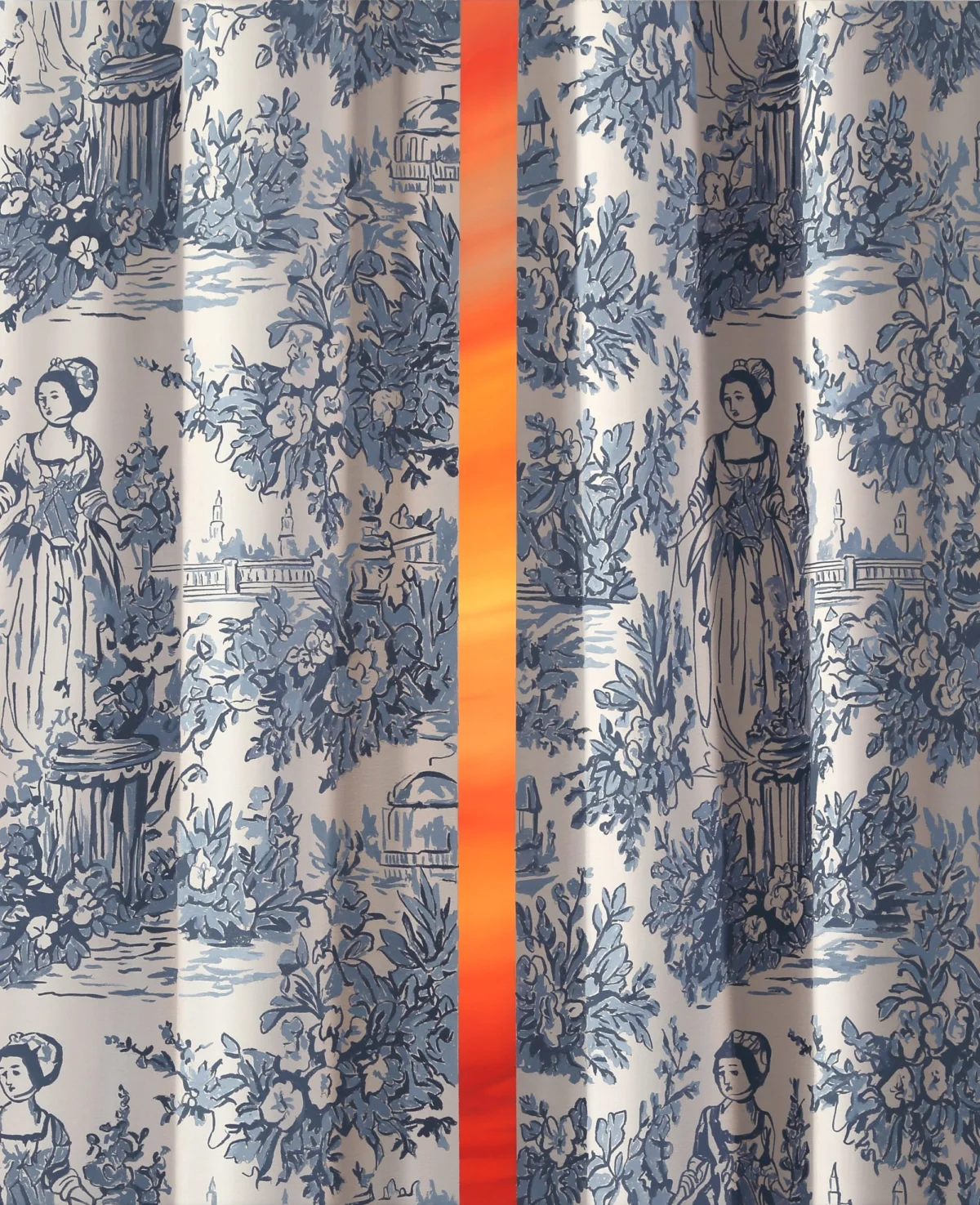
In his latest exhibition, Slow Burn, New Hampshire-based painter Shawn Huckins forces a confrontation with the uncomfortable duality of modern existence: the ability to witness global devastation while remaining physically detached from its epicenter. Through a series of meticulously rendered canvases, Huckins dissects the cognitive dissonance that defines the mid-2020s, blending the domestic comfort of the interior with the encroaching, volatile realities of a world in crisis.
The Main Facts: A Study in Domestic Dissonance
Slow Burn is a masterclass in visual juxtaposition. Each painting features a landscape—often defined by the smoke of a wildfire, the aftermath of an explosion, or the ominous glow of a climate-ravaged horizon—partially obscured by intricately painted curtains. These are not merely decorative elements; they serve as a psychological barrier, a thin, physical manifestation of the "screen" through which we consume global suffering.

Huckins, who has built a career challenging American mythology and the selective erasure of history, here turns his gaze toward the contemporary privilege of spectatorship. By pairing domestic motifs—delicate lace, floral drapery, and classic toile de jouy patterns—with scenes of war and environmental collapse, he underscores the fragility of our perceived safety. The exhibition, hosted at K Contemporary in Denver, serves as a mirror for a generation that watches the world burn while sitting comfortably in the air-conditioned, curated spaces of their own homes.
A Chronological Trajectory of Huckins’ Practice
To understand the weight of Slow Burn, one must look at the trajectory of Huckins’ artistic evolution. His work has never been purely aesthetic; it is deeply rooted in a critique of American identity and the performative nature of class.

- Early Explorations (2015–2018): Huckins initially gained recognition for reinterpreting canonical American artworks, injecting them with contemporary anxieties. His focus during this period was the U.S. proclivity for rewriting its own history, often juxtaposing 19th-century portraiture with the jarring, informal language of digital communication.
- The Study of Class (2019–2022): As his style matured, Huckins turned toward the symbolism of material culture. His "Dirty Laundry" series, for instance, examined how our garments—and the ways we care for them—act as markers of social status and class, revealing the hidden labor and systemic inequalities embedded in the mundane.
- The Current Era (2026): Slow Burn marks a shift from the internal social critique to a global, existential one. The transition from examining the "self" and the "community" to the "spectator" marks a maturation in his career. He is no longer asking, "Who are we?" but rather, "How do we live with what we see?"
Supporting Data: The Anatomy of a Canvas
Huckins’ technique is as significant as his subject matter. By utilizing a combination of oil and acrylic on canvas, he creates a high-fidelity contrast between the rigid, manufactured patterns of the curtains and the chaotic, fluid atmosphere of the disasters beyond.
Technical Composition
The paintings, which range from intimate 32-inch studies to expansive 96-inch vistas, demand a specific type of viewing. In works such as War Cloud and Floral Blue Curtain, the level of detail applied to the fabric suggests an obsession with order and tradition, while the explosion visible in the sliver of space is rendered with a loose, violent brushwork that mirrors the uncontrollable nature of the disaster itself.

Curatorial Context
The exhibition’s presentation at K Contemporary is deliberate. Denver, a city that has seen its fair share of Western wildfires and the encroaching impacts of climate change, provides a poignant backdrop for the collection. The gallery’s layout forces the viewer to navigate the physical space in a way that mimics the act of peeking through a window, further collapsing the distance between the art and the viewer.
Official Responses and Critical Reception
While the exhibition is currently in its nascent stages, early critical reception has focused on the "theatricality" of the work. Art critics have noted that Huckins effectively uses the "curtain" as a metaphor for the media cycle—an item that can be drawn to provide comfort or pulled back to reveal the grim reality of the outside world.

In a recent statement, the curators at K Contemporary noted that the exhibition is designed to be "unsettling rather than comforting." They argue that the power of the work lies in the liminal space—the inches of canvas between the curtain’s edge and the disaster. This, they suggest, is where the modern human currently lives: in the space between action and observation.
The Implications: A Critique of Complacency
The central implication of Slow Burn is a sobering one: our complacency is a form of active participation. By framing disasters—whether the fires of climate change or the bombs of geopolitical conflict—as distant, manageable spectacles, we effectively neutralize their impact on our own moral conscience.

The Death of the Romantic Landscape
Huckins’ work is a direct rebuttal to the 19th-century Hudson River School. Artists like Frederic Edwin Church or Albert Bierstadt painted the American wilderness as a divine, infinite space—a romantic promise of manifest destiny. Huckins, by contrast, suggests that this era of romanticism is dead. In his paintings, there is no "untouched" landscape. The fire, the smoke, and the war are not encroaching on the landscape; they have become the landscape.
The Precariousness of Privilege
The most stinging critique in the collection is the suggestion that our protection is entirely artificial. The lace, the floral prints, and the ornate drapery are symbols of a domestic privilege that is, in reality, paper-thin. As the disasters depicted on canvas inch closer to the foreground, the viewer is forced to confront the reality that the "safety" of the home is a construct that relies entirely on a luck and status that may soon be exhausted.

Conclusion: Looking Through the Veil
Slow Burn is an essential exhibition for a time defined by the constant, flickering light of digital screens. Shawn Huckins does not offer a solution to the crises he depicts, nor does he suggest that simply "pulling back the curtain" will fix the world. Instead, he asks us to acknowledge the act of looking.
As we move through the summer of 2026, the exhibition serves as a haunting reminder that while we may feel safe behind our metaphorical curtains, the fire is burning nonetheless. The exhibition remains open to the public at K Contemporary in Denver until August 22, 2026. For those unable to attend in person, the artist’s ongoing documentation on social media continues to provide a window into his process, though it serves as a stark reminder of the very distance his art seeks to challenge.

In the end, Huckins leaves us with a difficult question: When the curtains are finally torn down, will we have the courage to face the view, or will we simply look for another layer of lace to hide behind? The answer, as suggested by the title of his exhibition, is a process that is already well underway—a slow, inexorable burn that consumes everything in its path, one degree at a time.









No comments yet. Be the first to join the conversation!