Rifan Muazin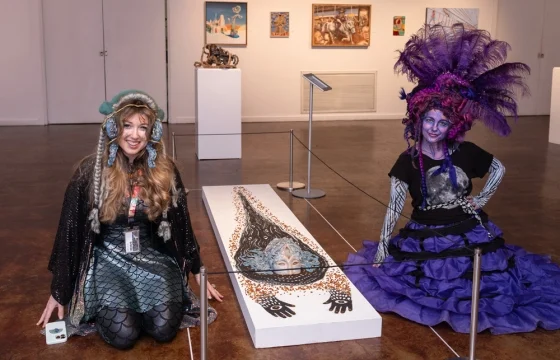
The art world is often defined by the permanent: bronze casts, oil-on-canvas, and climate-controlled archives meant to endure for centuries. Yet, there is a burgeoning movement of artists who find power in the ephemeral—in works designed to decay, shift, or vanish entirely. Among the vanguard of this movement is River Reishi, the recent winner of the coveted "Best in Show" at Surreal Salon 18 in Baton Rouge. Selected by the legendary multidisciplinary artist and juror Caledonia Curry, known globally as Swoon, Reishi’s installation, Surface Tension, stood out in a field of extraordinary talent for its haunting, otherworldly grace.
The Convergence of Water and Thresholds
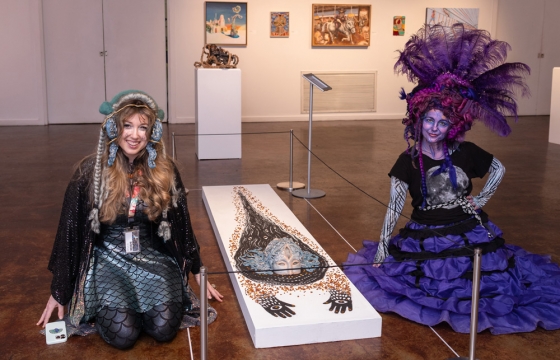
At the heart of Reishi’s winning installation lies Surface Tension, a work that physically and metaphorically captures the boundary between two realities. The sculpture depicts a figure emerging from dark, turbulent waters, hands outstretched as if piercing the veil between the known world and the mysterious, submerged depths below.
“From land, the surface of water looks smooth and transparent, almost empty,” Reishi explains. “But of course, it hides an entire world that is not ours. I have always been fascinated by that threshold. The installation tries to hold that exact moment where the two worlds meet.”
The sculpture is not merely a static object; it is an environment. A subtle, internal glow emanates from the figure, visible only to those who approach the piece with intentionality. It is a quiet, spectral presence that challenges the viewer to slow down. Surrounded by an ephemeral field of hand-drawn black sand and amber, the installation is a study in fragility. Every vibration in the gallery floor—every footfall of a passerby—alters the composition.
“I am interested in that fragility,” Reishi notes. “In works that cannot quite stay fixed.”
A Chronology of the Surreal Salon Experience
Surreal Salon has long served as a pilgrimage site for the pop-surrealist community. For those in the know, it is more than an exhibition; it is a cultural touchstone, often viewed as the unofficial kickoff to the Mardi Gras season. The event is famous for its atmosphere, where the boundary between the art on the walls and the audience in the room dissolves.
The Preparation
For Reishi, this year’s participation marked a significant milestone. While she had followed the salon’s reputation for years, Surreal Salon 18 was the first time she lived within striking distance of the event. She arrived at the gallery with her materials—loose sand, delicate sculptural elements, and a vision for an environment that would interact with the space. Upon entering the gallery, she was struck by the caliber of the work around her. “When I arrived to install the piece and saw the other works for the first time, I remember thinking how haunting and memorable every single one was,” she recalls.
The Award
The announcement of the "Best in Show" prize was, for Reishi, a moment of profound disbelief. To be selected by Swoon—an artist whose work she has admired for over a decade—elevated the win from a professional milestone to a personal triumph. “Hearing the piece announced as Best in Show later that night felt surreal in the truest sense,” she says.
The "Living" Exhibit
One of the most remarkable aspects of the salon is the audience’s commitment to the theme. Reishi witnessed a phenomenon that truly validated her work: attendees designing costumes based on the pieces in the show. “At one point, someone came up to me wearing a costume inspired by my piece,” Reishi recounts. “Getting to watch him model it and explain how the sculpture influenced the design completely made my night. It felt like the work had briefly stepped out of the gallery and into the room.”
The Juror’s Influence: A Legacy of Boldness
The presence of Caledonia Curry (Swoon) as the guest juror provided a thematic anchor for the exhibition. Swoon’s career, characterized by public interventions, massive architectural installations, and a refusal to wait for institutional permission, has profoundly shaped Reishi’s trajectory.
Reishi traces her admiration back to 2009, when Swoon debuted her Swimming Cities of Serenissima project at the Venice Biennale. Watching a fleet of hand-built, sculptural rafts navigate the rigid, elite art world was a revelatory experience.
“That gesture has always stayed with me,” Reishi says. “Not only because of the work itself, but because of the confidence behind it. The willingness to claim space in a world that does not always easily offer it.”
This ethos of "art without permission" resonates with Reishi’s own struggle to find her voice. As a woman in the arts, she observes that the act of creating is an act of defiance. “Voice is an interesting concept to me as a woman, because women often face particular obstacles when it comes to the emergence of voice. It takes a certain measure of audacity to say something and commit it to art.”
Process and Philosophy: The Geometry of Absence
Reishi’s practice is defined by constraints. Early in her career, lacking the luxury of a permanent, large-scale studio, she was forced to innovate. She began creating work that was modular, collapsible, and ephemeral. These practical necessities eventually evolved into a core aesthetic language.
“I am not sure I feel comfortable in any single medium, and I think that is probably a good thing,” she explains. “I tend to move toward whatever material feels necessary for the idea at hand.”
Her preference for sand, light, and organic elements serves a purpose: it prevents the work from becoming a static monument. By forcing the viewer to engage with something that is constantly on the verge of disappearing, Reishi creates a sense of urgency. Her work does not just demand to be seen; it demands to be experienced now.
This philosophy was put to the test during Surreal Salon 18 when a visitor accidentally bumped the platform supporting Surface Tension. The vibration destroyed the intricate patterns she had spent hours hand-drawing into the sand. Rather than a disaster, it became a moment of revelation.
“It suddenly became clear that the entire surface was loose and hand-drawn,” Reishi recalls. “I sat beside the piece and carefully repaired it while people watched. For me, that moment captured the spirit of the work. The installation only existed in that exact form on that particular night.”

Future Horizons: Iceland and the Solar Eclipse
Looking ahead, Reishi is preparing for a project that blends her love for mythology with the raw, elemental beauty of the North. In August, she will head to Reykjavik, Iceland, for an exhibition at Raf Gallery, coinciding with a rare total solar eclipse on August 12.
The project is ambitious: an installation that explores the myth of the birth of Baltic amber, layered with celestial themes of darkness and light. True to her practice, the installation will be communal. The sand, sourced from the local Icelandic shoreline, will be returned to the sea at the end of the exhibition.
“We carry the sand back to the ocean and return it with a wish, prayer, or intention,” she says.
This act of returning material to its source is a hallmark of Reishi’s work. Whether in the galleries of Louisiana or the black volcanic beaches of Iceland, her work serves as a reminder that art is not something we own—it is something we participate in.
Implications for the Contemporary Art Scene
River Reishi’s success at Surreal Salon 18 signals a wider shift in the art world’s appetite. As digital fatigue sets in and audiences grow weary of the hyper-commercialization of art, there is a clear move toward the tactile, the temporary, and the mythic.
By centering her work on the feminine experience, water deities, and the fragility of our environment, Reishi is not just making sculpture; she is constructing a symbolic language that invites the audience to become a part of the narrative. In a world that often feels fractured and permanent, her work provides a necessary, if fleeting, space for reflection.
As she prepares to bring her work to the global stage in Reykjavik, the message remains clear: the power of art does not lie in its durability, but in its ability to haunt us long after it has returned to the elements.


 Pevita Pearce
 Neng Nana