Lina Irawan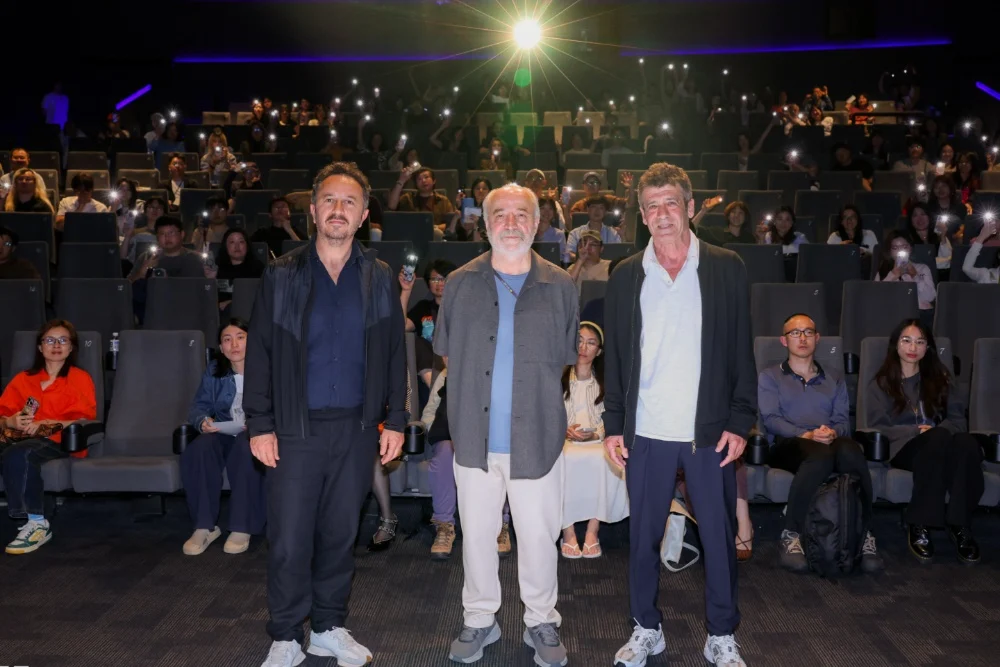
At the 28th Shanghai International Film Festival (SIFF), amidst the glitz of the international cinema circuit, Turkish auteur Reis Çelik has debuted a haunting, monochrome meditation on survival and political trauma. His latest feature, Night of Blindness, a Turkish-German co-production, has emerged as a frontrunner in the festival’s prestigious Golden Goblet main competition, offering a stark, visceral look at the human cost of political instability.
Set against the harrowing backdrop of Turkey’s 1980 military coup—a period defined by mass arrests, ideological fracturing, and the suspension of civil liberties—the film functions as both a historical record and a universal allegory for the loss of human connection.
The Narrative Architecture: A Portrait of Claustrophobic Resilience
Night of Blindness centers on Fatma, a left-wing activist forced to flee the iron-fisted crackdown of the junta. Her sanctuary is as precarious as her political standing: a cramped, dark void between wooden planks at a construction site. In this liminal space, Fatma’s survival hinges entirely on the complicity and quiet courage of a group of laborers—men she has never met and whose allegiances are unknown to her.
By confining his protagonist to such a narrow, sight-restricted environment, Çelik forces the audience into a state of sensory deprivation. The film is shot entirely in black and white, a stylistic choice the director defends as essential for stripping away the "distractions" of modern color cinematography. For Çelik, the absence of color is not merely an aesthetic preference; it is a narrative necessity intended to focus the viewer’s gaze on the "nakedness" of the story and the literal, frantic searching of eyes peering through the wooden slats.
Chronology of the ‘Night’ Trilogy
Night of Blindness represents the second installment in Çelik’s ambitious "Night Trilogy," a project dedicated to exploring the erosion of empathy in the modern age.
- The Foundation (2012): The trilogy began with Night of Silence, a critically acclaimed drama that earned the Crystal Bear at the Berlin International Film Festival. That film established Çelik’s interest in the psychological weight of isolation and the crushing burden of societal expectations.
- The Current Entry (2024): Night of Blindness deepens this investigation, shifting the focus from individual tradition-based trauma to state-sanctioned political erasure.
- The Future (TBA): The director confirmed at the SIFF press conference that a third installment, tentatively titled Sağır Gece (Night of the Deaf), is in active development.
Taken together, the trilogy reflects Çelik’s growing concern that humanity is rapidly approaching a point of terminal alienation, where the ability to see, hear, or understand "the other" has been permanently severed by the noise of ideology and fear.
Artistic Intent: Why the Female Voice Matters
One of the most significant departures in this second chapter of the trilogy is the gender of the protagonist. In a genre traditionally dominated by male perspectives—often centering on the heroics of male revolutionaries or the brutality of male soldiers—Çelik’s choice to center Fatma is intentional and subversive.
"Many countries are no strangers to political oppression, and most similar films feature male protagonists," Çelik noted during the press engagement in Shanghai. "By having a female protagonist, I hope to give voice to women in this genre."
This focus on the female experience serves as a lens through which to view the collateral damage of history. In the cramped, dark spaces of the construction site, Fatma represents the vulnerability of the individual against the monolith of the state, but she also embodies a resilience that is often overlooked in traditional historical narratives.
Official Responses and Cast Perspectives
The Shanghai press conference was marked by the presence of key cast members Iştar Gökseven, who plays the military commander, and Aydin Orak, who portrays an inspector. For the actors, the film’s unique production environment offered a significant challenge.
Gökseven, tasked with portraying the antagonist, spoke to the difficulty of performing within the film’s restricted visual language. "Performing in near-total darkness forced me to rely on voice, posture, and shadow to convey emotion," he remarked. "It was a great gift for an actor to be stripped of the usual tools of expression and forced to rely on the essence of the character."
Both Gökseven and Orak, visiting Shanghai for the first time, expressed deep appreciation for the festival’s atmosphere, highlighting the cross-cultural dialogue that such events foster. Their presence at the festival underlines the international ambitions of the project, which aims to bridge the gap between Turkish historical reality and a global audience.
Sociopolitical Implications: Turkey, China, and the Universal Human Condition
Beyond its narrative merits, Night of Blindness is a bridge-building exercise. Çelik noted that he expects Chinese audiences to find deep resonance in the film, citing a shared worldview regarding history and the complexities of national development.
"Turkey and China have a lot in common in terms of worldview and history," the director explained. He posited that the film serves to illuminate "certain aspects of reality that are being downplayed and ignored." This is the core of Çelik’s directorial mission: to act as a witness to the "blindness" of the present.
The implications of the film are twofold. Firstly, it challenges the audience to recognize the "blind spots" in their own societies—the moments where humanity is sacrificed at the altar of political stability or ideological conformity. Secondly, it serves as a cautionary tale about the dangers of institutional silence. By documenting the 1980 coup through the eyes of someone hidden, Çelik is arguing that history is best understood not through the proclamations of those in power, but through the whispers of those forced into the shadows.
Supporting Data: The 28th SIFF and the Global Stage
The 28th Shanghai International Film Festival, which runs through June 21, serves as the perfect crucible for Night of Blindness. As one of the most influential film festivals in Asia, its platform provides a crucial venue for international co-productions to find a foothold in the massive Chinese market.
The Golden Goblet Award, for which Night of Blindness is currently competing, carries significant weight in the industry, often serving as a barometer for the artistic vitality of international cinema. Given the critical success of Night of Silence and the thematic depth of this second installment, critics are watching closely to see if Çelik will secure a victory that validates his commitment to his "Night" series.
Conclusion: The Clarity of Darkness
Reis Çelik’s Night of Blindness is more than just a period piece; it is a profound exploration of the fragility of truth. In an era where digital saturation and political noise make it harder than ever to see the reality of the human condition, Çelik asks us to sit in the dark and listen.
By stripping away the color, the grandiosity of the military state, and the traditional hero archetypes, he reveals a raw, agonizing, and ultimately necessary portrait of survival. As the film continues its run at SIFF, it stands as a testament to the power of cinema to act as a flashlight in the dark—reminding us that even in the most suffocating circumstances, the human spirit continues to watch, to wait, and to bear witness. Whether the final chapter, Night of the Deaf, will complete this cycle of sensory reclamation remains to be seen, but for now, Night of Blindness commands our full attention.


 Asro
Asro
 Basiran