Jia Lissa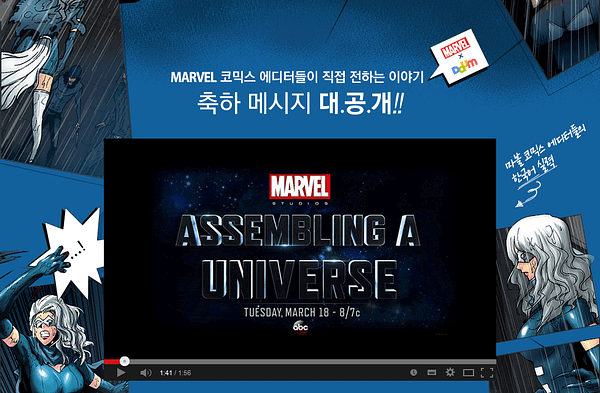
In the ever-evolving landscape of global pop culture, few partnerships have been as fascinating as the convergence of Western superhero mythology and the hyper-stylized digital medium of Korean webtoons. A prime example of this cross-pollination is Avengers: Electric Rain, a unique project that saw the legendary Marvel Universe collide with the aesthetic and delivery systems of South Korea’s burgeoning digital comics scene. Featuring the distinct artistic vision of Younghoon Ko, the series introduced an original character to the Avengers roster, grounded in the vibrant, neon-soaked streets of modern Seoul.
Main Facts: A Bold Cross-Cultural Experiment
Avengers: Electric Rain represents more than just another tie-in comic; it is a landmark project that highlights Marvel’s strategic expansion into international markets. At the heart of the series is a collaboration between Marvel Entertainment, Disney Korea, and Daum—one of South Korea’s most prominent web portal services and a titan in the digital manhwa (Korean comic) industry.

The project centers on a fresh narrative that takes the classic Avengers lineup and transplants them into the heart of South Korea. Unlike traditional serialized American comics, which are typically printed on paper and distributed through direct-market comic shops, Electric Rain was conceived specifically for the webtoon format. This means it features the long-form, vertical-scrolling layout that has become the gold standard for mobile comic reading in Korea, prioritizing dynamic movement and fluid, cinematic pacing.
The primary creative force driving the visual identity of the series is the Korean artist Younghoon Ko. His work on the title is characterized by sharp, high-octane action sequences and a meticulous attention to the architectural and cultural nuances of Seoul. The series also notably introduced an original character, specifically designed to bridge the gap between Marvel’s established global icons and the local flavor of the Korean market.

Chronology: From Concept to Digital Publication
The genesis of Avengers: Electric Rain can be traced back to Marvel’s increasing interest in the late 2000s and early 2010s to localize its properties for international audiences. As the Marvel Cinematic Universe (MCU) began to dominate the global box office, the demand for localized content grew exponentially.
- The Planning Phase: Through a collaboration with Disney Korea, Marvel sought a publisher that could effectively reach the massive Korean digital audience. Daum, with its massive, built-in user base, was the logical partner.
- Creative Selection: The selection of Younghoon Ko was a strategic move to ensure that the series maintained the "manhwa" aesthetic that local readers were accustomed to, while still honoring the character designs established in Western canon.
- Launch and Serialization: Upon its debut, the series was released as a serialized webtoon on the Daum platform. Each installment was designed to be consumed on mobile devices, utilizing the vertical scroll to create a sense of speed and immediacy during fight scenes.
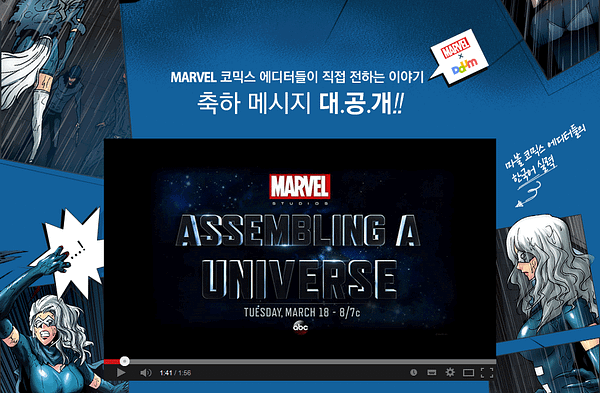
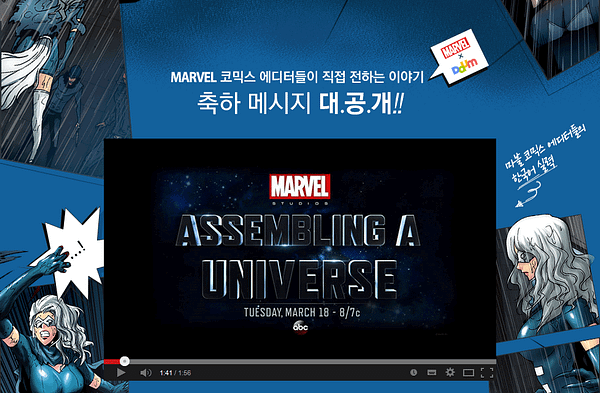
- Promotion and Global Awareness: Marvel utilized its internal infrastructure—including executive commentary and promotional videos—to bridge the gap for Western fans, showcasing the unique collaborative nature of the project.
Supporting Data: The Rise of the Webtoon Format
To understand the significance of Avengers: Electric Rain, one must understand the environment in which it was released. The "Webtoon" format is not merely a digital version of a print comic; it is a distinct storytelling medium.

- Vertical Scrolling: Unlike traditional panel-by-panel reading, webtoons are read by scrolling down. This allows creators to control the pacing of the reader’s eyes, creating dramatic pauses or rapid-fire action sequences that print media cannot replicate.
- Accessibility: By partnering with Daum, Marvel moved away from the "gatekeeper" model of specialty comic shops. Instead, they tapped into a platform where millions of users already visited daily for news, forums, and entertainment.
- Artistic Integration: Data from the period suggests that the hybrid approach—using a local artist like Ko to interpret global icons like Captain America and Iron Man—resulted in a higher engagement rate among Korean readers compared to direct translations of American-printed material. The familiarity of the art style, combined with the prestige of the Marvel brand, created a unique "best of both worlds" scenario.
Official Responses: The Marvel Editorial Perspective
The promotion of Avengers: Electric Rain involved a heavy-hitting contingent of Marvel’s editorial staff, including C.B. Cebulski, Axel Alonso, Tom Brevoort, Ellie Pye, Jordan White, and Nick Lowe. Their public commentary during the project’s launch served to legitimize the venture for Western fans who were largely unfamiliar with the Korean webtoon landscape.
In various promotional segments, the editorial team expressed genuine enthusiasm for the project’s ability to "re-imagine" the Avengers. While the editorial staff—many of whom are native English speakers—often struggled with the nuances of the Korean language during these promotional interviews, their effort highlighted a sincere commitment to the collaboration.

Marvel’s leadership emphasized that Electric Rain was not meant to replace the mainline canon but rather to explore the elasticity of the Avengers brand. They praised Younghoon Ko’s ability to infuse the characters with a kinetic energy that felt distinctly modern. As the editorial team noted, the process of working with a foreign team, dealing with time zones, and navigating a different language was a learning experience that informed how Marvel approached future international projects.
The Role of Younghoon Ko
While the Marvel editors provided the corporate backing, it was the brushwork of Younghoon Ko that defined the project’s soul. Ko’s work is noted for its high-contrast rendering and expressive character designs. In Electric Rain, Ko took the familiar silhouettes of the Avengers and placed them against the backdrop of real-world Korean locations, providing a sense of "boots-on-the-ground" realism that rarely appears in the standard New York-centric Marvel continuity.

His ability to capture the "electric" nature of the combat—often utilizing lightning effects and motion blur—perfectly suited the webtoon format. The fluidity of his panels, which often bled into one another during the scroll, made the action feel relentless. For many readers, Ko’s interpretation of these characters served as a gateway, showing that the Avengers were not tethered to a single city or country, but were truly global figures.
Implications: A Blueprint for the Future
The success of Avengers: Electric Rain carries significant implications for the future of the comic book industry. It demonstrated that established intellectual properties can successfully adapt to different digital delivery methods without losing their identity.

1. The Global Localization Strategy
The project proved that "localization" goes beyond simple translation. It requires an adaptation of the medium itself. By embracing the webtoon format, Marvel gained traction in a market that had previously been difficult to penetrate via traditional print distribution.
2. Diversifying Creative Voices
Electric Rain opened the door for more international artists to take the helm of major franchises. Following this, Marvel and other publishers have become more aggressive in scouting international talent, recognizing that local artists bring a unique perspective that can revitalize long-running series.
3. Digital-First Content
The industry has since seen a massive shift toward "digital-first" content. The lessons learned from Electric Rain—specifically the importance of mobile-optimized formatting—have influenced how major publishers design their own apps and digital reading experiences today.
4. Cultural Exchange
Perhaps the most lasting implication is the cultural exchange facilitated by the project. By placing the Avengers in Korea, the series forced a dialogue between two distinct comic book cultures. It highlighted the shared DNA between the superhero genre and the "action-manhwa" genre, suggesting that the hero’s journey is a universal language, even if the artistic dialect varies from region to region.

Conclusion: The Legacy of Electric Rain
Avengers: Electric Rain remains a touchstone for those interested in the globalization of the comic book medium. It was a project that required patience, cross-cultural communication, and a willingness to step outside the traditional "Marvel House Style." While it may have been a singular experiment at the time, its impact continues to resonate.
By trusting Younghoon Ko to handle the Avengers, Marvel did more than just publish a comic; they acknowledged that their characters belong to the world. The project serves as a reminder that the digital age has effectively demolished geographical barriers for creators. Whether through the vertical scroll of a smartphone in Seoul or the printed page in London, the core appeal of the Avengers—the struggle of the extraordinary against the impossible—remains unchanged. As the industry continues to move toward a more digital, globalized future, the lessons provided by Electric Rain will undoubtedly continue to guide the way for the next generation of storytellers.

 Nana
Nana
 Iffa Jayyana