Nana Muazin
The second episode of AMC’s The Vampire Lestat does more than simply advance the plot; it serves as a masterclass in narrative manipulation. By placing the audience inside the head of a protagonist who views truth as a fluid, malleable commodity, the series forces viewers to question every frame of what they are seeing. From the sterile, gray monotony of a touring rock band’s life on the road to the haunting, dream-like sequences of Lestat’s childhood in the French countryside, this episode establishes a clear mandate: nothing is objective, and everything is a performance.
The Mechanics of Memory: Lestat as Editor
To review an episode of this caliber, one must move beyond a casual first viewing. While a standard critique involves note-taking, The Vampire Lestat demands a level of forensic analysis that necessitates re-watching with captions engaged. The density of the storytelling—where every blink, wardrobe choice, and shift in lighting serves a narrative purpose—is overwhelming.

Lestat de Lioncourt is not merely a vampire; he is an auteur. By framing his story through the medium of 111 vinyl albums, he attempts to create an uneditable, immutable historical record. Unlike Louis de Pointe du Lac, who allowed others to contribute to his narrative, Lestat is crafting a singular vision. He is the director, the editor, and the sole arbiter of truth. When he recounts his childhood, he does so with a repetitive, ritualistic trauma, painting his family as "the cabbages"—dull, boorish, and cruel—while positioning his mother, Gabriella, as the only light in his darkness. Yet, one must ask: is this the truth, or is this the version of the past Lestat needs us to believe?
A Chronology of Control
The episode’s timeline weaves between the present-day tour and the deeply personal, often grotesque, memories of Lestat’s mortal life.

- The Gray Road: The episode opens on the reality of a touring band—endless highways, cramped spaces, and the mundane exhaustion that even a vampire cannot escape. This serves as a grounding mechanism, contrasting the supernatural stakes of the show with the tedious reality of human logistics.
- The Childhood Dreams: We are treated to a recurring, nightmare-laden exploration of Lestat’s upbringing. The setting is less the gothic, dark aesthetic one might expect, and more a cycle of domestic abuse, stutter-shaming, and psychological manipulation.
- The Wolf Killings: Lestat glosses over the pivotal moment of his youth—the slaughter of the wolves—with a dismissive speed. This deliberate omission is telling. It suggests that while the legend of the wolf-killer is central to his public identity, the actual event is secondary to the relationship he wants to highlight: his bond with his mother.
- The Dinner Party of Puppets: The episode’s climax is an elaborate, imagined dinner scene where Lestat brings together key figures from his life, including Louis and Daniel Molloy. Here, Lestat admits to his own artifice, claiming the right to "speak for" the tertiary figures in his life.
Supporting Data: The Power Dynamics of the Tour
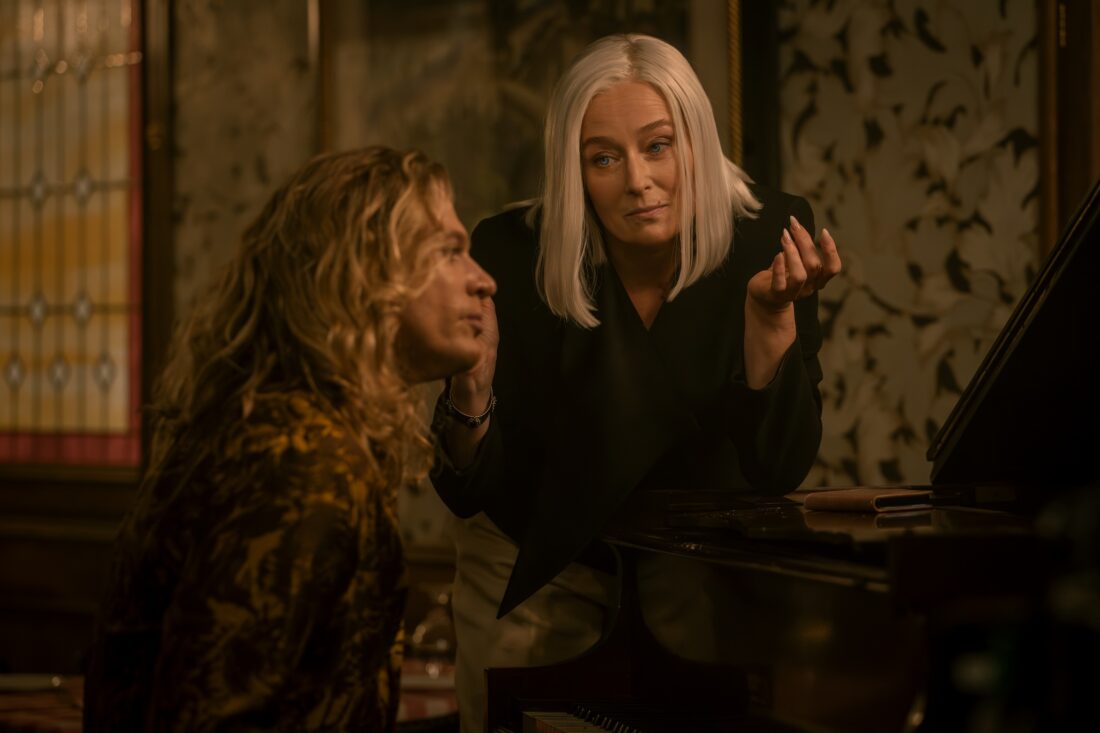
The tension within the band provides a fascinating microcosm of the broader power struggle. When the bandmates—Alex, Larry, Salamander, and TC—finally confront the reality of Lestat’s vampiric nature, their reactions are as varied as they are grounded. Alex is primarily concerned with the "cannibalism" aspect, while Larry is possessive over the band’s ownership.
Lestat’s interactions here are telling; he is at his most physically and emotionally "unlocked" when he is honest about his nature, yet he remains a master of evasion. He hides behind vague references to the "blood of Akasha," knowing full well that his human companions lack the context to understand the magnitude of that claim. His clothing choices throughout these scenes are equally telling: he wears layers and sunglasses when dealing with Louis, as if he is protecting himself from the man who stripped away his narrative control. In contrast, he is half-naked and relaxed among his bandmates, emphasizing his dominance and his role as the orchestrator of their reality.
Official Perspectives: The Role of the Talamasca
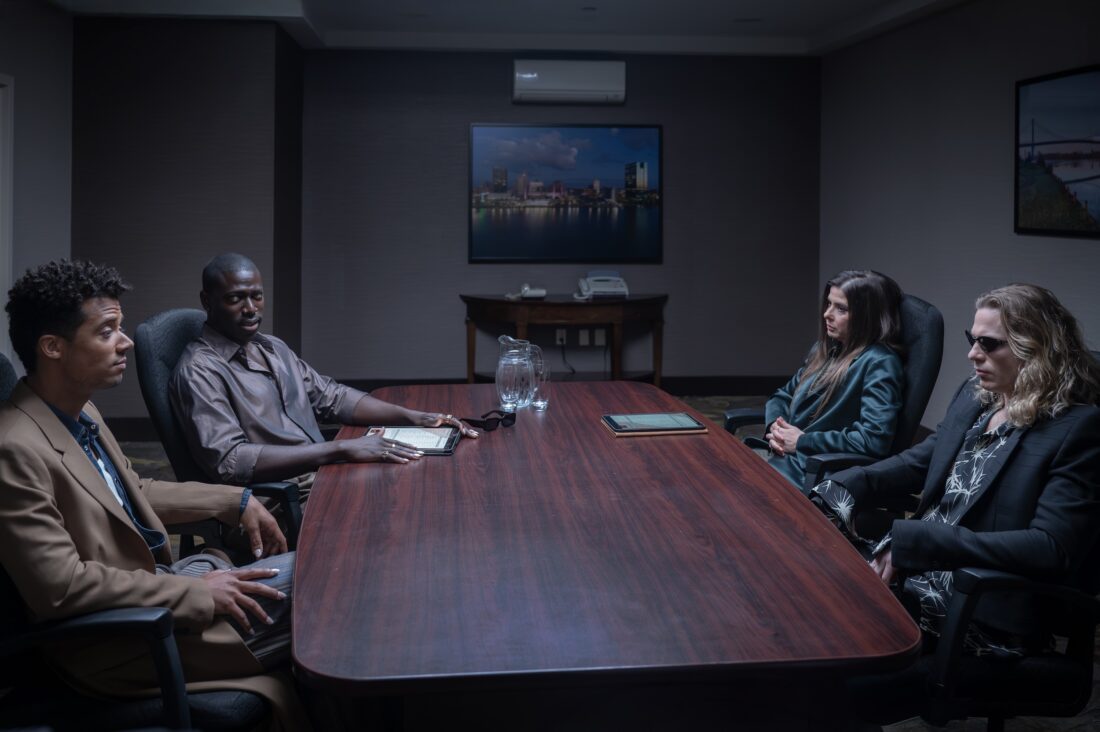
A significant shift in the episode is the introduction of external, non-vampiric perspectives—specifically the Talamasca. Through the character of Raglan James, portrayed with delightful menace by Justin Kirk, we receive the first concrete intel on the fallout of Season Two.
The revelation that the Talamasca views Louis as the ideal candidate to neutralize the "Fang Gang"—a fentanyl-distributing, violent coven—recontextualizes Louis. He is not just the "sensitive" vampire; he is an apex predator tasked with a clean-up mission. The personal stakes are heightened by the inclusion of Bruce, the antagonist who left a permanent mark on the history of these characters. This confirms that the "world outside the bus" is not only growing more dangerous but that the Talamasca is actively maneuvering the vampires against one another.
Implications: The Great Conversion and the Crumbling World
The casual references to the "Great Conversion" and the exponential growth of the vampire population suggest that the series is building toward a catastrophic societal event. While Lestat focuses on his music, his mother, and his petty squabbles with Louis, the world is shifting under his feet.
The implications of this episode are twofold:

- Narrative Instability: The audience can no longer trust the visual information provided. If Lestat can manifest a dinner party with people who aren’t there, and if he can "puppet" their dialogue, the entire season becomes a subjective experience.
- The Price of Truth: Louis’s own version of events, which Lestat views as a betrayal, has become a source of massive wealth for Louis—real estate, merchandise, and media control. The conflict is no longer just romantic or personal; it is an economic and ideological war over who gets to define the history of the vampires.
As we move deeper into the season, the question remains: does it matter if Lestat’s story is true? He is clearly crafting a mythos that serves his own ego and his desperate need for relevance. The "cabbage" brothers, the manipulative mother, and the trolling ex-lover are all pieces of a larger, grander puzzle. By the time the final note of the tour is played, it is clear that Lestat is not just playing for the audience in the arena; he is playing for the ears of history itself. Whether he succeeds in convincing us—or himself—remains the most compelling mystery of the series.

 Layla Zulfa
 Ali Ikhwan