Asep Darmawan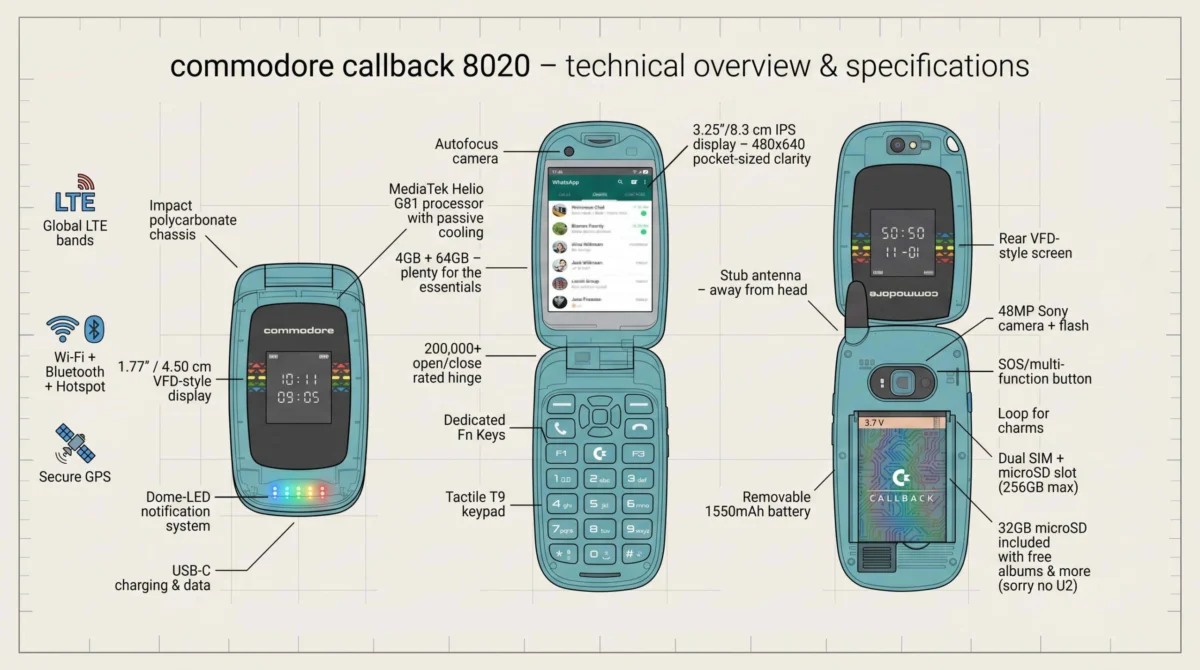
In an era defined by the "glass slab" hegemony—where the average smartphone is an endless feed of algorithmic stimuli and persistent notification loops—Commodore is making a bold, nostalgic, and arguably necessary play to reclaim our attention. The tech giant, a name synonymous with the dawn of home computing, has officially unveiled the Callback 8020, a modern flip phone designed to bridge the gap between high-utility functionality and the digital minimalism movement.
By blending the tactile satisfaction of a clamshell device with a sophisticated, Linux-based operating system, the Callback 8020 isn’t just another retro gimmick. It is a calculated intervention in the way we interact with our technology.
Main Facts: A New Philosophy of Connectivity
The Commodore Callback 8020 is built on a custom iteration of Sailfish OS, a platform developed in collaboration with Jolla. This choice of operating system is critical; it bypasses the data-harvesting ecosystems of mainstream mobile giants, offering a privacy-first approach that does not require mandatory account sign-ins.
Perhaps the most impressive technical achievement is the phone’s ability to bridge the gap between "dumb" and "smart." While the device is physically limited to a clamshell form factor, its Linux-based kernel supports approximately 99% of Android applications. However, there is a catch: the phone’s interface is intentionally curated. Commodore has implemented a hard-coded "digital perimeter," blocking social media feeds, web browsers, email clients, and professional work-chat applications.
The device functions as a tool, not a time sink. Users retain access to critical utility software—maps, rideshare, music streaming, podcasts, QR scanners, and calendar management—without the siren call of endless scrolling. Supplementing this is a high-performance 48MP Sony rear camera, proving that the phone is designed for the creator, not the consumer.
Chronology: The Path to the Callback 8020
The road to the Callback 8020 began in the quiet corners of the tech industry where developers and designers started questioning the sustainability of the modern smartphone lifecycle.
- Q1 2025: Initial concepts for a "minimalist communicator" were drafted within the Commodore design lab, focusing on the mechanical satisfaction of a hinge.
- Q4 2025: Commodore entered a formal partnership with Jolla to adapt Sailfish OS for the specific hardware constraints of a clamshell device.
- May 2026: Leaked renders of the Callback 8020 began circulating, showcasing its distinct aesthetic—a nod to the beige-and-grey hardware of the 80s, reimagined with modern materials.
- June 2026: Official unveiling of the device, accompanied by the announcement of the June 30th preorder window.
- June 30, 2026 (10:00 CEST): The scheduled opening of global preorders, with a starting price of $499.
Supporting Data: Performance Meets Constraint
To understand why the Callback 8020 is a viable contender in a market dominated by flagship powerhouses, one must look at its design philosophy.

The Anatomy of the Hinge
The "rhythm" of the device is dictated by the physical act of opening and closing. Unlike a smartphone, which is always "on" and always "present," the Callback 8020 introduces a natural break in the user experience. You open the device to perform a task—navigating to a destination, checking a calendar event, or snapping a photo—and then you close it. That physical "click" serves as a psychological cue that the task is complete.
T9 and the Return of Intent
The inclusion of T9-style texting is not merely a design choice; it is an accessibility and psychological feature. By slowing down the input process, the device forces the user to be more intentional with their communication. The user is no longer a rapid-fire responder to digital demands; they are a deliberate architect of their messages.
The Notification Ecosystem
The Callback 8020 utilizes an external status display for at-a-glance information, such as time, battery life, and cellular signal. For alerts, it features custom dome LED notifications. This means the user is no longer bombarded by a screen full of icons every time a notification arrives. They receive a discrete visual cue, leaving the decision to "check the phone" entirely in their hands.
Official Responses and Strategic Vision
In press materials accompanying the launch, Commodore’s leadership emphasized that the Callback 8020 is a response to the "Attention Economy."
"We are not competing with the 6.7-inch screens that dominate the market," a spokesperson noted. "We are competing for the user’s peace of mind."
The decision to lean into the Linux-based Sailfish OS was born out of a desire for autonomy. By removing the need for deep integration with Google or Apple ecosystems, the Callback 8020 offers a degree of privacy that is becoming increasingly rare. Commodore’s commitment to this is clear: the device is not designed to monetize the user’s behavior. While the company acknowledges that app compatibility may fluctuate depending on regional services and network providers, they have prioritized an "open-tool" philosophy, allowing users to sideload essential applications through Linux-native environments.
Implications: The Future of Digital Wellness
The release of the Commodore Callback 8020 carries significant weight for the mobile industry. It signals that a segment of the consumer base is reaching a "saturation point" with traditional smartphones.

The Economic Shift
At $499, the Callback 8020 is positioned as a premium mid-range device. It is not an entry-level feature phone, nor is it a $1,500 foldable flagship. By occupying this middle ground, Commodore is testing the waters to see if consumers are willing to pay a premium for less functionality. If successful, this could spark a trend among major manufacturers to offer "Zen Modes" or "Lite Versions" of their existing hardware.
The Sociological Impact
We are entering a phase of "Digital Minimalism." For years, the industry pushed for more—more RAM, more cameras, more screen real estate. The Callback 8020 represents a pivot toward "Better." If the device finds an audience, it could lead to a cultural shift where being "offline" while on the move becomes a status symbol rather than a social failure.
The Hurdles Ahead
Despite the optimism, there are clear challenges. The modern world is built on the assumption that everyone has a full-featured browser and a suite of social apps in their pocket. Using the Callback 8020 requires a lifestyle adjustment. Users must be willing to verify that their "must-have" apps are compatible with the Linux-based environment. Furthermore, because some of the hardware and software specifications are currently in the pre-production stage, early adopters will have to navigate the inevitable "first-batch" quirks that come with a non-traditional operating system.
Final Thoughts
The Commodore Callback 8020 is a nostalgic throwback to the aesthetic of the 1980s, but it is firmly rooted in the anxieties of the 2020s. It serves as a reminder that we are the masters of our technology, not the other way around.
By stripping away the algorithmic feeds and the constant demand for our attention, Commodore has created a device that prioritizes the user’s focus over the manufacturer’s data requirements. Whether this will successfully disrupt the current smartphone landscape remains to be seen, but for those who find themselves checking their screens with growing exhaustion, the Callback 8020 offers a much-needed path of exit.
As the preorder date of June 30 approaches, the industry will be watching closely. If the Callback 8020 sells out, it will send a clear message to the tech world: people are ready to stop scrolling, and they are ready to start living again.


 Azzam Bilal Chamdy
 Layla Zulfa