Azzam Bilal Chamdy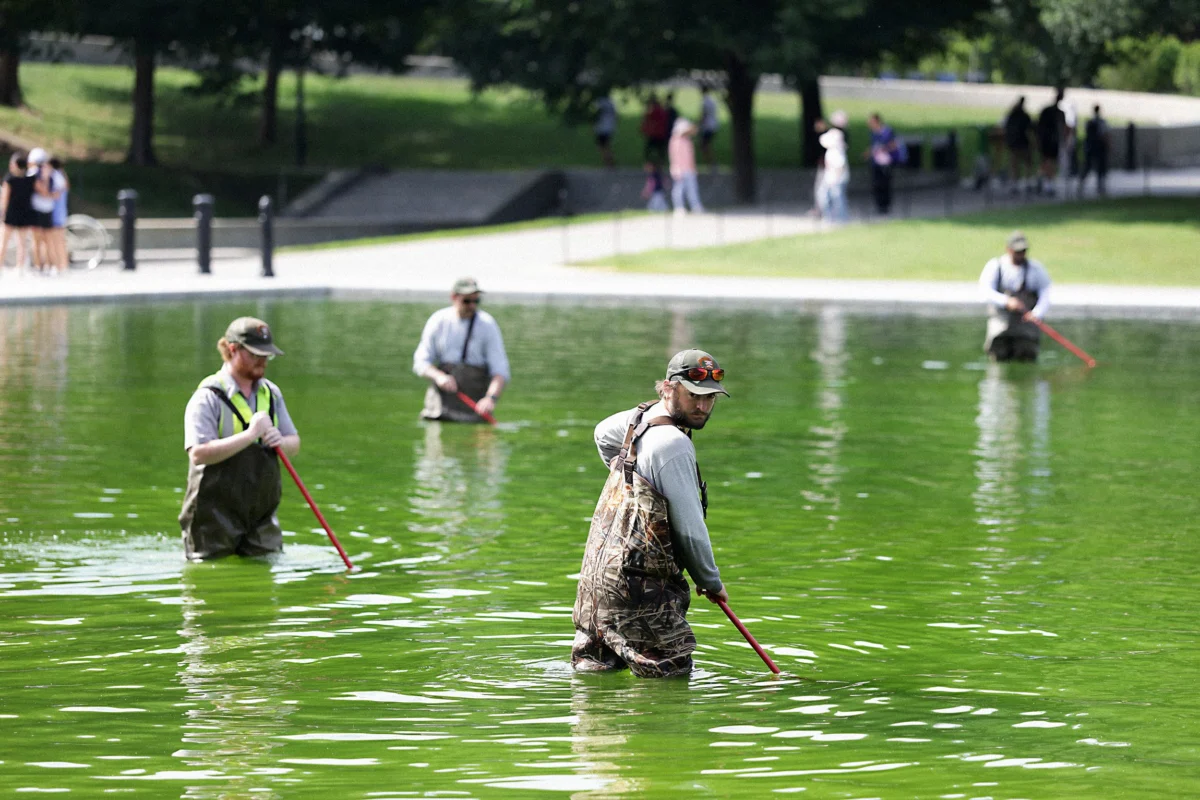
The iconic waters of the Lincoln Memorial Reflecting Pool, designed to offer a serene and majestic mirror to the nation’s capital, have become the center of a public relations and environmental headache for the Trump administration. As the United States approaches its 250th anniversary—a milestone for which the White House has promised a spectacle of historic proportions—the pool has turned a vibrant, opaque green, choked by an aggressive algae bloom that has defied initial containment efforts.
On Wednesday morning, federal workers were seen pouring hydrogen peroxide into the basin, the latest in a series of desperate tactical maneuvers intended to restore the water to the specific shade of “American flag blue” promised by the administration. This chemical intervention highlights a growing friction between the political aesthetic goals of the current presidency and the unforgiving reality of local climate factors and infrastructure limitations.
A Legacy of Expense and Political Rhetoric
The current crisis follows a $14 million renovation project spearheaded by the Trump administration. The contract, awarded on a no-bid basis, was granted to a firm with no prior experience in federal government projects, though it has maintained a long-standing business relationship with President Trump’s private golf course developments.
The administration’s public framing of this project has been contentious. President Trump has frequently asserted that his intervention was a necessary corrective to the alleged neglect of the Obama and Biden administrations. However, these claims have been frequently fact-checked; records indicate that the Obama administration oversaw a $34 million, two-year comprehensive renovation in the early 2010s, while the Biden administration did not authorize major structural changes. President Trump has gone as far as using AI-generated imagery in public forums to depict the pool in a state of decay under previous leadership, a move that has drawn sharp criticism from historical preservationists and political opponents alike.
Chronology of the Bloom
The timeline of the current failure is as swift as it is embarrassing for the Interior Department. The newly renovated pool was unveiled to the public with great fanfare just last week. Yet, within less than 24 hours of the official reopening, observers noted the water beginning to cloud.
- Pre-Launch: The supply lines for the pool sat dormant for eight weeks prior to the unveiling, a period during which stagnant water likely created a breeding ground for biological growth.
- Opening Week: Within one day of the system being activated, the characteristic bright green tint of an algae bloom became visible across the surface.
- Initial Response: The Interior Department initially attributed the bloom to "residual algae" lingering in the dormant supply pipes.
- Current Phase: By mid-week, the "residual" excuse gave way to active chemical treatment, with the introduction of hydrogen peroxide and the deployment of experimental nanobubble ozone technology.
Environmental Factors and the Climate Connection
While the administration seeks to address the issue through technical fixes, experts suggest the pool is suffering from a "perfect storm" of environmental pressures. Hans Paerl, a former professor at the University of North Carolina’s Institute of Marine Sciences, notes that the Reflecting Pool is highly susceptible to the same forces affecting reservoirs globally.
"Lakes and reservoirs around the world are currently battling similar outbreaks," Paerl explains. The combination of stagnant water—which prevents the oxygenation necessary to suppress certain algae species—and record-high temperatures creates an ideal environment for rapid proliferation. As Washington, DC, prepares for a weekend of higher-than-normal temperatures, the efficacy of current treatments is being pushed to the limit.
Furthermore, there is a broader context that the administration has been reluctant to address: climate change. Paerl points out that the global expansion of toxic algae blooms is not merely a seasonal fluke but a trend driven by rising average temperatures. "It’s clearly a temperature effect allowing them to optimize their growth," he says. The warming climate is effectively pushing these biological phenomena into higher latitudes, making the management of public water features like the Reflecting Pool increasingly complex and costly.
The Infrastructure Dilemma
A significant, yet under-discussed, factor in the recurring nature of the algae problem is the water source itself. The pool traditionally draws water from the Tidal Basin, a body of water notoriously prone to algae growth due to its own environmental conditions.
During peak bloom periods, the facility is designed to switch to municipal drinking water, which is filtered and treated. However, the Interior Department has remained tight-lipped regarding the current source of the water feeding the pool. Observers speculate that if the pool is still drawing from the Tidal Basin, the current chemical treatments may be fighting a losing battle against a constant influx of new spores.
Official Responses and Administrative Priorities
The Interior Department’s stance has been a mixture of technical defense and sharp partisan finger-pointing. An agency spokesperson, in an email to WIRED, emphasized that the current administration is utilizing state-of-the-art "nanobubble ozone technology" to rectify the situation.
Simultaneously, the department has doubled down on its criticism of previous administrations. In a statement provided to the press, a spokesperson claimed that the Obama-era renovations resulted in "massive algae clumps taking over the pool’s surface following years of construction that cost taxpayers millions upon millions only to be broken and disgusting days later."
This rhetoric suggests that the pool is not merely a site of maintenance, but a battlefield for the administration’s narrative of competence versus the "neglect" of its predecessors. Despite the complexity of issues such as the ongoing negotiations with Anthropic regarding Fable 5 or the administration’s delicate geopolitical balancing act with Iran, the President remains personally invested in the visual state of the Reflecting Pool.
Implications for the 250th Anniversary
With the nation’s 250th anniversary celebrations now less than two weeks away, the clock is ticking. The Reflecting Pool is intended to be a centerpiece of the festivities, a mirror for the historic monuments that define the American capital.
If the current cocktail of hydrogen peroxide and nanobubbles fails to clear the water, the administration faces a difficult choice: accept a green pool as a backdrop for the anniversary, or authorize further, potentially more drastic—and expensive—interventions. The situation serves as a microcosm for the intersection of modern governance, environmental reality, and political theater.
The ongoing saga also raises questions regarding the long-term stewardship of the National Mall. When infrastructure is treated as a political prop, there is a risk that the underlying technical requirements—such as consistent water source management, long-term environmental sustainability, and transparent contracting—are sacrificed for the sake of immediate visual impact.
As the heat rises in Washington, both the literal temperature and the political pressure surrounding the Reflecting Pool will continue to climb. Whether the pool achieves the desired "American flag blue" remains an open question, but the episode has already served as a stark reminder that even the most high-tech interventions are often no match for the fundamental, climate-driven processes of the natural world.


 Jia Lissa
 Ammar Sabilarrohman