Nana Muazin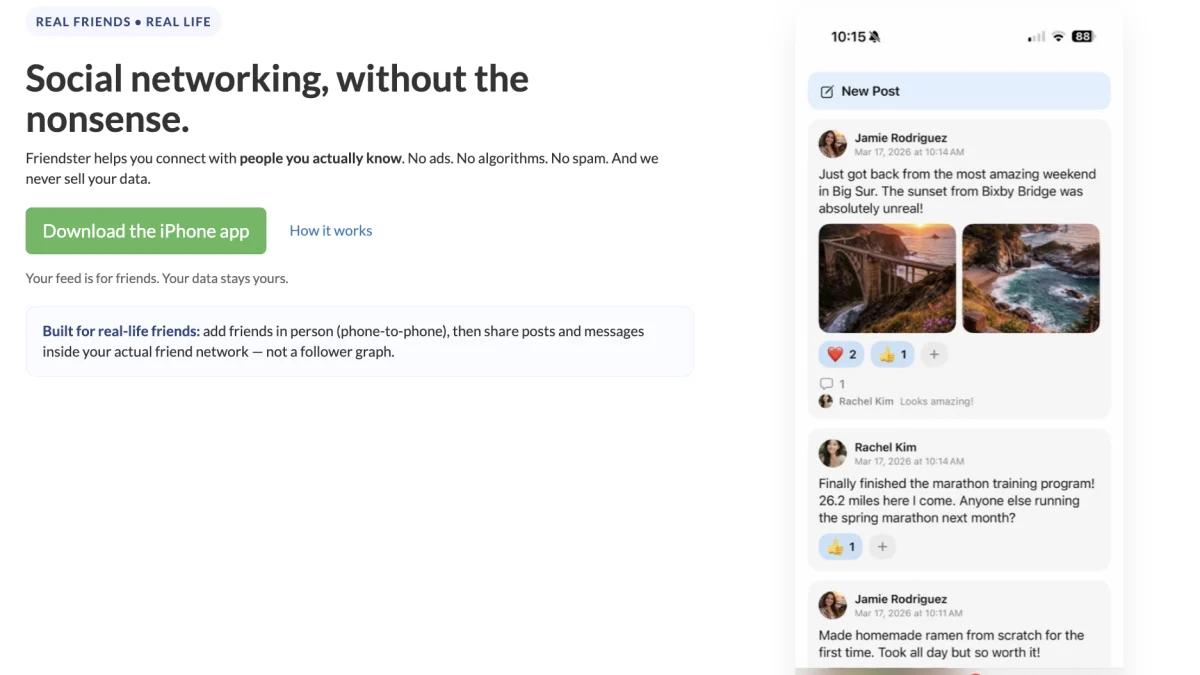
Do you remember the early days of the internet, before the infinite scroll, the algorithmic echo chambers, and the frantic chase for viral engagement? Before the giants of modern social media commodified our attention, there was Friendster. It was the digital frontier, the original pioneer that laid the groundwork for our modern connected lives. Now, nearly a quarter-century after its inception, the name is back—but it is no longer the platform you remember.
In a bold, if not counterintuitive, attempt to reclaim the essence of social networking, entrepreneur Mike Carson has relaunched Friendster. However, this iteration is defined not by what it includes, but by what it intentionally omits. There are no feeds, no advertisements, no influencers, and, perhaps most strikingly, no algorithms. In a world saturated with digital noise, the new Friendster is betting on a singular, physical premise: that the only meaningful connections are those forged in the real world.
The Evolution of a Digital Pioneer: A Chronology
To understand the audacity of this relaunch, one must first look at the meteoric rise and complicated fall of the original platform.
The Dawn of Social Networking (2002–2004)
Launched in March 2002 by Jonathan Abrams, Friendster was a cultural phenomenon. It was arguably the first major online social network to achieve mass-market appeal. It provided a digital directory for real-world social circles, allowing users to map their relationships in a way that had never been seen before. At its peak, it was the talk of Silicon Valley, famously rejecting a $30 million acquisition offer from Google in 2003—a move often cited as one of the greatest missed opportunities in tech history.
The MySpace Era and the Shift to Asia (2005–2011)
As Friendster struggled with technical infrastructure—specifically slow load times and database issues—competitors like MySpace surged, offering more customization and a more robust user experience. Friendster’s influence waned in the United States, but it found a second life as a powerhouse in Southeast Asia. For several years, it remained a dominant force in regions like the Philippines, Malaysia, and Singapore. By 2011, however, the platform pivoted away from its social roots, attempting to reinvent itself as a social gaming portal.
The Dark Years and Final Shutdown (2015)
The gaming pivot failed to stem the tide of competing platforms. In 2015, the service was shuttered entirely, and the iconic domain became a ghost of its former self, eventually falling into the hands of speculative domain investors. For years, the domain served as a repository for intrusive pop-up ads and low-quality affiliate links—a tragic end for a pioneer of the digital age.
The Acquisition: From $7,456 to a Bitcoin Deal
The story of the new Friendster began in 2023, when Mike Carson noticed that the URL, once synonymous with early 2000s internet culture, was being squandered. Upon investigation, he discovered the domain had been purchased at an expired domain auction for just $7,456.
Carson reached out to the owner, sparking a negotiation that would eventually see the asset change hands. The final deal was complex: Carson secured Friendster.com for $20,000 in Bitcoin, combined with the trade of another high-traffic domain he owned that generated $9,000 in annual revenue. It was a high-stakes bet on the value of brand nostalgia and a vision for a "clean" internet.
The Mechanism of Connection: Physicality as the New Algorithm
The most radical aspect of the new Friendster is its refusal to facilitate "virtual" connections. When a user downloads the iOS app, they are met with a startling void. There is no feed, no "suggested friends" list, and no search bar to find acquaintances.
The platform’s core mechanic is built on physical proximity. To add someone to your network, both users must be physically present and tap their phones together while the app is open. This "handshake" protocol is the only way to establish a connection. The design philosophy is clear: if you haven’t shared a physical space with someone, the app does not recognize the validity of the connection.
"The new Friendster is built for users to strictly follow people they know in real life," Carson explains. By removing the ability to add friends remotely, the app forces a return to authentic, in-person socialization.
Implications for the Future of Social Media
The "Empty App" Problem
The most significant hurdle for this project is the "cold start" problem. A social network is only as valuable as the people on it. Because the app is intentionally barren upon installation, the user experience can feel daunting or even non-existent for those who don’t immediately coordinate with friends to join the platform. It requires a high level of intentionality from its user base, a departure from the passive consumption models of TikTok or Instagram.
Planned Features and Ethical Nudges
Carson has outlined a roadmap that suggests a desire to bridge the gap between pure physical interaction and digital maintenance. Two features currently in development highlight his vision for the future:
- Friends of Friends: This feature will allow users to connect online if they share a common, verified physical connection. It acts as a bridge for the "friend-of-a-friend" social dynamic that dominated the original Friendster, while maintaining a tether to real-world authenticity.
- Fading Connection: Perhaps the most provocative addition, this feature acts as a "nudge" system. If a user hasn’t been in the same room as a connection for more than a year, the app will prompt them. As Carson notes, "It’s not a punishment—a gentle nudge that real friendships are kept alive in person, not online."
Analysis: Can Nostalgia Combat the Algorithm?
The relaunch of Friendster is, at its heart, an anti-social media experiment. By stripping away the dopamine loops—the likes, the comments, the infinite scroll—Carson is attempting to sanitize the digital experience.
However, the implications of this model are twofold. On one hand, it addresses the widespread "digital fatigue" caused by modern platforms that prioritize engagement at the cost of mental health. On the other hand, it challenges the fundamental utility of the internet as a tool for global, borderless connection. By restricting the app to physical proximity, Friendster is arguably limiting the very thing the internet was designed to expand.
Whether this model can scale remains to be seen. Historically, platforms that prioritize privacy and "slow" interaction have struggled to compete with the high-speed, hyper-connected giants of Silicon Valley. Yet, in an era where trust in traditional social media is at an all-time low, a return to the basics—to the people we can actually reach out and touch—might be exactly what a segment of the population is craving.
Conclusion: A Digital Laboratory
The new Friendster is not just a revival of a brand; it is a laboratory for social behavior. It asks a fundamental question: Do we actually want "social" media, or do we want a tool that facilitates real-world intimacy?
If the app succeeds, it will be because it successfully leveraged the power of "real-life" exclusivity. If it fails, it will serve as a reminder that the internet’s greatest strength is its ability to shrink the globe, and that forcing the digital world to mimic the physical one may be a hurdle too high for the average user. For now, the app remains a blank canvas—a quiet, empty space waiting for a community that is willing to put their phones together and reconnect, one physical tap at a time.

 Laily UPN
 Ammar Sabilarrohman