


In the hyper-competitive landscape of web browsers, speed is the ultimate currency. This week, Google provided a compelling look into the engineering efforts driving the Chromium project, announcing that its Chrome browser has achieved unprecedented performance benchmarks. By leveraging the raw power of Apple’s latest M5 MacBook Pro and the sophisticated architecture of macOS 26.0.1, Google has set new industry standards for web responsiveness and processing efficiency.
The Core Achievement: Redefining Browser Speed
Google’s latest update to the Chromium blog outlines a significant leap in browser capabilities. The results center on two critical industry-standard benchmarks: Speedometer 3.1 and JetStream 3.0. These tests are not merely synthetic exercises; they represent a rigorous evaluation of how a browser handles the complex, data-heavy demands of modern web applications.
On the M5 MacBook Pro, Chrome recorded a score of 61 on the Speedometer 3.1 benchmark—a 5% increase compared to performance metrics captured just one year ago. Simultaneously, in the JetStream 3 benchmark, Chrome achieved a score of 469 points, marking a substantial 10% improvement over testing conducted at the beginning of this year. These gains, while seemingly incremental in isolation, represent a cumulative advancement in how browsers manage JavaScript, WebAssembly, and pixel rendering.
A Chronology of Optimization
The trajectory of Chrome’s performance on macOS has been one of consistent, iterative improvement. Understanding how we arrived at these record-breaking figures requires looking back at the foundation established in mid-2025.
The Foundation: June 2025
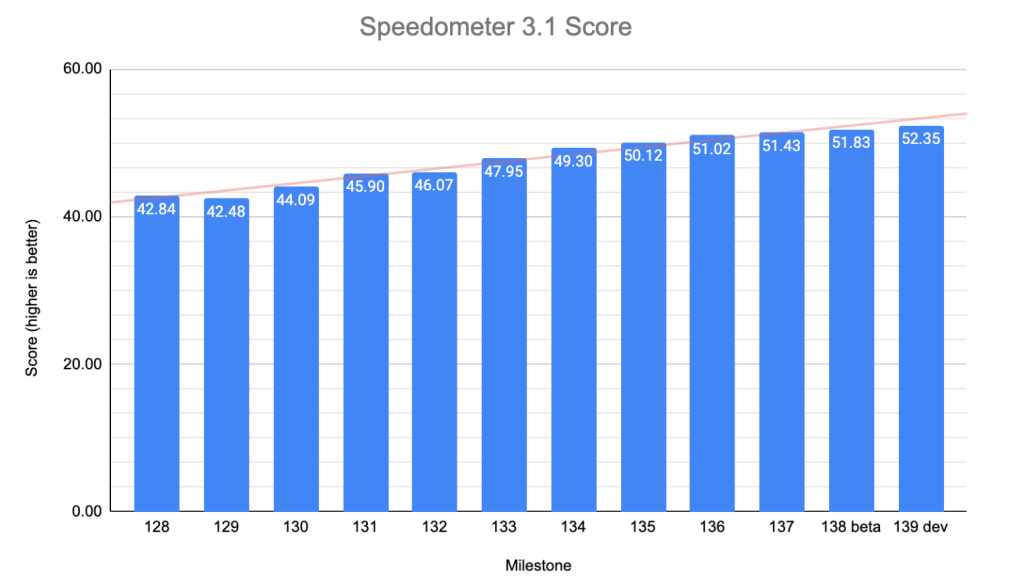
In June of last year, Google’s engineering team published a performance report detailing the progress made from Chrome 128 through the then-experimental Chrome 139 dev builds. These tests, performed on the M4 MacBook Pro running macOS 15, demonstrated that Google was successfully optimizing the Blink rendering engine to better communicate with Apple Silicon.

The Evolution: Early 2026
By the first quarter of 2026, the focus shifted from general rendering to specialized execution. As complex web applications began to rely more heavily on WebAssembly, Google intensified its efforts to optimize its JavaScript execution engine, V8. The improvements noted in the early months of 2026 provided the baseline for the 10% jump in JetStream 3 performance reported this week.
The Current State: Mid-2026
Today, with the M5 MacBook Pro and macOS 26.0.1, Google has reached a new zenith. The synergy between the hardware-level advancements of the M5 chip—which boasts superior neural processing and memory bandwidth—and the refined software architecture of Chrome has allowed the browser to hit its highest performance markers to date.
Supporting Data: Understanding the Benchmarks
To appreciate the significance of these scores, one must understand what is actually being measured. Google’s Chromium team emphasizes that these benchmarks are the result of open, cross-industry collaboration.
Speedometer 3.1: The Metric of Responsiveness
Speedometer 3.1 is designed to simulate real-world user interactions. It measures how quickly a browser can execute tasks like adding items to a to-do list, navigating complex DOM structures, and handling heavy JavaScript frameworks. According to Google, the benchmark covers a vast array of areas within the Blink rendering engine, including:
- HTML Parsing: The speed at which the browser translates raw code into a functional visual structure.
- JavaScript and JSON Processing: The efficiency with which the browser handles data-heavy web application logic.
- Pixel Rendering: The fluidity with which the browser paints complex animations and layouts to the screen.
JetStream 3.0: Pushing the Limits of WebAssembly
While Speedometer focuses on UI responsiveness, JetStream 3.0 is a specialized suite aimed at advanced web applications. It rigorously tests the limits of JavaScript and WebAssembly—the technologies that power modern tools like video editors, design software, and complex data visualization dashboards running directly in the browser. A 10% improvement in this area is a significant milestone for developers who rely on the browser as a primary workspace.

Official Perspectives and Industry Collaboration
Google’s success is not an isolated effort. The Chromium blog highlights that these benchmarks were created in collaboration with other major browser vendors, including Apple, Mozilla, and various industry contributors.
This spirit of "co-opetition" is vital. By refining the benchmarks themselves, these companies ensure that the industry is measuring performance in ways that actually matter to the end user. When Google touts a 5% or 10% improvement, they are not merely "gaming" a synthetic test; they are participating in a standardized framework that reflects the actual health of the open web.
Google’s internal messaging remains clear: "These results directly translate into a meaningfully faster experience for our users." For the average person, this means less time waiting for dynamic pages to load, smoother scrolling during high-intensity tasks, and a more stable environment for memory-intensive web applications.
Implications for Users and Developers
The implications of these performance gains extend far beyond a high score on a chart.
For the Average User
For the typical user, the benefit is improved "perceived performance." As websites become increasingly bloated with scripts and high-resolution assets, the efficiency of the browser becomes the primary bottleneck. By reducing the time taken to process JavaScript and render pixels, Chrome ensures that a user’s interaction with the internet feels snappy and immediate, regardless of the complexity of the sites they visit.
Furthermore, efficient rendering often correlates with better power management. Because the processor spends less time working to complete a task, the thermal load is reduced, which can contribute to better battery life—a critical factor for MacBook users.
For Web Developers
Developers are perhaps the greatest beneficiaries of this optimization. As web-based applications continue to replace native desktop applications, the browser is becoming the new operating system. A faster, more capable browser engine allows developers to build more ambitious tools. With Chrome’s ability to process complex WebAssembly tasks more efficiently, we can expect to see even more powerful browser-based productivity tools that feel just as responsive as traditional software installed locally on the hard drive.
The Future of Browser Competition
This performance race also signals a healthy competitive environment. With Apple’s Safari and Mozilla’s Firefox constantly improving their own engines, Google is under immense pressure to keep Chrome lean and fast. This creates a virtuous cycle where every performance record set by one company serves as the new baseline for the next, ultimately resulting in a more robust and capable web for everyone.
Conclusion: The Path Forward
As we look toward the remainder of 2026, the focus will likely shift from pure speed to a balance of performance and intelligence. With the rise of AI-driven web features, the next challenge for Chrome will be maintaining these record-breaking benchmark speeds while integrating resource-heavy machine learning models directly into the browser.
Google’s latest report confirms that they have mastered the current hardware generation. By consistently pushing the boundaries of what is possible on Apple Silicon, Chrome remains the standard-bearer for web performance. Whether you are a casual browser user, a professional creative, or a web developer, the latest updates to Chrome signify that the browser is not just a gateway to the web—it is a high-performance engine capable of powering the next generation of digital experiences.

For those interested in the technical minutiae, Google encourages users and developers to review the full Chromium blog post, which provides granular data on how these specific improvements were implemented within the V8 engine and the Blink rendering pipeline. As technology continues to evolve, these benchmarks will continue to serve as the yardstick by which we measure the health and vitality of the internet.











