Pevita Pearce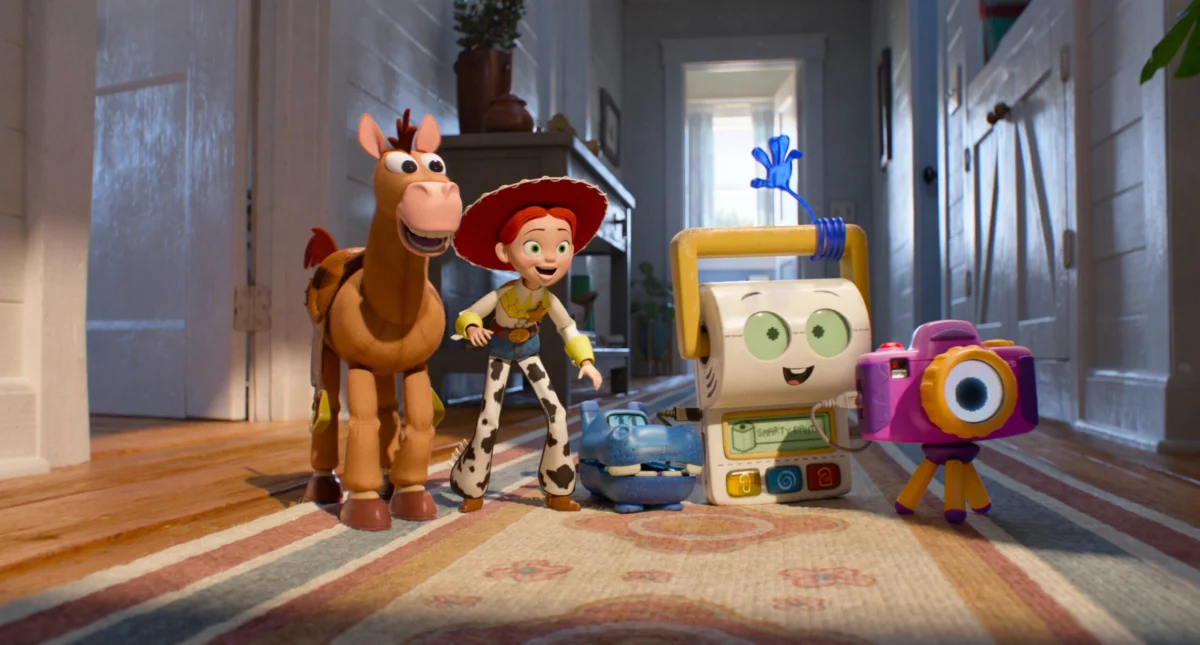
It is no longer a matter of debate: the magic of the playroom remains as potent as ever. Disney and Pixar’s Toy Story 5, the latest installment in the storied animation franchise, has launched with an explosive force that is rapidly rewriting the record books. Directed by industry stalwart Andrew Stanton, the film has arrived in theaters with a kinetic energy that suggests the franchise is not merely surviving, but thriving in an era of unpredictable theatrical performance.
With a staggering $129.3 million amassed globally in its opening surge, the film is poised to comfortably eclipse its initial worldwide opening forecast of $275 million. As audiences across 48 territories flock to theaters to reunite with Woody, Buzz, and Jessie, the industry is witnessing a cultural phenomenon that reaffirms the enduring power of intellectual property when handled with narrative precision.
Main Facts: The Numbers Behind the Magic
The domestic performance of Toy Story 5 has been nothing short of historic. Stateside, the film generated $71 million on its opening Friday alone. To put this in perspective, that figure marks the second-best Friday opening ever for an animated feature, trailing only the $71.2 million debut of Incredibles 2.
The momentum is not confined to North American shores. Internationally, the film has secured an additional $58.3 million, bringing the total global tally to nearly $130 million before the first full weekend is even in the books. Market analysts have consequently revised their domestic outlook, with projections now surging to a range of $160 million to $170 million—a significant jump from the $140 million estimates circulated earlier in the week.
While the film chases the high-water mark set by Inside Out 2—which holds the record for the best global opening for a Pixar title at $384 million—the sheer velocity of Toy Story 5 suggests that it may soon stand as a top-tier performer in the studio’s prestigious four-decade history.
Chronology of the Global Expansion
The rollout of Toy Story 5 has been a masterclass in strategic distribution. Following its initial debut, the film expanded into seven additional major markets on Friday, including the critical pillars of the United Kingdom and China. This brought the film’s total footprint to 48 distinct territories.
The International Surge
In the United Kingdom, the film raked in $5.5 million on its opening day, setting a new record as the best opening day for any Pixar movie in that market. Similarly, China saw an immediate embrace of the franchise, with a $7.4 million opening day.
The film’s dominance is nearly universal. It opened at No. 1 or No. 1 among non-local titles in almost every territory in which it was released, including:
- Mexico: $11.4 million
- France: $3 million
- Spain: $2.7 million
- Italy: Strong No. 1 performance
- Australia: $2 million
- Brazil: $1.9 million
In Argentina, the film hit the ground running on Thursday, recording the second-best opening day of 2026 with $1.1 million, and quickly swelling to a $2 million running cume. In South Korea, the film’s Wednesday debut saw it capture a 50% market share with $1.1 million, marking the third-highest opening day for a Motion Picture Association (MPA) title year-to-date and the fifth-highest Pixar opening day of all time.
Supporting Data: Sentiment and Market Penetration
Beyond raw currency, the qualitative metrics surrounding Toy Story 5 suggest deep audience engagement. In South Korea, social scores are exceptionally high, with Naver users rating the film a 9.69/10 and CGV audiences awarding it a 98% approval rating.
In China, the film commanded a 30% market share, serving as the second-highest animated opening for an MPA title since 2020. It currently sits behind only the juggernaut Zootopia 2, which remains a benchmark for the region, having secured a massive $271.7 million opening on its way to a $1.86 billion global total. Social sentiment in the Chinese market remains stellar, with ratings of 9.6 on Mayan, 9.5 on TTP, and 8.0 on the notoriously discerning Douban platform.
Even in markets where the film did not claim the top spot—such as India and Vietnam—it remains a formidable contender. In Vietnam, the film achieved the second-highest opening day of 2026 for an MPA theatrical release, underscoring the brand’s ability to transcend cultural and geographic boundaries.
Official Responses and Creative Direction
The return of Andrew Stanton to the director’s chair has been cited by studio executives as a key driver for the film’s success. Stanton, whose fingerprints are on the original Toy Story and Finding Nemo, brings a sense of structural integrity that has been lauded by critics.
Disney and Pixar have remained relatively quiet regarding the specific plot mechanics of the fifth installment, choosing instead to focus on the emotional resonance of the legacy characters. Internally, the success of the film is being viewed as a validation of Pixar’s return to its "big screen" identity. After a period where several titles were diverted to Disney+, the studio’s commitment to an exclusive theatrical window is paying dividends, proving that family audiences are still eager to participate in the "event" nature of a cinema release.
Implications for the Future of Animation
The seismic success of Toy Story 5 carries several profound implications for the animation industry and the broader theatrical ecosystem:
1. The Power of Established Intellectual Property
While original stories remain a vital part of the creative ecosystem, the box office performance of Toy Story 5 proves that established franchises act as an essential "anchor" for theater chains. When audiences trust a brand, they are willing to return to the cinema in droves, providing the financial stability that allows studios to take risks on smaller, original projects.
2. The Resurgence of the "Family Event"
The film’s performance in diverse markets—from Turkey to Brazil—indicates that the "family outing" is back in full force. The social scores in markets like Korea and China suggest that even in regions with highly competitive local film industries, a well-executed Hollywood animation can still command significant attention and social discourse.
3. The Bar for "Sequel Success"
By setting the bar high with a massive opening, Toy Story 5 has raised the stakes for upcoming animated sequels. The success of Zootopia 2 and now Toy Story 5 suggests that audiences are increasingly discerning; they are not just looking for more of the same, but for high-quality storytelling that honors the history of the characters while evolving the franchise’s visual and emotional language.
4. A Boost for the 2026 Slate
With the theatrical industry looking to recover fully from the fluctuations of the early 2020s, Toy Story 5 provides a much-needed shot in the arm. The momentum generated by this release will likely provide a "halo effect" for other upcoming films, as it brings families back to the lobby, encourages concession spending, and restores the habit of frequent cinema-going.
Conclusion
As the first weekend concludes, the narrative surrounding Toy Story 5 is one of triumph. It is not merely a film about toys; it is a film that has successfully navigated the complexities of global distribution, audience expectations, and the weight of legacy.
Whether it will ultimately reach the stratospheric heights of its predecessors remains to be seen, but the early indicators are clear: Woody, Buzz, and their companions have once again proven that they are among the most valuable assets in cinematic history. As the international rollout continues, all eyes will be on the final weekend tallies, which are expected to confirm that Toy Story 5 is the definitive box office force of the year. For now, the toys are on top—and they show no signs of slowing down.


 Lina Hope
 Nana Muazin