Ammar Sabilarrohman
After decades of shadow, speculation, and creative purgatory, the legendary "lost" finale to Rick Veitch’s Swamp Thing saga has finally emerged from the primordial muck. Issue #3 of the Swamp Thing 1989 series arrives as more than just a comic book; it serves as a historical correction, a creative reclamation, and a staggering piece of metaphysical fiction that finally allows one of the most acclaimed runs in DC Comics history to reach its intended, mind-bending conclusion.
The Core Conflict: Facing the Source
At the heart of this long-awaited installment lies an existential crisis of cosmic proportions. Rick Veitch, known for pushing the boundaries of the medium during his original tenure, returns to the character with a narrative that transcends the physical realm. The protagonist, Alec Holland—the man-turned-elemental known as Swamp Thing—finds his odyssey through time reaching its ultimate destination: the literal beginning of the universe.
Having traveled across the eons, Swamp Thing stands at the precipice of the Big Bang, confronted by the "Source of the Multiverse." This is the pivotal moment that has been teased for over thirty years. The narrative places the hero in an impossible position: to either abandon his humanity and merge with the Source, becoming the foundational life-force of all creation, or to reject godhood in favor of his mortal connection to his beloved, Abby Arcane.
This dichotomy—the struggle between the cold, infinite potential of the divine and the warm, finite fragility of human love—has always been the bedrock of the Swamp Thing mythos. However, in this final chapter, Veitch elevates these themes, forcing the reader to question whether an elemental avatar can ever truly belong to a world defined by the limitations of love and death.

Chronology of a Controversial Saga
To understand the significance of this release, one must look back at the fraught history of the 1989 series. Following the departure of Alan Moore, who redefined the character for a mature audience, Rick Veitch took the reins. His run was marked by high-concept science fiction and occult horror, culminating in a planned storyline that would have seen Swamp Thing travel through time, meeting historical figures and DC icons alike.
The saga hit a wall when, in 1989, a planned issue featuring Swamp Thing encountering Jesus Christ was canceled by DC Comics editorial, citing concerns over the sensitive subject matter. The resulting fallout led to Veitch’s departure from the series, leaving his planned conclusion—the "time-travel saga"—unfinished and abandoned. For three decades, this "lost" ending remained a holy grail for comic historians. The release of this third issue represents the final piece of that puzzle, closing a narrative loop that has been open since the twilight of the 1980s.
Supporting Data: The Convergence of Plotlines
The narrative architecture of Swamp Thing 1989 #3 is deceptively complex. While Swamp Thing stands at the dawn of time, the story simultaneously shifts to the future—thirteen billion years later—where the occult investigator John Constantine operates his web of supernatural influence.
The stakes are personal and apocalyptic. Hell is currently in a state of upheaval, with the villains of the past converging to forge a new, terrifying reality. Meanwhile, the impending birth of the child of Swamp Thing and Abby Arcane serves as the series’ emotional anchor. This child is poised to become the heir to the mantle of Earth’s Elemental, a role that carries with it both immense power and an inherent curse.
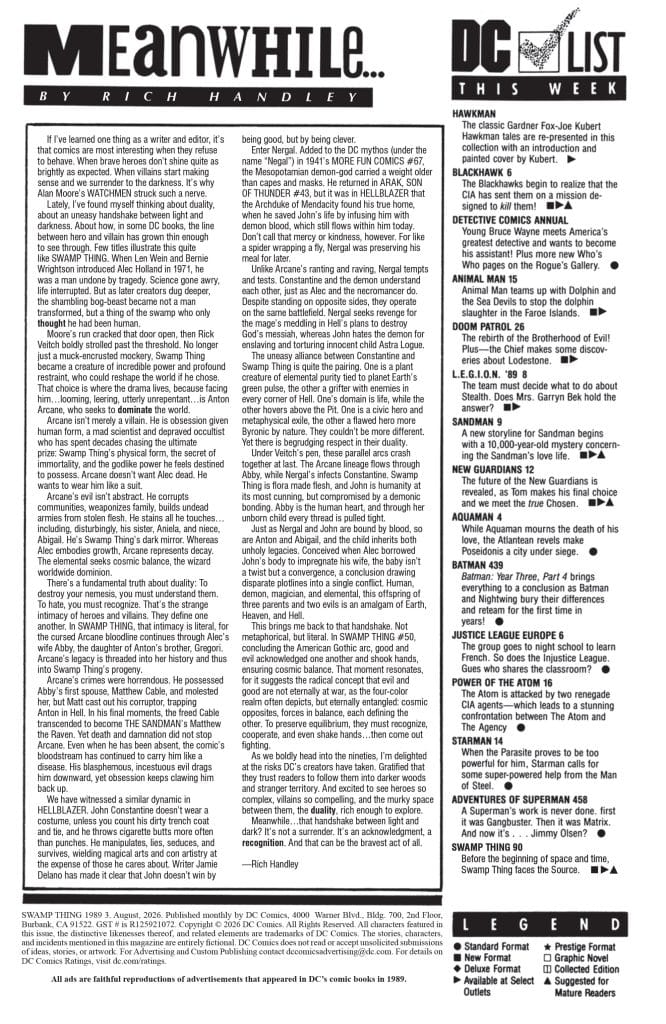
The interplay between these two disparate timelines—the origin of the universe and the birth of a new, potentially world-altering life—creates a sense of inevitability. Veitch, working with artist Tom Mandrake, crafts a visual and narrative tapestry where the past, present, and future are inextricably linked. Mandrake’s art, characterized by its visceral, organic detail and shadow-drenched atmosphere, perfectly captures the horror and the majesty of Veitch’s cosmic vision.
Official Context and Creative Intent
In the decades since the cancellation, the industry has changed significantly. The "mature readers" market, which Swamp Thing helped pioneer, has grown into a cornerstone of the medium. The current release is not merely a "legacy" product; it is an active, vibrant piece of storytelling that feels as fresh today as it might have in 1989.
While DC Comics has seen numerous reboots and reimaginings of its multiverse, the Veitch/Mandrake collaboration retains a unique, singular voice. The creative intent here was always about the evolution of the hero. Swamp Thing is not just a monster; he is a force of nature, and Veitch’s script treats him with the gravitas of a Greek deity. By finally allowing this conclusion to reach print, the creators have provided closure for a generation of fans who grew up waiting for the resolution of the Swamp Thing time-travel saga.
Implications for the Swamp Thing Mythos
The release of this issue carries significant weight for the broader DC Universe. By addressing the "Source" and the origin of the elemental powers, the story recalibrates our understanding of how the Green—the mystical force connecting all plant life—functions within the multiverse.

- The Nature of the Elemental: The story suggests that the role of the Swamp Thing is not merely a biological accident, but a cosmic necessity. The "impossible choice" presented to Alec Holland implies that the Elemental is a bridge between the Source and the sentient life of Earth.
- The Constantine Factor: John Constantine’s role in this saga highlights the predatory nature of his character. Even as he appears to be working toward a resolution, his methods remain morally ambiguous, reinforcing the long-standing dynamic between the mage and the monster.
- Legacy and Lineage: The focus on the birth of the child establishes a new status quo. By making this child the heir to the Elemental mantle, the story moves beyond the singular journey of Alec Holland and looks toward the future of the mythos.
A Masterpiece of Meta-Fiction
Ultimately, Swamp Thing 1989 #3 is a testament to the endurance of creative vision. It serves as a reminder that the best comic book stories are those that refuse to be constrained by editorial mandates or the passage of time. Rick Veitch has managed to craft a conclusion that feels earned, satisfying, and deeply unsettling all at once.
The imagery provided in the preview pages—the stone monoliths, the fiery backdrops of Hell, and the lonely silhouette of the green avatar—all point to a finale that embraces the "Source and Sorcery" of the title. The dialogue, captured in the gritty, lived-in environments of occult pubs and ethereal voids, balances the cosmic with the intimate.
For long-time fans of the character, this issue is a necessary purchase. For those new to the lore, it offers a window into a golden age of storytelling, proving that even a story buried for thirty years can still sprout, grow, and bloom into something truly profound. The wait is finally over: the Swamp Thing has returned to face his maker, and in doing so, he has reminded us all why he remains one of the most compelling figures in the history of graphic literature.
As the dust settles on this long-gestating project, one thing is clear: the history of Swamp Thing has been rewritten to include this final, brilliant, and terrifying chapter. The journey that began at the dawn of time now reaches its conclusion, proving that in the world of the Green, nothing ever truly dies—it only transforms.

 Sagoh
Sagoh