Layla Zulfa
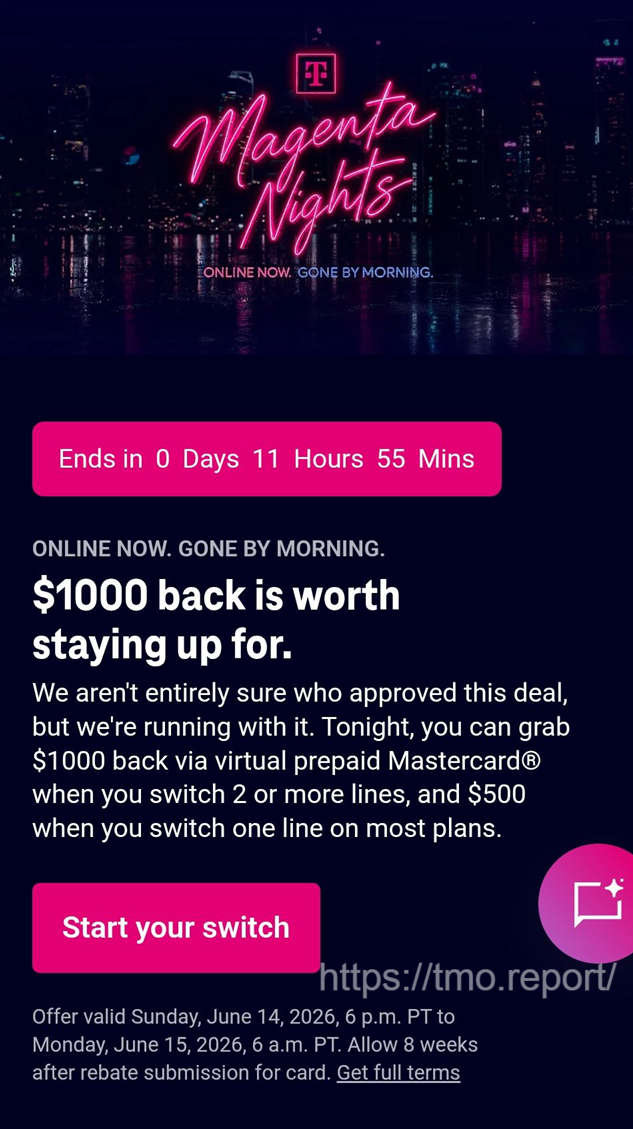
In a landscape where wireless carrier promotions are typically static, month-long affairs designed to capture the attention of the general public, T-Mobile has pivoted to a radically different strategy. The “Un-carrier” recently unveiled a highly personalized, time-sensitive incentive program dubbed “Magenta Nights.” This flash-promotion initiative, which promises up to $1,000 in rebates for customers who port in new lines, marks a significant departure from the company’s traditional marketing playbook.
While the offer has generated significant buzz across social media platforms and tech forums, its unconventional delivery—hidden within the T-Life app and restricted to narrow, overnight windows—has left many consumers confused. As T-Mobile continues to assert its dominance as the premier 5G carrier in the United States, this latest maneuver raises questions about the future of customer acquisition strategies and the efficacy of algorithmic, personalized discounting.
Main Facts: What Is “Magenta Nights”?
At its core, "Magenta Nights" is a port-in incentive designed to aggressively target customers currently subscribed to competing networks like Verizon and AT&T. The offer is essentially a rebate program that rewards new and existing customers for adding new lines to their accounts.
The primary highlights of the promotion include:
- Variable Incentives: Rebate values are not standardized. Users have reported seeing offers ranging from a modest $100 up to a substantial $1,000.
- The Mechanism: The reward is issued in the form of a virtual prepaid Mastercard.
- Platform Specificity: The offer is exclusively visible within the T-Life application.
- Exclusivity: The promotion is not a permanent fixture. It is unlocked only during specific, limited-time "overnight" windows.
- Targeting: Evidence suggests the highest tiers of the rebate are reserved for "port-in" customers—those switching their phone numbers from a rival carrier to T-Mobile.
Chronology: The Evolution of the Flash Promotion
The “Magenta Nights” phenomenon did not follow a typical press-release-led launch. Instead, it surfaced organically, characterized by a mix of confusion and excitement within the T-Mobile user community.
The Initial Discovery
The promotion was first identified by The Mobile Report during the weekend of June 14, 2026. The initial campaign appeared in the T-Life app at 6:00 PM PT (9:00 PM ET) and concluded at 6:00 AM PT (9:00 AM ET) the following morning. This 12-hour "overnight" window created a sense of urgency, forcing interested customers to make immediate decisions regarding their wireless service.
Community Verification
Following the initial reports, Reddit’s r/tmobile community became the primary hub for documentation. Users began sharing screenshots of their personal offers. The thread revealed a striking lack of uniformity: while some users were greeted with a $1,000 incentive, others were offered only $100, or in some cases, no promotion at all. This sparked a debate regarding how T-Mobile segments its user base and determines the value of a prospective customer.
The Rolling Schedule
Recognizing the success of the initial rollout and the viral interest it generated, it appears T-Mobile has decided to extend the campaign. The carrier has scheduled subsequent "Magenta Nights" events for the following dates:
- June 21–22
- June 28–29
- July 5–6
These dates suggest that T-Mobile is testing the efficacy of weekend-only, high-intensity acquisition spikes rather than sustaining a lower-level promotion throughout the entire quarter.
Supporting Data: The Complexity of Personalized Discounts
The most intriguing aspect of “Magenta Nights” is the lack of a universal code or landing page. In traditional retail, a promotion is usually accessible to any user who meets a specific set of criteria (e.g., "Switch to a Go5G Plus plan to get $800").
With "Magenta Nights," the offer is opaque. Analysts suggest that T-Mobile is utilizing internal account data to generate these offers dynamically. Factors influencing the specific dollar amount likely include:
- Account Tenure: The length of time an existing customer has been with the carrier.
- Market Competition: Whether the user is located in an area where T-Mobile is aggressively trying to gain market share against a specific competitor.
- Plan Tier: Users on higher-cost, premium plans may be targeted with higher incentives to ensure retention and high Average Revenue Per User (ARPU).
- Churn Risk: Predictive models likely identify which customers are considering leaving, triggering a higher-value offer to incentivize them to stay or add additional lines.
The Fine Print
For those who successfully secure the deal, the "payout" is not immediate. The virtual prepaid Mastercard is subject to the following conditions:
- Processing Time: It can take up to eight weeks for the rebate to be processed and issued.
- Expiration: Once the virtual card is received, it carries a six-month expiration window.
- Usage: While the card is generally accepted anywhere that takes Mastercard, it remains a "virtual" asset, which some consumers may find less flexible than a direct bill credit or a cash refund.
Official Responses and Corporate Strategy
While T-Mobile has not issued a formal, widespread press release explaining the methodology behind "Magenta Nights," the initiative aligns with the company’s recent performance. Having been crowned the "best overall carrier" in recent independent 5G network reports, T-Mobile is currently in a position of strength.
By using the T-Life app—the company’s integrated lifestyle and management platform—T-Mobile is effectively driving engagement with its own ecosystem. By forcing users into the app to check for these offers, they are ensuring that customers are interacting with their proprietary interface, checking their plan details, and potentially discovering other services, such as T-Mobile Home Internet or device protection plans.
The "Un-carrier" philosophy has always been about disrupting the industry status quo. By moving away from standardized national advertising and toward "gamified" or algorithmic promotions, T-Mobile is essentially testing a new way to optimize its marketing spend. Instead of spending millions on broad television spots, they are focusing their capital on specific, high-intent individuals who are most likely to switch.
Implications: What Does This Mean for the Consumer?
The "Magenta Nights" initiative represents a double-edged sword for the average consumer.
The Benefits
For those who are already planning to switch or add lines, the potential for a $1,000 rebate is significant. In an era of rising costs, a windfall of this size can effectively cover the cost of several months of service or offset the price of new hardware. The "limited-time" nature of the offer also provides a clear "call to action" for fence-sitters.
The Risks and Frustrations
The lack of transparency is the primary drawback. Customers who see a $100 offer while their neighbor receives $1,000 may feel alienated or discriminated against by the carrier’s algorithm. This disparity can lead to brand frustration. Furthermore, the reliance on the T-Life app excludes users who prefer to manage their accounts via a web browser or by visiting a physical retail store, potentially alienating less tech-savvy customers.
Future Outlook
If the upcoming weekends in late June and early July prove successful for T-Mobile, we can expect to see this strategy adopted by competitors. The telecommunications industry is notoriously copycat-driven; if Verizon or AT&T see that T-Mobile is successfully capturing market share through app-exclusive, time-sensitive flash sales, they will almost certainly attempt to implement their own version of "dynamic, personalized discounting."
For consumers, the takeaway is clear: the era of the "standard" wireless offer is fading. To get the best deal, consumers must now be active participants in their carrier’s digital ecosystem. Checking the T-Life app—or its equivalents—on weekends or holidays may soon become as important as checking the weekly grocery circular for discounts.
Conclusion
T-Mobile’s "Magenta Nights" is a bold, if slightly polarizing, experiment in digital marketing. It leverages the company’s strong network reputation and the captive audience of its mobile application to create a high-pressure, high-reward environment. While the unpredictability of the offer amounts may irk some, the potential for a $1,000 rebate is likely enough to keep the promotion trending for the remainder of its scheduled run.
As the program continues through July, potential switchers should remain vigilant. If you are currently locked into a contract or paying high rates with another provider, keeping a close eye on your T-Life app during the upcoming weekends could be the key to unlocking substantial savings. However, consumers should approach these offers with the understanding that in the modern, algorithm-driven economy, the best deals are no longer guaranteed—they are earned through digital engagement.

 Raul Delapena Setiawan
 Asep Darmawan