Reynand Wu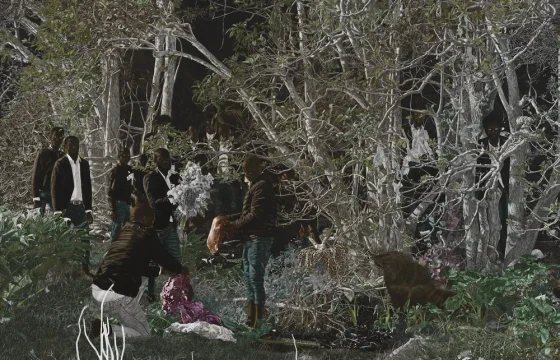
Main Facts: A Nocturnal Communion
South African artist Cinga Samson has unveiled his latest body of work, a series of oil paintings collectively titled Ukuphuthelwa. The exhibition, which serves as a profound meditation on existence, spirituality, and the nature of the image, will remain on view through April 18, 2026.
Derived from his native isiXhosa, the title Ukuphuthelwa translates to "unable to sleep." However, Samson is careful to distinguish this state from the clinical, often pathologized Western concept of "insomnia." To the artist, Ukuphuthelwa is not a deficit or a disorder to be treated; rather, it is a state of heightened spiritual alertness—a nocturnal sensitivity that intensifies as the light fades. Rendered in his signature palette of carbon, deep Prussian blues, and near-black hues, the exhibition presents a series of haunting, contemplative scenes featuring enigmatic figures, watchful dogs, and indigenous South African flora.
At its core, the exhibition grapples with the existential dilemma of the painter: the quest to create a "true and honest" painting while acknowledging the inherent failure of the image to capture the totality of reality. Samson’s work does not merely depict the physical world; it attempts to map the vast, unseen energies that move beneath the surface of the mundane.
Chronology: The Evolution of a Visual Language
Cinga Samson’s trajectory as one of the most vital voices in contemporary African art has been marked by a consistent interrogation of the medium of painting.
- Early Development: Samson initially gained acclaim for his ability to manipulate light and shadow to create atmospheric, often ceremonial, interiors.
- The Shift to the External: Over the last several years, his focus has transitioned from domestic spaces to the expansive, often eerie, landscapes of the South African wild.
- The 2026 Series: In Ukuphuthelwa, the artist has reached a new level of technical abstraction. Works such as Umlindo (Watcher), Imfihlo (Secret), and Intsingiselo (Meaning), all produced in 2026, represent a synthesis of his previous explorations into ritual and the instability of the signifier.
- The Exhibition Run: With the exhibition now open, the public is invited to engage with these works through mid-April 2026, a period during which the works are expected to spark significant discourse regarding the role of indigenous philosophy in global contemporary art.
Supporting Data: The Anatomy of the Image
The aesthetic impact of Ukuphuthelwa relies on a sophisticated interplay of technical mastery and deliberate omission.
The Optics of Absence
Samson’s approach to light functions "like a magic trick." He employs a technique of glazing and wiping back paint to build a chromatic density that feels at once heavy and ethereal. A defining characteristic of his figures is the absence of pupils. By leaving the eyes unpainted, Samson allows the light to circulate through the canvas, effectively dissolving the boundary between the figure and the background. This ensures that his subjects are not individual identities—personified characters with distinct histories—but rather elemental forms enmeshed in the environment.
The Linguistic Interstice
The titles of the works provide a roadmap for the viewer, yet they simultaneously highlight the limitations of language. In isiXhosa, words like Intsingiselo carry cultural weights that are lost in English translation. This linguistic "gulf" mirrors the artistic gulf: the space between the static painted sign and the fluid, living experience it gestures toward.
For example, in Intsingiselo II, a dog serves as a central motif. To a Western viewer, the dog might symbolize loyalty or companionship. Within an amaXhosa context, however, the figure may evoke the protective, guiding principles of the ancestors. By providing these prompts, Samson forces the viewer to confront the subjectivity of their own interpretive lens.
The Sublime in the Ordinary
Whether it is the vast, moon-washed cloud in Tshee or the stark, rocky crags of Sithini ngelilitye, Samson’s landscapes evoke the "sublime"—a sense of beauty so vast it borders on the terrifying. He describes this oscillation in energy: "The sky can be so friendly, but sometimes so heavy, dark, so scary. It’s the same energy, but it exists in different forms."
Official Perspectives: The Artist’s Quandary
In various statements surrounding the exhibition, Samson has articulated a philosophy that eschews the desire for artistic mastery in favor of an encounter with the divine.
"The ritual itself is not the important thing," Samson notes, referring to the ceremonial scenes depicted in his paintings. "It’s an opening to what exists beyond."
For Samson, the act of painting is a conduit for accessing the "unnameable." He argues that images are merely symbols—relative, subjective, and incomplete. This admission of failure is the driving force of the exhibition. By exposing the under-drawings and revealing the "tricks" of his craft, Samson invites the viewer to look past the artifice. He seeks to bridge the gap between the viewer and the infinite, suggesting that the divine is not found in a distant, ethereal realm, but is embedded in the vernacular of every leaf, every shadow, and every creature that populates his canvases.
Implications: The Future of Existential Painting
The implications of Ukuphuthelwa extend far beyond the gallery walls. By centering indigenous concepts and refusing to provide easy, didactic answers to the mysteries posed by his work, Samson is challenging the current conventions of global art criticism.
Challenging the Western Gaze
Historically, the "gaze" in Western art has been one of ownership and classification. By creating figures that do not look outward—because their "knowing" comes from within the world they inhabit—Samson subverts the traditional power dynamic between the viewer and the subject. The viewer is not an observer looking at the world; the viewer is invited to be a participant in an interconnected, animate reality.
A New Framework for Contemplation
The exhibition advocates for a "slow, contemplative looking." In an era of rapid digital consumption, Samson’s insistence on the "existential gravity" of his paintings demands a recalibration of the viewer’s pace. The work suggests that there is a profound, latent magic in the ordinary that remains invisible to those who are not sufficiently sensitive to the dark.
The Universal Vernacular
Ultimately, Ukuphuthelwa acts as a bridge. By utilizing isiXhosa as a primary framework for his inquiry, Samson insists on the validity of his specific cultural heritage as a lens for universal existential inquiry. The "truth" he seeks is not a singular, verifiable fact, but a recognition of the interconnectedness of all things—what he characterizes as "a thing that links us to God—and by God, I mean everything."
As the exhibition continues its run through April 2026, it serves as a reminder that the most significant art does not solve the mysteries of existence. Instead, it makes the mystery more palpable, more urgent, and, ultimately, more beautiful. Whether through the flickers of light across a dark forest floor or the stoic, pupil-less gaze of a figure in a clearing, Cinga Samson has ensured that the "sleeplessness" of his artistic pursuit will resonate long after the viewer leaves the gallery.


 Siti Muinah
 Asep Darmawan