Azzam Bilal Chamdy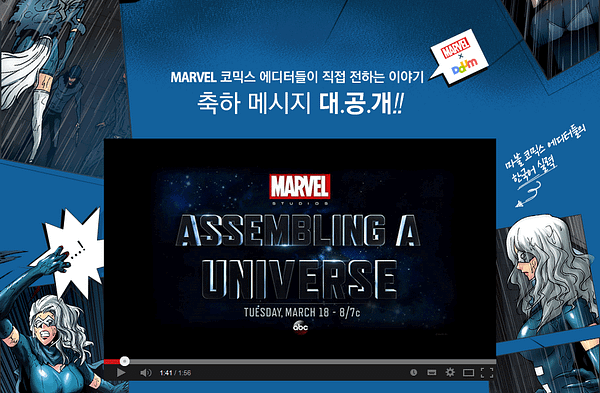
In the ever-evolving landscape of global comics, the collision between Western superhero archetypes and Eastern digital storytelling platforms has produced some of the most intriguing experiments in modern media. Among the most notable of these ventures is Avengers: Electric Rain, a pioneering webtoon collaboration that brought the Marvel Universe to the vibrant, vertical-scrolling ecosystem of South Korea. Spearheaded by artist Younghoon Ko and published via the massive Korean portal Daum, this project represented a significant shift in how Marvel Comics approached international markets and digital-first consumption.

Main Facts: A New Chapter for Earth’s Mightiest Heroes
Avengers: Electric Rain is not merely a translation of existing American source material; it is an original, localized narrative set within the borders of South Korea. The series serves as a bridge between the traditional, panel-by-panel aesthetics of Marvel’s house style and the "manhwa-style" digital webcomics—or webtoons—that dominate the Korean entertainment industry.

The central hook of the series is the introduction of a brand-new character specifically crafted for the Korean audience, integrated into the classic roster of the Avengers. By situating the action in Seoul, the comic utilizes the city’s dense urban geography and technological landscape to recontextualize the Avengers’ familiar dynamics. The collaboration between Marvel, Disney Korea, and the platform Daum was a landmark agreement, marking one of the first times a major Western publisher granted such significant creative leeway to a local artist to expand upon their IP in a non-Western format.

Chronology: The Genesis of the Collaboration
The development of Electric Rain did not occur in a vacuum. It was the culmination of a broader strategic pivot by Marvel to leverage its cinematic success in Asia.

- Initial Partnership (2014): Marvel and Disney Korea finalized the agreement with Daum to launch a localized comic initiative. The goal was to reach the massive demographic of Korean mobile users who consumed content almost exclusively through the Daum Webtoon portal.
- Creative Selection: Younghoon Ko was selected to spearhead the artistic vision. His background in manhwa provided the necessary aesthetic sensibility to capture the fast-paced, high-motion requirements of the webtoon format.
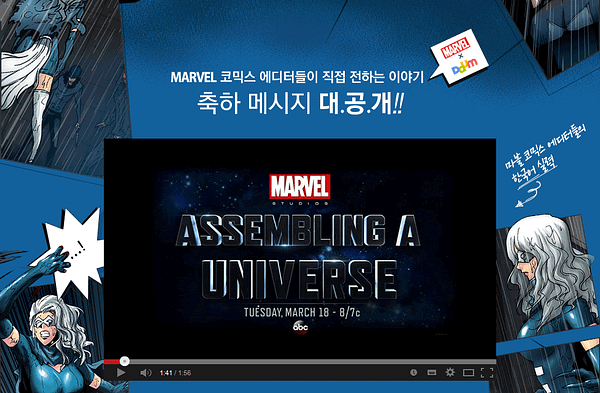
- The Promotional Push: Ahead of the launch, a series of interviews and promotional videos were released featuring key Marvel editorial figures, including C.B. Cebulski, Axel Alonso, Tom Brevoort, Ellie Pye, Jordan White, and Nick Lowe. These clips were intended to drum up enthusiasm, though they famously highlighted the cultural and linguistic gaps between the American editors and the project’s Korean roots.
- Launch and Serialization: Following the hype, Electric Rain began its weekly serialization. It was designed to be consumed on smartphones, utilizing long-strip layouts that allowed for seamless vertical scrolling—a departure from the static, page-based layouts found in traditional Marvel print comics.
Supporting Data: The Webtoon Phenomenon
To understand the importance of Avengers: Electric Rain, one must understand the platform it inhabited. Daum, along with Naver, serves as the primary gateway for webcomics in South Korea. Unlike the declining print market for comics in the West, the Korean webtoon industry has seen explosive, double-digit growth annually since the early 2010s.

- Format Disruption: Webtoons utilize a "long-strip" format. Unlike traditional Western comics, which are constrained by page turns and rigid panel grids, webtoons use infinite canvas technology. This allows artists to pace their narrative with precise control over the reader’s scrolling speed, creating a cinematic experience that is inherently tied to the mobile device.
- Color and Accessibility: The industry standard for webtoons is full color. By shifting the Avengers into this medium, Marvel effectively modernized its visual identity for a generation of readers who found the black-and-white or limited-color palettes of traditional manga or the expensive, high-quality printing of American comics to be less accessible.
- Engagement Metrics: During the run of Electric Rain, the series maintained high engagement on Daum, proving that the Marvel brand—already bolstered by the success of the Avengers film franchise—could translate effectively to serialized digital platforms.
Official Responses and Cultural Translation
The reception of Avengers: Electric Rain was a mix of critical curiosity and fan engagement. However, the project is also remembered for the lighthearted, if slightly awkward, attempts at cross-cultural communication between the American editorial team and the Korean creators.

In the promotional videos released at the time, Marvel editors attempted to discuss the series while grappling with the nuances of the Korean language. While these segments were clearly meant to be a show of solidarity and partnership, they became a point of discussion among fans who noted the stark contrast between the editors’ linguistic struggles and the professional, polished work of Younghoon Ko.
When the focus shifted to Ko, however, the tone changed significantly. His work was praised for its technical proficiency and its ability to handle the complex character models of Marvel’s heroes while maintaining the flow and energy required for a webtoon. The consensus among the creative community was that while the Marvel editorial team was still learning how to navigate the specificities of the Korean market, the artist they had entrusted with the project was an expert in his field.

Implications: A Blueprint for the Future
The legacy of Avengers: Electric Rain is significant, as it served as a proof-of-concept for the "glocalization" of superhero media.

- The Digital-First Strategy: The project demonstrated that major publishers could effectively outsource creative control to regional artists to create content specifically for local digital platforms. This paved the way for subsequent partnerships where publishers like Marvel and DC have experimented with manga-style spin-offs or localized webtoon stories.
- Expanding the Marvel Multiverse: By establishing that the Avengers could operate in Korea under the guidance of local talent, Marvel signaled that its universe was not confined to New York City or the American Midwest. This has since been echoed in the increasing diversity of characters and settings within the Marvel Cinematic Universe and the printed comics.
- The Evolution of the "Webtoon" Model: Since 2014, the webtoon format has gone global. Platforms like WEBTOON and Tapas have brought the Korean scrolling style to millions of Western readers. Avengers: Electric Rain stands as an early, experimental bridge that helped familiarize Western readers with a format that has since become the dominant mode of comic consumption for younger generations.
Final Reflections
Avengers: Electric Rain remains a fascinating artifact of a transitional period in comic history. It represents the moment when the traditional, print-heavy giants of the industry finally looked toward the smartphone-dominated future of Asia and decided to participate in it.

While the project may not be remembered as the most groundbreaking narrative in the history of the Avengers, its structural impact cannot be overstated. It challenged the rigid standards of what a Marvel comic could be—physically, aesthetically, and culturally. It proved that a superhero story could be told with a vertical scroll, in full color, by a local artist, and still retain the "Marvel feel" that fans around the world recognize.
For Younghoon Ko, the project was a masterclass in blending two distinct comic traditions. For Marvel, it was a necessary step in evolving from a traditional publishing house into a global digital entertainment entity. Today, as we see more international creators taking the helm of iconic American characters, the ripple effects of this Korean collaboration continue to be felt, reminding us that the best stories are those that can transcend borders, screens, and formats.

 Siti Muinah
 Rifan Muazin