Siti Muinah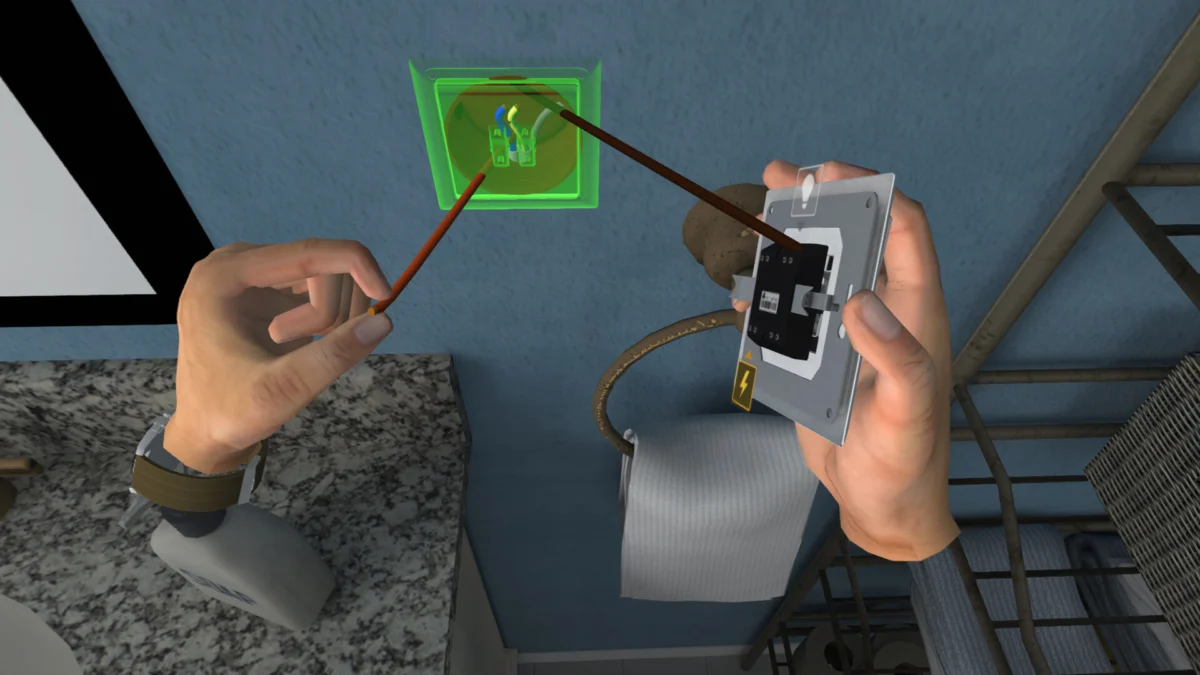
Developer/Publisher: Take IT Studio!
Genre: Simulation / VR
Platforms: PlayStation VR2 (Reviewed), PC VR, Meta Quest
Author: Marcus Orchard
The Evolution of the "Job Sim" Genre
The simulation genre has undergone a seismic shift over the last decade, transitioning from complex, spreadsheet-heavy management titles to tactile, hands-on experiences that thrive in the immersive environment of virtual reality. Among the myriad of "workplace simulators" currently flooding digital storefronts, few have managed to bridge the gap between mundane labor and genuine digital satisfaction quite like Electrician Simulator VR.
Developed and published by Take IT Studio!, the title invites players to trade their controllers for a virtual toolkit. Whether you are stripping wires, mounting electrical boxes, or troubleshooting a short circuit in a dimly lit basement, the game promises a slice-of-life experience that turns the often-invisible work of residential maintenance into a rewarding, gamified loop.
Main Facts: What Does the Job Entail?
At its core, Electrician Simulator VR is a process-oriented experience. Players take on the role of an independent electrical contractor, navigating a variety of customer requests that range from trivial household chores to complex electrical rewiring.
The gameplay loop is straightforward:
- The Request: Players receive jobs via their digital workbench.
- The Preparation: You must select the appropriate tools, such as screwdrivers, wire strippers, and voltage testers.
- The Execution: Arriving at a customer’s home, you identify the fault—whether it’s a blown fuse, a flickering light, or a faulty wall socket—and execute the repair through interactive, motion-controlled mini-games.
- The Compensation: Successfully completing tasks earns you currency, which can be reinvested into better tools or office upgrades, providing a sense of progression that is crucial for a title of this nature.
Unlike the flat-screen version of the game, which relied on mouse-and-keyboard precision, the VR iteration demands physical presence. You are not just clicking on a circuit breaker; you are physically reaching out, flipping the switch, and checking the flow of power.
Chronology: From Flat Screen to Immersive Reality
The journey of Electrician Simulator began as a desktop experience, where players managed their electrical business through a 2D interface. While the game was praised for its technical accuracy regarding basic electrical safety, it lacked the "tactile feedback" that truly makes simulation games feel meaningful.

- Initial Release (PC): The flat-screen version established the core mechanics, focusing on the "business management" aspect of running a repair shop.
- VR Port Development: Take IT Studio! recognized that the mechanics—unscrewing plates, connecting wires, and measuring voltage—were inherently suited for VR. The development team spent significant time mapping the complex 2D interactions to motion-controlled gestures.
- The PS VR2 Launch: With the recent release on PlayStation VR2, the game has been optimized to take advantage of haptic feedback and the precision of the Sense controllers, marking the most refined iteration of the project to date.
Supporting Data: The VR Advantage
The success of Electrician Simulator VR lies in its ability to gamify the "un-gamifiable." While real-world electrical work is governed by strict regulations, danger, and years of apprenticeship, the game creates a sandbox that feels authoritative without being overwhelming.
Tactile Immersion
The primary differentiator here is the VR implementation. In a standard game, "wiring an outlet" is a menu choice. In Electrician Simulator VR, it is a sequence of events:
- Unscrewing the faceplate: Requires a realistic rotational motion of the wrist.
- Wiring: Requires precision to ensure the correct colored wires are placed in the correct terminals.
- Testing: Using a voltage meter provides immediate visual and audio feedback, satisfying the user’s desire for a job well done.
The "Rhythm of Labor"
There is a profound psychological appeal to manual labor simulation. By abstracting the stress and physical exhaustion of real-world trade work, the game leaves only the "flow state"—the satisfaction of seeing a chaotic, broken system return to a state of order.
Official Responses and Developer Intent
Take IT Studio! has been vocal about their design philosophy regarding the title. According to their development logs, the goal was never to create a "training manual" or a substitute for professional certification. Instead, the studio aimed to capture the spirit of the trade.
"Our objective was to make the player feel the weight of the tools and the importance of the connection," a representative for the studio stated during the initial launch phase. They acknowledged that, while they have simplified electrical diagrams and physics to keep the game approachable for non-professionals, they maintained the fundamental safety procedures—such as shutting off the main power before working—to instill good habits and maintain the "realism" of the simulation.
Implications: The Future of "Blue Collar" Gaming
The success of Electrician Simulator VR points toward a broader trend in the gaming industry: the "Simulation Boom." As hardware continues to improve, the demand for games that simulate real-world skills—be it cooking, power washing, or electrical repair—is growing.
Educational Potential
While the developer is quick to warn that this game will not make you a licensed electrician, it does lower the barrier to entry for the curious. By demystifying the interior of a wall or the components of an outlet, the game removes the "fear factor" associated with home repairs. It serves as a digital sandbox where the worst-case scenario is a simulated spark rather than a house fire.

Limitations and Rough Edges
However, it is vital to approach the game with tempered expectations. As noted in the review process:
- The Learning Curve: The control scheme can be cumbersome. Early hours are often spent fighting with virtual tool belts or misplacing tiny screws.
- Visual Fidelity: While functional, the game’s environment is not a graphical powerhouse. It prioritizes performance and interaction over photorealistic textures.
- The Simplification Gap: Those looking for a deep-dive, technical simulator will find the game’s puzzles to be "puzzles" rather than true electrical engineering problems. The logic is simplified to ensure the game remains fun, which may frustrate those with actual field experience.
Final Assessment: Is It Worth Your Time?
Electrician Simulator VR occupies a specific niche. It is not a high-octane action title, nor is it a complex narrative RPG. It is a meditative, methodical experience that rewards patience and attention to detail.
For the player who enjoys the "zen" of organizing, fixing, and completing a checklist, this title offers a compelling escape. It turns the mundane into the magical, allowing you to walk away from a virtual job site with a genuine sense of accomplishment. While it carries the typical "rough edges" of an indie simulation title—occasional bugs, clunky menu interfaces, and simplified mechanics—the core loop is strong enough to carry the experience.
If you have ever looked at a broken light switch and wondered, “What exactly is going on in there?” and wished you could tinker with it without the risk of electrocution, this game is for you. It won’t pay your bills, and it won’t help you get your electrician’s license, but it will provide hours of satisfying, hands-on entertainment that reminds us why virtual reality remains one of the most exciting frontiers in gaming today.
By stripping away the hazards and keeping the satisfaction, Take IT Studio! has created a virtual space where work actually feels like play. Whether you are playing on the PS VR2, a PC headset, or the Meta Quest, the experience remains a testament to the fact that sometimes, the most rewarding games are the ones that let us work for a living—without the real-world pressure.


 Sagoh
Sagoh
 Ammar Sabilarrohman