Lina Irawan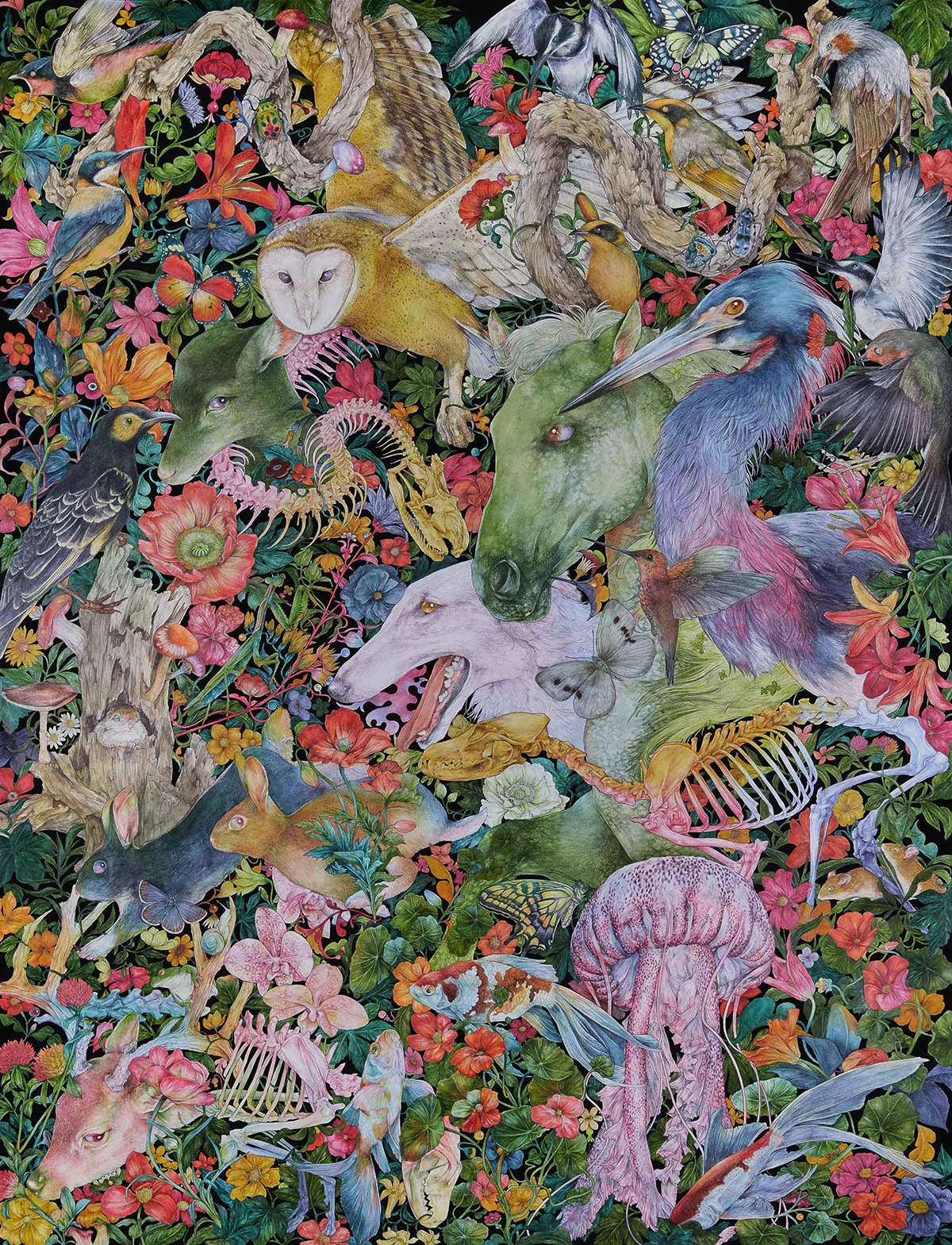
In the contemporary art landscape, few illustrators possess the ability to bridge the gap between the visceral reality of biological decay and the serene beauty of the natural world with such delicate precision as Fumi Nakamura. A Shizuoka-born artist now operating out of the bustling creative epicenter of New York City, Nakamura has carved out a distinct niche for herself. Her work—a meditative blend of graphite and colored pencil—serves as a visual exploration of the symbiotic relationship between humanity and the environment.
Following her recent recognition as a shortlisted artist in the 2025 Booooooom Illustration Awards, Nakamura’s profile has ascended, prompting a deeper look into the technical mastery and philosophical underpinnings that define her practice.
Main Facts: The Intersection of Nature and Narrative
Fumi Nakamura’s aesthetic is instantly recognizable. Her compositions often feature anthropomorphic figures, flora, and fauna that seem to exist in a state of suspended animation. Unlike traditional illustrators who focus on sharp, digital precision, Nakamura leans into the tactile nature of her mediums. By layering colored and graphite pencils, she achieves a texture that feels organic, porous, and alive.
The core of her work is not merely decorative; it is a conceptual meditation on the "continuous cycle of life and death." Her subjects are often depicted in transition—blooming, decaying, or entwined with elements of the earth. This thematic preoccupation with mortality is tempered by a profound sense of tranquility, a paradox that anchors her viewers in a space of quiet reflection rather than existential dread.
Chronology: A Journey from Shizuoka to the Global Stage
To understand the evolution of Nakamura’s art, one must trace the geographical and educational trajectory that shaped her worldview.
The Formative Years in Japan
Growing up in Shizuoka, a prefecture defined by its proximity to both the iconic Mount Fuji and the expansive coastline of Suruga Bay, Nakamura’s early life was framed by the rhythms of the Japanese landscape. The seasonal shifts of the forest and the vast, indifferent power of the ocean left an indelible mark on her psyche, planting the seeds for her later artistic focus on the sanctity of life.
The California Transition
Nakamura’s transition to the United States was marked by her enrollment at San Jose State University. This period served as a critical bridge between her Japanese roots and her Western artistic sensibilities. Her time in the Bay Area provided a secondary, distinct natural landscape—a rugged, Californian terrain that reinforced her interest in environmental aesthetics. During this tenure, she refined her technical skills, moving away from purely illustrative commercial work toward a more fine-art-oriented practice.
The New York Evolution
The move to New York City introduced a new friction to her work. Removed from the immediate, enveloping presence of the forest, her urban environment forced a shift in focus. Her work became more introspective, acting as a portal back to the natural world she missed. It is here, in the heart of the metropolis, that her work gained the refined, melancholic edge that defines her current portfolio.
Supporting Data: The Technical Architecture of Her Work
Nakamura’s process is laborious, prioritizing the physical interaction between hand, tool, and paper. Her reliance on graphite and colored pencils is a deliberate rejection of the "fast art" culture that pervades much of modern illustration.
The Layering Technique
Nakamura employs a technique of gradual accumulation. By building thin, translucent layers of color, she achieves a depth that digital mediums struggle to replicate. This "breathing" of the drawing is the result of thousands of micro-strokes that create a varied topography on the page.
Subject Matter Analysis
According to an analysis of her recent exhibition pieces, several motifs appear consistently:
- The Anthropomorphic Vessel: Human figures are rarely isolated; they are often covered in moss, intertwined with vines, or carrying small creatures, suggesting a loss of the boundary between the individual and the ecosystem.
- The Palette of Decay: Her use of muted, earthy tones—ochres, deep forest greens, and bruised violets—is calculated to evoke a sense of history and weathered endurance.
- Symbolic Stillness: Her figures often exhibit "stilled" body language, a technique designed to evoke the tranquility of a forest clearing, even when the subject matter touches on darker themes of mortality.
Official Responses and Industry Recognition
The art world has taken note of Nakamura’s unique voice. Her representation by Thinkspace Projects in Los Angeles has been a pivotal factor in her career trajectory. Thinkspace, a gallery known for its championing of the New Contemporary movement, has provided the ideal platform for Nakamura to reach a global audience.
The Booooooom Illustration Awards
The 2025 Booooooom Illustration Awards solidified her standing among the industry’s elite. By making the shortlist, Nakamura was vetted by a panel of judges looking for originality, technical execution, and emotional resonance. The recognition serves as a testament to the fact that, in an age of AI-generated imagery and digital art, there remains a deep, unquenchable hunger for work that demonstrates the distinct, imperfect, and intimate touch of the human hand.
In her own words regarding the recognition:
"Spending many years surrounded by forests, mountains, and the oceans have taught and given me value to appreciate nature and life itself. My drawings focus on the heavy influences from the relationship with it, where I depict the subject on a continuous cycle of life and death, and the emotions that all brings together."
Implications: The Future of Illustrative Fine Art
Fumi Nakamura’s success has wider implications for the future of the illustration industry. As the line between "commercial illustration" and "fine art" continues to blur, artists like Nakamura are leading the way in proving that illustration can hold its own in a gallery context.
The Counter-Trend to Digital Saturation
Her work represents a growing counter-movement. While many artists are pivoting to high-tech digital workflows, Nakamura’s commitment to the tactile and the slow-made resonates with a generation of collectors seeking authenticity. Her success suggests that the market is beginning to value the "trace" of the artist—the physical evidence of time spent and labor invested.
Environmentalism as an Artistic Lens
Beyond the technical, Nakamura’s work highlights a shift in environmental art. Rather than using environmentalism as a political or polemic tool, she uses it as a spiritual one. By positioning humans as part of a cycle of death and rebirth, she encourages a humility that is often absent from contemporary discourse. Her work implies that we are not observers of nature, but participants in its decay and regeneration.
A Path for Emerging Illustrators
For the next generation of illustrators, Nakamura’s career provides a blueprint:
- Develop a signature, tactile technique: Use medium-specific qualities (like the texture of graphite) to distinguish your work.
- Find a philosophical anchor: Let your work be driven by a specific, personal inquiry rather than mere aesthetic trends.
- Seek specialized representation: Aligning with galleries that understand your niche—like Thinkspace Projects—is crucial for moving beyond the internet and into the physical art market.
Conclusion
Fumi Nakamura stands at the intersection of the ancient and the modern. Her drawings are more than mere images; they are quiet, persistent protests against the fast-paced, disposable nature of modern life. Through the careful application of pencil to paper, she manages to capture the fleeting, fragile beauty of the natural world, reminding us all that we are part of a larger, grander cycle. As she continues to evolve her practice in New York, the art world waits with anticipation to see how she will further translate the silence of the forest into the language of the page.
For those interested in exploring her complete body of work or following her upcoming exhibitions, her portfolio can be accessed at miniminiaturemouse.com, with exhibition updates regularly provided through her representation at Thinkspace Projects. As we look toward the future of illustration, Fumi Nakamura remains a beacon of intentionality, showing us that when we slow down to look, the cycle of life and death is perhaps the most beautiful thing we can behold.


 Siti Muinah
 Evan Lee Salim