Nana Wu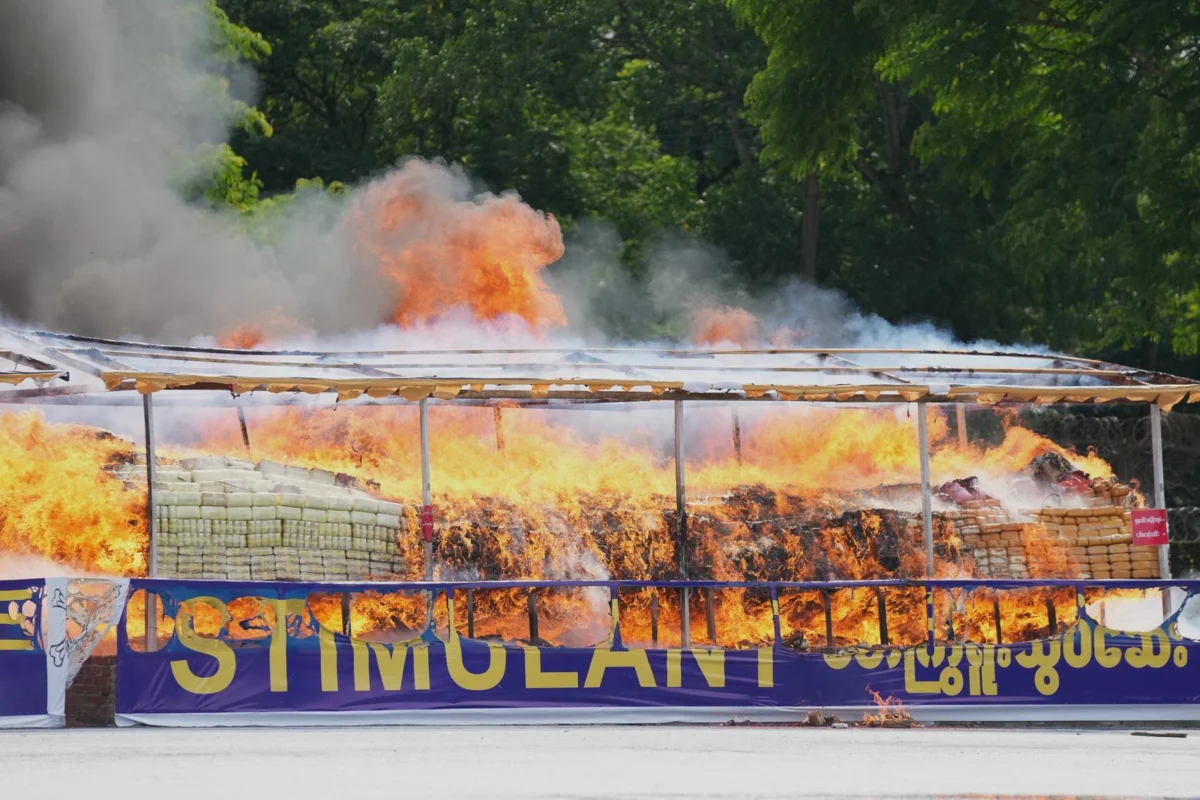
YANGON – Thick, acrid plumes of black smoke choked the horizon on the outskirts of Myanmar’s largest city this Friday, marking a grim, high-stakes spectacle: the incineration of over 50 tons of illicit narcotics. From heroin and opium to synthetic ketamine and crystal methamphetamine, the pyre represented a staggering $600 million in confiscated contraband. As the flames consumed the illicit harvest, the event served as a visceral reminder of Myanmar’s status as a global epicenter of drug production—a status that has only hardened in the shadow of a brutal, ongoing civil war.
The Pillars of the Trade: A History of Instability
Myanmar, formerly known as Burma, has long occupied a precarious position in the global narcotics trade. Its mountainous borders, particularly the infamous "Golden Triangle" where the borders of Myanmar, Laos, and Thailand converge, have provided fertile ground for the cultivation of opium poppies and the clandestine manufacture of synthetic drugs.
This production is not merely a criminal enterprise; it is inextricably linked to the country’s deep-seated political and economic instability. For decades, Myanmar has been defined by a mosaic of ethnic conflicts, where armed groups have utilized the drug trade as a financial lifeline to purchase weaponry, sustain their militias, and maintain control over vast, ungovernable territories. Despite international pressure, sanctions, and periodic "crackdowns" by successive governments, the country remains one of the world’s most prolific suppliers of heroin and methamphetamine to East and Southeast Asian markets.
Chronology of a Crisis: From 2021 to the Present
The current surge in narcotics production can be traced directly to the seismic political shift of February 2021. The military’s coup, which ousted the democratically elected government of Aung San Suu Kyi, plunged the nation into a chaotic civil war.
- February 2021: The military seizes power, sparking widespread protests that rapidly evolve into an armed insurgency. The central government’s grip on the periphery begins to fray as the military redirects resources to suppress pro-democracy urban movements.
- 2022–2023: As the conflict intensifies, reports from international monitors indicate a significant uptick in synthetic drug production. Experts suggest that the breakdown of civil administration and the desperation of displaced populations have incentivized illicit labor.
- January 2024: The military government announces its largest-ever seizure of illicit drugs and manufacturing equipment. Raids across 12 production sites in northern Shan state highlight the industrial scale of current operations.
- June 2026 (The Current Day): Marking the United Nations’ International Day Against Drug Abuse and Illicit Trafficking, authorities hold synchronized burnings in Yangon, Mandalay, and Taunggyi, destroying double the volume of drugs compared to the previous year.
Supporting Data: The Economics of Destruction
The scale of the destruction observed this Friday provides a rare, quantifiable snapshot of the illicit economy. Police Lt. Col. Aung Myat Soe, representing Yangon’s Anti-Narcotics Police Force, stood at a bus station compound—now a makeshift pyre—to provide the grim statistics to the press.
In Yangon alone, $321 million worth of 31 different types of drugs were set ablaze. Across the country, the total valuation of destroyed narcotics reached $600 million. This figure is more than double the street value of drugs destroyed in the previous year, a development that police officials cite as evidence of a more "aggressive" enforcement strategy. However, independent analysts argue that this increase in seizures is less a sign of successful eradication and more an indication of the sheer, unmitigated explosion in manufacturing capacity.
The geographical distribution of the burnings—specifically in Taunggyi, the capital of Shan state—is significant. Shan state remains the heart of Myanmar’s drug industry, serving as the primary manufacturing hub due to its porous borders and the historical presence of powerful ethnic militias.
Official Responses and the Narrative of Conflict
The military government maintains a specific narrative regarding the narcotics crisis: they characterize themselves as the sole bulwark against a "narco-insurgency." According to official statements, the various ethnic armed organizations (EAOs) and the pro-democracy "People’s Defense Forces" (PDFs) are fueled by drug profits, making them unwilling to engage in peace negotiations.
"The militias use illicit drugs to fund their insurgencies," a military spokesperson suggested, arguing that the lucrative nature of the trade provides an inherent disincentive for any group to lay down their arms.
However, this narrative is contested. While several militias have historically been involved in the narcotics trade—either through taxation of farmers or direct oversight of laboratories—the reality on the ground is nuanced. Some ethnic groups have actively attempted to enforce drug-free zones, claiming that the narcotics trade brings social decay to their own communities.
A notable example is the Ta’ang National Liberation Army (TNLA). Having captured significant territories in northern Shan state during the recent civil war, the group maintains a complex relationship with the drug trade. While the TNLA signed a ceasefire with the military in October, they simultaneously announced the destruction of approximately $5.5 million worth of seized drugs in their controlled areas on Thursday. Such gestures serve as a political tool, signaling to the international community that these groups are legitimate governing entities, distinct from the criminal elements the military accuses them of being.
Implications: A Nation at a Crossroads
The implications of this cycle of production and destruction are profound, both internally and regionally.
1. The Regional Security Threat
The surge in methamphetamine and ketamine production in Myanmar has created a regional public health and security crisis. Neighboring nations, including Thailand, Laos, and even further afield in Australia and Japan, are grappling with the influx of high-purity synthetic drugs. As Myanmar’s internal conflict continues to erode border security, the trafficking routes have become more efficient, with criminal syndicates leveraging the chaos to move goods with relative impunity.
2. The Economic Trap
For many in rural Myanmar, the drug economy is not a choice but a survival mechanism. In areas where the formal economy has collapsed due to the civil war, and where infrastructure and agriculture have been decimated, the opium poppy or the chemical precursor trade offers the only reliable income. Unless the fundamental economic and political grievances are addressed, burning tons of product will remain a symbolic gesture rather than a solution.
3. The Failure of "Free and Fair" Governance
The military’s recent claim of a "landslide victory" in elections held earlier this year has done little to stabilize the nation. With major opposition groups banned and international observers dismissing the process as neither free nor fair, the government lacks the legitimacy required to coordinate a national anti-narcotics strategy. Without the cooperation of the ethnic armed groups and the broad support of the populace, any effort to curb production will likely remain localized and ineffective.
Conclusion: Smoke Without Fire?
As the final embers cooled in Yangon, the cycle of violence and illicit production continued unabated. The $600 million bonfire was a spectacle designed for the international stage, a public relations effort by a military government struggling to maintain a facade of order in a state fragmented by war.
Yet, for the people of Myanmar, the smoke carries a heavier meaning. It represents not only the destruction of contraband but the burning of a country’s potential, caught between an entrenched military elite and a fractured resistance, both of whom are operating within a landscape where the production of poison has become the primary currency of survival. Until the underlying political conflict is resolved and the rule of law is restored, the smoke over Yangon is unlikely to be the last of its kind.


 Neng Nana
 Asro
Asro