Sagoh
Sagoh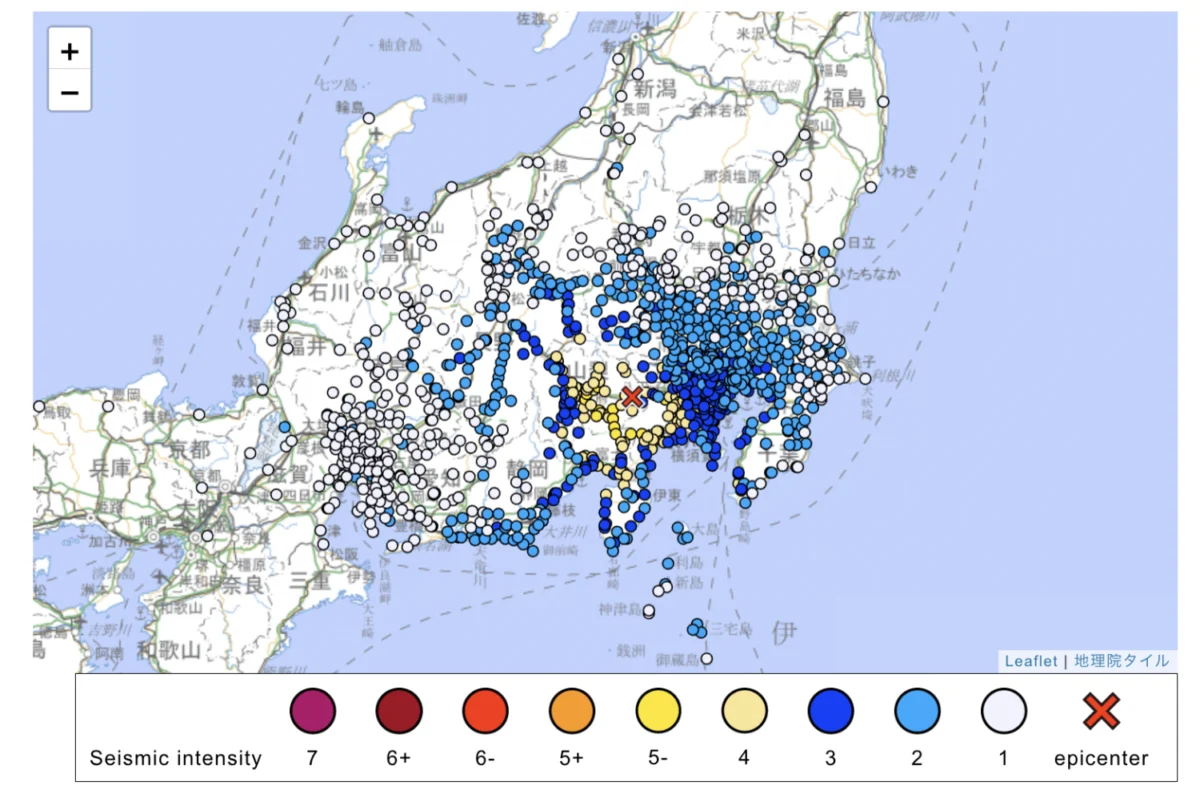
TOKYO – A powerful 5.6-magnitude earthquake struck Yamanashi Prefecture and the surrounding Kanto region on Friday night, sending shockwaves through the Tokyo metropolitan area and prompting a massive emergency response. The seismic event, which occurred at 10:29 p.m., caused structural damage, triggered localized landslides, and led to temporary suspensions of major rail services.
Despite the intensity of the shaking, which reached a "lower 6" on Japan’s rigorous 7-point shindo intensity scale, there was no threat of a tsunami. Officials have confirmed that Mount Fuji, located just 30 kilometers from the epicenter, remains stable with no signs of volcanic activity.
The Seismic Event: An Unprecedented Tremor
The earthquake, which originated at a depth of 20 kilometers, registered a "lower 6" in the town of Fujikawaguchiko in Yamanashi Prefecture. On the shindo scale, a lower 6 is classified as a level where standing becomes difficult, unsecured furniture is prone to tipping over, and wall tiles or windows may sustain damage.
In the city of Otsuki, the intensity was recorded as an "upper 5," while parts of Shizuoka and Kanagawa prefectures felt a "lower 5." The Japan Meteorological Agency (JMA) also reported that the earthquake generated "Class 1" long-period ground motion. This phenomenon, which produces slow, rhythmic, and prolonged oscillations, is particularly hazardous to high-rise structures. Even at the lowest intensity, Class 1 motion is sufficient to cause hanging objects to swing noticeably and can induce feelings of dizziness or swaying among those situated on the upper floors of skyscrapers.
For Yamanashi, this event is historic. It marks the first time the prefecture has experienced a shindo 6 earthquake in over a century, with the previous occurrence dating back to 1924. While tremors of shindo 5 or higher occur in this region roughly once per decade, the intensity of Friday’s quake serves as a stark reminder of the volatile tectonic nature of the Japanese archipelago.
Chronology of the Crisis
The night unfolded rapidly as emergency services scrambled to manage the cascading effects of the tremor:
- 10:29 p.m.: The earthquake strikes, centered in Yamanashi Prefecture.
- 11:00 p.m.: Power outages are reported across approximately 2,860 households in Yamanashi, Saitama, and Ibaraki. Chubu Electric Power confirms that the Hamaoka Nuclear Power Plant in Shizuoka remains stable with no radiation leaks.
- 11:25 p.m.: Authorities report 24 emergency calls involving collapsed walls, traffic signal failures, and structural damage.
- 12:40 a.m. (Saturday): Chief Cabinet Secretary Minoru Kihara hosts an emergency press conference, confirming six injuries—five in Yamanashi and one in Kanagawa.
- 1:08 a.m. – 1:17 a.m.: JR East and the Tokaido Shinkansen resume normal operations following safety inspections, though lingering delays continue to affect the rail network.
Assessing the Damage and Infrastructure
As of early Saturday morning, the primary focus of local authorities shifted to infrastructure assessment. In the town of Nakai, Kanagawa Prefecture, a landslide was reported, necessitating a swift response from rescue teams. In Fujiyoshida, Yamanashi, a large concrete wall collapsed, though no injuries were reported at that specific site.
In Kofu, the capital of Yamanashi, news footage revealed damaged building facades and debris-strewn streets. Prefectural authorities issued urgent advisories to residents, urging them to exercise extreme caution when traversing the area, as damaged structures and unstable road surfaces remain hazardous in the dark, rainy conditions.
The rail network, a lifeline for the Tokyo metropolitan area, faced significant disruption. While the Tokaido Shinkansen and JR East lines were forced to halt operations for mandatory safety checks, the swift restoration of services by 1:17 a.m. helped mitigate the long-term impact on commuters. However, the situation was compounded by the fact that several rail lines were already experiencing service interruptions due to two tropical storms currently moving toward the main island of Honshu.
Official Responses and Government Coordination
Prime Minister Sanae Takaichi addressed the nation shortly after 11:00 p.m. from the Prime Minister’s Office. She announced the establishment of a centralized crisis management center to coordinate the government’s response and gather real-time data on the impact of the disaster.
"I have directed that the government do everything possible in responding to this disaster. Human life is our top priority," Takaichi stated, urging residents in affected areas to remain alert.
The Chief Cabinet Secretary echoed these sentiments, emphasizing that while current damage reports remain localized, the government is treating the situation with the highest level of gravity. Regarding the nuclear power plants, officials confirmed that monitoring stations around the Hamaoka plant showed no irregularities, providing much-needed reassurance to a public often anxious about the safety of nuclear facilities during seismic events.
Implications: The Threat of Aftershocks and Weather Hazards
The most pressing concern moving forward is the risk of further seismic activity. Ayataka Ebita, head of the JMA’s earthquake and tsunami monitoring division, delivered a sobering assessment at 12:40 a.m. Saturday. He warned that the next week carries a 10% to 20% probability of another major earthquake occurring in the same vicinity, with the risk being particularly elevated over the next 48 to 72 hours.
This risk is further complicated by the impending arrival of two tropical storms. The combination of saturated soil from heavy rain and the structural weakening caused by the earthquake significantly increases the potential for landslides. The JMA has urged residents in mountainous or hillside areas to monitor official evacuation orders closely.
Regarding recent seismic activity elsewhere in Japan—specifically strong shaking felt in Iwate and Chiba prefectures over the past week—Ebita sought to clarify that these events are geologically distinct. "These quakes are geographically far apart and are considered unrelated," he noted, effectively quelling fears of a larger, systemic tectonic shift across the country.
Looking Ahead: Preparedness in an Age of Uncertainty
For the residents of Yamanashi and Tokyo, the event was a visceral reminder of Japan’s vulnerability to natural disasters. The effectiveness of the early warning systems and the rapid resumption of transport services highlight the country’s high state of disaster preparedness. However, the psychological toll of a "lower 6" quake, combined with the dual threat of incoming tropical storms, places an immense burden on local communities.
As daylight breaks, authorities expect a clearer picture of the damage to emerge. The focus will now shift from immediate life-saving operations to long-term recovery and the stabilization of residential areas. For now, the message from the government remains consistent: stay informed, remain cautious, and be prepared for potential aftershocks.
The JMA continues to monitor the region around the clock, with all eyes on the tectonic stability of the Yamanashi region. While the immediate danger has passed, the combination of weather-related threats and the possibility of seismic aftershocks means that the state of high alert remains firmly in place for the coming days.


 Neng Nana
 Asro
Asro