Asro
Asro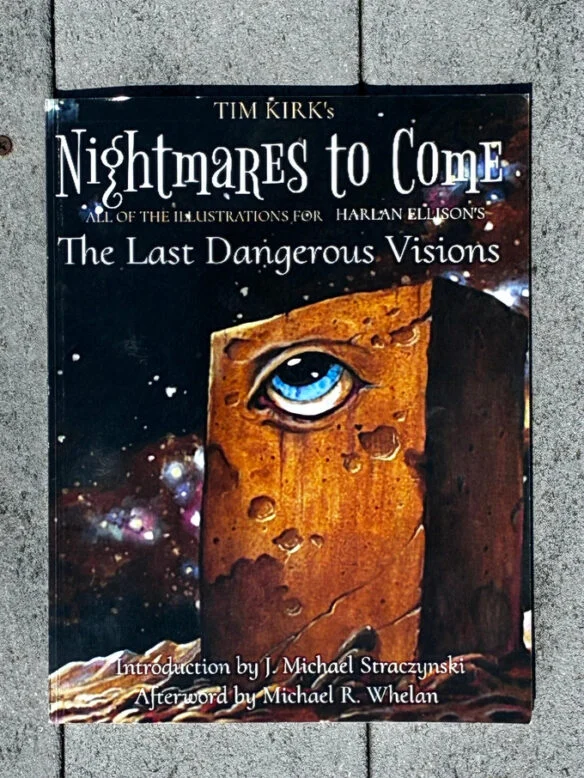
The landscape of speculative fiction remains as vibrant and volatile as ever. From the recovery of long-lost artistic treasures linked to legendary authors to the institutional shifts within the world’s largest knowledge repositories, the past week has been a whirlwind of cultural evolution. This report synthesizes the latest developments in SFF literature, art, digital governance, and industry news.
I. Unearthing the "Lost" Visions: Tim Kirk’s Hidden Legacy
A long-dormant chapter in science fiction history has been reopened with the launch of a Kickstarter campaign for Nightmares to Come, a collection of artwork by Tim Kirk. The project aims to compile illustrations Kirk produced for Harlan Ellison’s legendary, long-delayed anthology, The Last Dangerous Visions.
The Historical Context
For decades, The Last Dangerous Visions (TLDV) served as the "Holy Grail" of science fiction publishing. Ellison commissioned Kirk to illustrate every story within the anthology, a monumental task that spanned over twelve years. Due to the shifting nature of the project and the eventual withdrawal of many stories, Kirk produced over 100 illustrations, only a fraction of which appeared in the final version of the book—a volume eventually completed and published posthumously by J. Michael Straczynski.
Jan Strnad, speaking on behalf of the project, noted that these original drawings were scattered across Ellison’s home, hidden in file folders and boxes. The upcoming collection will feature these rediscovered pieces, with fewer than a third of the included works having ever been published before. The Kickstarter has already garnered significant support, reflecting the enduring obsession with Ellison’s editorial legacy and the high regard for Kirk’s diverse stylistic range, which spans from whimsical cartoons to complex, Beardsley-esque tableaux.

II. Digital Governance: The Wikipedia/Sanger Conflict
In a landmark decision, Wikipedia’s volunteer community has barred co-founder Larry Sanger from editing the platform. The move, reported by The New York Times, underscores the tension between Wikipedia’s decentralized, consensus-based governance and the influence of high-profile critics.
Procedural Violations
While Sanger has long been a vocal critic of Wikipedia—accusing it of systemic left-wing bias—the ban was not based on his rhetoric. Instead, editors cited "canvassing" violations. Sanger had used his significant social media presence on X (formerly Twitter) to rally an outside audience to support his "WikiProject Intellectual Diversity" proposal.
Wikimedia Foundation representatives emphasized that their policies apply uniformly to all users, regardless of their status as founders. By attempting to sway internal policy votes through external pressure, Sanger was deemed to be in violation of the platform’s core ethos: that it is a space for building an encyclopedia, not a battleground for political maneuvering. Sanger has decried the lack of "due process," while the community maintains that their transparent, consensus-driven system is the only way to protect the site’s integrity.
III. Industry Shifts: DC Animation and the "Absolute" Success
Warner Bros. Animation and DC Studios have officially announced the development of an adult animated series based on the Absolute Batman comic run. The announcement, made at the Annecy International Animation Film Festival, signals a major push to capitalize on the massive commercial success of the Absolute line.

Implications for the DCU
The Absolute Batman series will be helmed by writer Scott Snyder and artist Nick Dragotta, who serve as showrunners and producers. This expansion follows the critical and commercial triumph of the print series, which has successfully bridged the gap between legacy readers and a new generation of fans. The project is seen as a strategic pivot to leverage the "Absolute" brand’s ability to revitalize the DC narrative universe.
Concurrent with this, critical reception for other DC properties remains mixed. A notable review in Reactor by Emmet Asher-Perrin—titled "Supergirl Should Be Ashamed of Itself"—highlights the ongoing difficulties Hollywood faces in translating female-led superhero narratives into cinematic gold, despite the success of the recent Superman film reboot.
IV. Community and Memory: Remembering Inge Heyer and Eugie Foster
The SFF community is mourning the loss of two influential figures: astronomer and convention stalwart Inge Heyer, and award-winning author Eugie Foster.
Inge Heyer: Bridging Science and Fandom
Inge Heyer, Co-Chair of the Shore Leave convention, passed away recently, leaving behind a legacy that spanned from the Space Telescope Science Institute to the classroom. Heyer was instrumental in bringing authentic Hubble Space Telescope imagery to science fiction television staples like Babylon 5 and Star Trek. Her work as an educator and public speaker served as a bridge between the rigorous world of astrophysics and the imaginative freedom of fandom.

Eugie Foster: A Life in Short Fiction
Cat Eldridge provided a moving retrospective on Eugie Foster, who passed away in 2014. A Nebula Award winner and a powerhouse in the short fiction community, Foster’s work—such as "The Sinner, Baker, Red Mask, Black Mask, Gentleman, Beast"—remains a touchstone for the genre. Her dedication to the craft, even during her final illness, serves as a testament to her profound impact on SFF literature.
V. Chronology of Recent Developments
- June 25, 2026: Jerry Moriarty, the painter who transformed the aesthetics of modern comics, passes away at 88. His work in Raw magazine is credited with elevating cartooning to high art.
- June 26, 2026: Scott Edelman releases Episode 285 of Eating the Fantastic, featuring an in-depth conversation with Mark L. Van Name, touching on the Clarion workshop, comic collecting, and the legacy of Harlan Ellison.
- July 1, 2026: The Speculative Literature Foundation (SLF) opens submissions for the "Diverse Writers" and "Diverse Worlds" grants ($500 each), aimed at supporting underrepresented voices in the genre.
- Ongoing: KalpaDB continues to build India’s first community-curated database for speculative fiction across Indian languages, inviting global volunteers to contribute.
VI. Intellectual Frontiers: Demons and Gonzo Writing
The intersection of science and humanities continues to provide fertile ground for exploration. Robert Crease and Elyse Graham at Stony Brook University have successfully integrated the study of "demons"—both the metaphorical creatures of thermodynamics and the digital "daemons" of computer science—into a university curriculum. Their course, "Demons to think with," challenges students to look at how mythological archetypes shape our understanding of modern technology and physics.
Meanwhile, author Ernst Hogan continues to push the boundaries of "Gonzo" writing. In a recent diary entry, Hogan details his process for his Chicanonautica series, describing how he uses live, improvisational writing exercises to fuel his fiction. His approach highlights a trend in SFF: the move toward more transparent, process-oriented storytelling that invites the reader into the "diabolical imagination" of the author.
VII. Conclusion: The State of the Field
As we look at the breadth of these events, a clear picture emerges: the speculative fiction community is in a state of rapid, reflexive growth. Whether it is the reclamation of lost artistic history (Kirk), the rigorous debate over digital governance (Sanger/Wikipedia), or the celebration of those who bridged the gap between the stars and our screens (Heyer), the field remains a space of constant re-evaluation.

The success of Absolute Batman and the continued growth of initiatives like KalpaDB suggest that, despite institutional tensions, the appetite for SFF-related content—and the community’s desire to organize and document it—is stronger than ever. As these projects mature, they will undoubtedly continue to shape the cultural conversation for years to come.


 Azzam Bilal Chamdy
 Raul Delapena Setiawan