Iffa Jayyana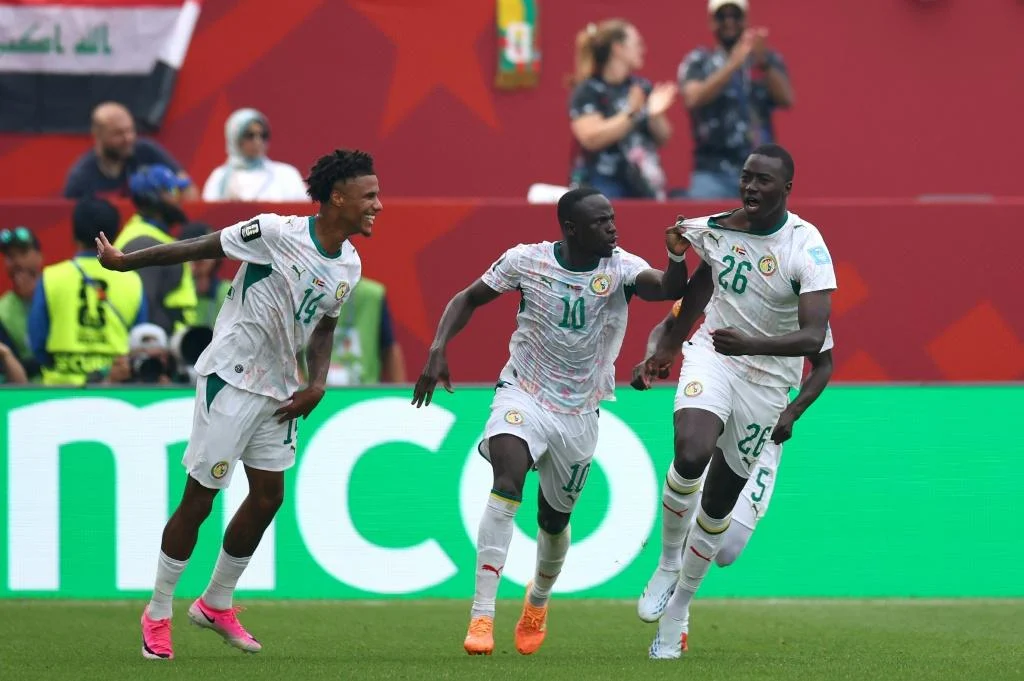
By Sports Correspondent
Friday, June 12, 2026
In a display of clinical efficiency and overwhelming attacking prowess, Senegal etched their name into the annals of football history on Friday, becoming the first African nation to score five goals in a single World Cup match. The 5-0 demolition of Iraq in their final Group I encounter was not merely a victory; it was a statement of intent that revitalized Senegal’s tournament ambitions and left the Iraqi side reeling from a calamitous exit.
While the result leaves Senegal waiting nervously to see if they secure a place in the last 32 as one of the best third-placed finishers, their superior goal difference has placed them at the front of the queue. For Iraq, the final whistle signaled the end of a grueling, heart-wrenching campaign that promised much but delivered nothing in terms of points.
The Chronology of a Collapse
The match began with a palpable sense of urgency from the Teranga Lions, who knew that a simple win would not suffice; they needed a margin of victory that would bolster their goal difference.
Early Breakthrough and the Turning Point
Senegal struck within the opening minutes. A perfectly weighted corner kick found the head of Abdoulaye Seck, whose powerful effort was redirected by the slightest of touches from Habib Diarra. It was Diarra’s first international goal since his strike against England last year, and it served as the catalyst for the chaos that followed.
Iraq’s defensive stability disintegrated in the 13th minute. In a moment of desperation, defender Rebin Sulaka—recalled to the starting lineup by coach Graham Arnold—clattered into Sadio Mane as the talismanic forward broke through on goal. English referee Anthony Taylor, after a deliberate review at the VAR monitor, reached for the red card.
The dismissal was historic: it was the earliest red card shown in the 2026 World Cup and the fourth-fastest in the tournament’s long history. Reduced to ten men, Iraq’s tactical game plan was shredded. Despite the man advantage, Senegal initially struggled to break down a low block, with Ismail Jakobs coming closest with a fierce strike that narrowly whistled past the post, leaving the goalkeeper rooted to the spot.
The Second-Half Avalanche
The halftime interval proved disastrous for Iraq. Goalkeeper Ahmed Basil, having sustained a knock in the opening 45 minutes, was forced to withdraw, leaving backup Jalal Hassan to face the onslaught.
The dam broke in the 56th minute. A catastrophic error by former Manchester United midfielder Zidane Iqbal deep in his own half surrendered possession to the predatory Senegalese attack. Ismaila Sarr, capitalizing on the turnover, tapped home his third goal of the tournament. The release of pressure was evident, with Sarr celebrating by lying prone on the turf, pumping his fists in a display of pure, unadulterated relief.
The Pape Gueye Show
If the first two goals were about building momentum, the next two were about individual brilliance. Enter Pape Gueye. The Villarreal midfielder, brought on as a substitute, took exactly 89 seconds to leave his mark. Receiving the ball outside the box, he unleashed a sublime, curling effort that defied physics, bending into the top corner to make it 3-0 in the 59th minute.
Twelve minutes later, Gueye repeated the feat, though with more venom. A vicious half-volley screamed past Hassan, leaving the Iraq goalkeeper with no chance. By this point, the Iraqi dugout was a portrait of despair, with coach Graham Arnold seen leaning heavily against the structure, shaking his head in disbelief as his defensive structure crumbled.
The misery for Iraq was compounded in the 82nd minute when Iliman Ndiaye joined the party, firing home another long-range screamer to seal the 5-0 victory.
Supporting Data: Statistical Dominance
The statistics from the encounter underscore the lopsided nature of the game. Senegal controlled 68% of possession and registered 18 shots, 11 of which were on target. Iraq, by contrast, struggled to maintain any attacking continuity after the 13th-minute red card, failing to register a single shot on target throughout the entire 90 minutes.
Key Match Metrics:
- Total Shots: Senegal 18, Iraq 4
- Possession: Senegal 68%, Iraq 32%
- Pass Accuracy: Senegal 89%, Iraq 74%
- Red Cards: 1 (Iraq – Rebin Sulaka)
- Tournament Milestone: First African side to score 5+ goals in a World Cup game.
The result leaves Senegal with a +3 goal difference. Among the teams currently sitting on three points in the group stages, Senegal now holds the most favorable margin, significantly improving their odds of sneaking into the Round of 32 as one of the eight highest-ranked third-place sides.
Official Responses and Tactical Post-Mortems
Following the match, the mood in the post-game press conferences was a study in contrasts.
Senegal Coach’s Perspective:
The Senegalese manager praised his side’s patience, noting that the goal was always to stay composed. "We knew that once the first goal went in, the space would open up. It wasn’t just about winning; it was about the statement we made today. We have players who can score from anywhere, as Pape Gueye showed. This is the level we expect from this group."
Graham Arnold’s Disappointment:
Iraq’s manager, Graham Arnold, was visibly pained. "When you lose a player of Sulaka’s caliber after 13 minutes, your strategy goes out the window. We asked the boys to dig deep, and for a half, they did. But the error for the second goal killed us mentally. It’s a bitter way to leave the tournament, especially after the effort we put in to qualify."
When asked about Zidane Iqbal’s error, Arnold was protective of his player. "These things happen at the highest level. You can’t blame one individual when the entire team is under such sustained pressure."
Implications: What Lies Ahead?
For Senegal, the win acts as a massive psychological boost. They have evolved from a team struggling to find the net to a side capable of dismantling defenses with ease. Their path to the knockout stages is now out of their hands, dependent on the results of other groups, but they have done everything within their power to earn a reprieve.
For Iraq, the implications are more somber. The campaign ends in a "hugely disappointing" fashion. Despite an arduous qualifying journey that saw them traverse the continent, they leave the 2026 World Cup without a single point. For the Iraqi Football Federation, the post-mortem will likely focus on the lack of discipline and the inability to rotate the squad effectively under pressure.
The Bigger Picture for African Football
This victory serves as a watershed moment for African football. While nations like Cameroon, Nigeria, and Morocco have long been associated with World Cup pedigree, Senegal’s five-goal haul signals a shift in attacking intensity. The ability to finish games with such clinical authority is a trait often reserved for the European and South American powerhouses. If Senegal does progress, they will carry the hopes of a continent that is increasingly looking to redefine its standing in the global hierarchy.
As the dust settles on Group I, the footballing world is left to reflect on an evening where tactical discipline met individual genius, and where a tournament dream was kept alive in the most emphatic manner possible. Whether Senegal continues their journey in the Round of 32 remains to be seen, but their place in history is now permanently secured.
© 2026 AFP


 Neng Nana
 Asro
Asro