Layla Zulfa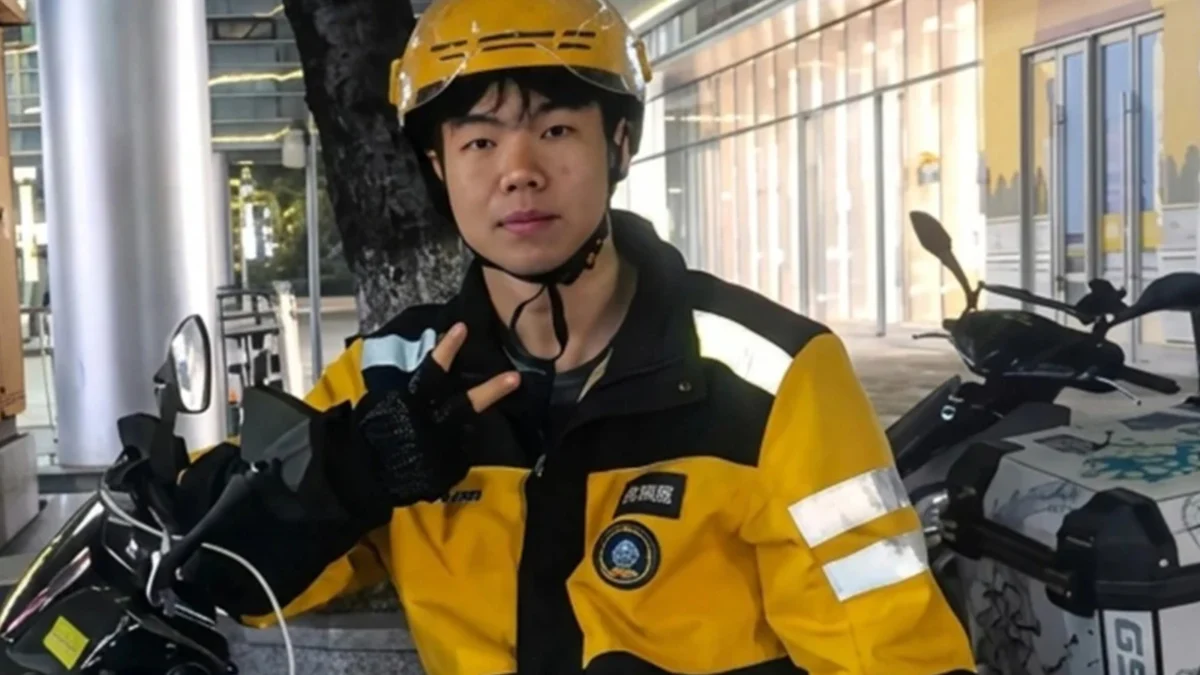
In the quiet corners of Guizhou province, China, the life of a 20-year-old delivery rider, Jin Xiaowu, was defined by his work—navigating bustling streets to deliver meals, chasing a modest dream of providing for his family. On May 27, however, his life was redefined by an act of profound courage. Jin, an employee of the delivery giant Meituan, lost his life while attempting to save a father and his young son from drowning in a river.
His sacrifice, which has since sent shockwaves of grief and admiration across Chinese social media, was not merely a tragic accident; it was the final chapter in a young man’s life defined by selflessness. In the aftermath of his passing, the corporate and local communities have rallied to honor his memory, culminating in a gesture that fulfilled his final, unvoiced dream: to provide his father with a vehicle of his own.
The Chronology of a Heroic Act
On that fateful day in May, the tranquil atmosphere near a riverbank in Guizhou was shattered when a child, playing near the water’s edge, lost his footing and plunged into the current. The child’s father, witnessing the horror unfold, immediately dove into the water in a desperate bid to save his son. However, the river, deceptive in its appearance and bolstered by strong, hidden currents, quickly overwhelmed both of them, pulling them toward deeper, more dangerous waters.
Jin Xiaowu, who was nearby, did not hesitate. Alongside his colleague, Wang Fangyang, and two other bystanders who witnessed the unfolding crisis, Jin sprinted toward the river. Without pausing to consider his own safety, he dove into the water.
The rescue mission was a grueling struggle against nature. The group of four rescuers eventually managed to reach the father and son, pulling them toward the bank and to safety. However, the exertion required to battle the currents had depleted Jin’s strength. Exhausted and struggling to maintain his footing, the 20-year-old was swept away by the river’s relentless force. Despite a search-and-rescue operation launched immediately, his body was recovered by firefighters later that evening.
The Human Cost: A Family’s Grief
The death of Jin Xiaowu left a void that transcends the local community. Jin Peiyin, the young man’s father, spoke to local media in the days following the tragedy, his voice heavy with a grief that is impossible to articulate.
"He was always the kind of person who would reach out to help others," Jin Peiyin said, his eyes filled with tears. "If someone was in danger, he would never hesitate. That was just who he was. But I miss him so much."
The sentiment was echoed by Jin’s sister, whose poignant social media post captured the agonizing sense of loss felt by those closest to him: "The closer I get to home, the further you seem to be from me."
Behind the label of "hero," Jin was a young man with a clear vision for his future. According to reports from the South China Morning Post, Jin had been working tirelessly to save 20,000 yuan—roughly $3,000—with a singular goal in mind: to purchase a minivan for his father. Friends have since come forward, sharing messages and photos of vans that Jin had sent them, discussing his plan to surprise his father with the gift. It was a humble, hardworking dream, cut short by an act of supreme altruism.
Corporate Responsibility and the Fulfillment of a Dream
In the wake of the tragedy, the response from Meituan, the delivery platform for which Jin worked, was both swift and significant. Recognizing the heroism of their employee and the profound loss suffered by his family, the company moved to provide both financial and emotional support.

Meituan announced a consolation payment of 100,000 yuan (approximately $15,000) to the family. Beyond the financial support, the company took a step that served as a powerful tribute to Jin’s final wish. One day before Father’s Day in China, the company presented the family with a new car—the very gift Jin had been working toward for his father.
"We are committed to standing by the family of our fallen colleague," a spokesperson for the company stated, promising ongoing support as the family navigates the difficult road ahead. This gesture, while not replacing the life of a son, serves as a symbolic completion of his final promise, allowing the family to feel that his hard work and dedication were not in vain.
Broader Implications: The "Gig Worker" as Modern Hero
The story of Jin Xiaowu has sparked a wider conversation in China about the role of delivery riders in society. Often seen as invisible laborers navigating the pressures of time-sensitive delivery quotas, these workers are increasingly becoming the "first responders" of the gig economy.
Local officials in Guizhou have moved to formalize their recognition of the event, nominating Jin and his fellow rescuers for prestigious bravery awards. The funeral, which saw an outpouring of support from villagers and locals, became a site of collective mourning and celebration of a life lived for others.
This incident is not an isolated one. The "delivery hero" archetype has become a recurring motif in recent years. Earlier this year, an Amazon delivery driver in the United States was credited with saving an 84-year-old woman from a house fire after he noticed smoke while on his route and immediately contacted emergency services. Similarly, in 2024, another Amazon driver made headlines for his quick thinking after a 6-year-old boy, terrified for his mother who had fainted, flagged the driver down for help.
These instances highlight a recurring pattern: delivery drivers, by virtue of their presence in neighborhoods and public spaces, are often the only ones in a position to intervene in crises. However, the tragic nature of Jin’s death serves as a sobering reminder of the physical risks involved in such spontaneous acts of courage.
Conclusion: A Legacy of Selflessness
The death of Jin Xiaowu is a profound reminder of the fragility of life and the strength of the human spirit. While he did not live to see the fruit of his labor or the pride on his father’s face when he received the car, his actions have secured his legacy as a man of extraordinary character.
As society continues to grapple with the challenges of the modern economy and the increasing reliance on frontline workers, stories like Jin’s challenge us to see the individuals behind the uniforms. He was more than a delivery rider; he was a son, a friend, and a man who valued the lives of strangers above his own.
In the quiet streets of his hometown, and in the hearts of those who heard his story, Jin Xiaowu remains a symbol of bravery. His journey reminds us that even in the most mundane of professions, there is room for extraordinary heroism. As his family moves forward, supported by his community and his employer, the memory of his sacrifice will likely remain a beacon—a testament to a young man who, in his final moments, gave everything to ensure that a father and his son could return home to theirs.


 Dwi Wanna
 Rifan Muazin