Asep Darmawan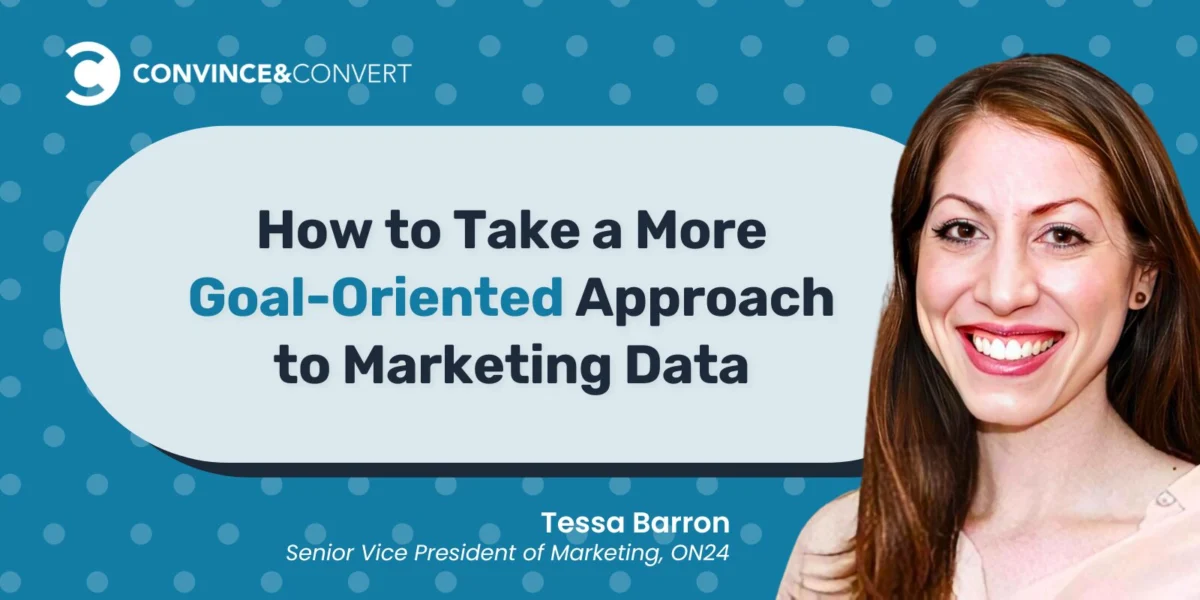
The perennial corporate mantra of "do more with less" is a phrase that often elicits a weary sigh from marketing professionals. In an era of tightening budgets, shrinking resources, and increasingly ambitious pipeline targets, the directive can feel fundamentally disconnected from reality. It suggests a quantitative solution to a qualitative problem—the assumption that if you simply run more webinars, publish more whitepapers, or increase ad spend, the results will follow.
However, Tessa Barron, formerly the Senior Vice President of Marketing at ON24, suggests that the solution is not to increase the volume of activity, but to fundamentally shift the marketing mindset. In a recent appearance on the Data-Driven Decisions podcast, Barron argued that the obsession with "tactical output" is a primary reason many marketing teams fail to move the needle. To thrive in the current landscape, marketers must move away from being "tactic-oriented" and toward being "goal-oriented," using data not just as a tracking tool, but as a compass for strategic decision-making.
The Evolution of Marketing Expectations: A Necessary Reckoning
The landscape of B2B marketing has shifted dramatically since 2020. Consumer behavior, the digital buyer’s journey, and the ways in which stakeholders consume information have undergone a permanent transformation. Yet, a significant number of marketing organizations remain tethered to the "playbooks" of yesteryear.
"We as marketers have to check in with ourselves and ask: ‘Have we changed? Are we still doing what we were doing three or four years ago?’" Barron notes. "If the answer is yes, that is the first sign that we need to stop expecting that if we execute in the same way, we’re going to get more in return."
The Danger of Tactic-First Thinking
For veteran marketers, it is comfortable to rely on "tried-and-tested" channels. Webinars, long-form whitepapers, blog series, and podcasts are staples of the modern marketing toolkit. There is nothing inherently flawed about these assets; the danger lies in leading with the tactic rather than the objective.
When a team sets a goal to "produce four webinars in Q1," they have already constrained their strategic potential. If the goal is instead "achieve a 10% uplift in pipeline target," the entire creative process changes. This shift allows marketers to ask the essential questions: What is the specific bottleneck in our conversion funnel? What information does our prospect need to move from the ‘discovery’ phase to ‘qualified lead’ status?
By working backward from the revenue goal, the tactic becomes a deliberate instrument of persuasion rather than just another content asset sitting in a digital library.
Uncovering Signals: The Architecture of Intent
In the modern enterprise, data is rarely in short supply. If anything, the challenge has shifted from a lack of data to an excess of "noise." Marketing dashboards are often cluttered with vanity metrics—page views, email open rates, and social media likes—that offer little insight into whether a lead is likely to convert into a paying customer.
Barron suggests replacing the concept of "data" with "signals." A signal is any behavioral indicator that suggests a buyer is nearing a point of decision. The goal of the marketer is to design "traps" or interactive touchpoints that force these signals to the surface.
Turning Webinars into Intelligence Hubs
ON24, under Barron’s strategic guidance, transformed the standard webinar from a passive broadcast medium into an active intelligence-gathering platform. By integrating polls, surveys, real-time Q&A, and targeted calls-to-action, they turned audience engagement into high-fidelity data.
- Case Study: The Cloud Provider Insight. A technology client struggling to reclaim market share identified a crucial variable: prospects using a specific cloud infrastructure were ten times more likely to convert. The marketing team didn’t just target these prospects with generic ads; they embedded a direct question into their webinar registration and session flow: "Which cloud provider do you currently use?" This immediately bifurcated the audience, allowing the sales team to prioritize the high-intent segment.
- Case Study: The Healthcare Risk Assessment. In the pharmaceutical sector, the objective was to identify physicians managing high-risk patient populations. Rather than bombarding doctors with broad information, the company hosted an educational session on new drug therapies. They asked participants to rate the risk profile of their patient base. Those who self-identified as having "high-risk" patients were flagged as prime candidates for personalized follow-up, transforming a broad marketing event into a targeted lead-generation engine.
The Sales-Marketing Nexus: Bridging the Gap
A recurring theme in high-performing organizations is the breakdown of silos between sales and marketing. Too often, marketing departments operate under the assumption that they are responsible for creating the pipeline. Barron offers a sobering correction: "Marketers are creating signals and developing a net to catch people, but it is the salespeople—those on the front lines—who actually create the pipeline."
Aligning on Qualification
The friction between these departments often stems from a lack of shared language. Marketing may define a "qualified lead" based on content consumption, while sales defines it based on budget, authority, need, and timeline (BANT).
Barron advocates for a collaborative approach:
- Interview the Frontline: Marketing leaders should regularly join sales calls to hear the specific objections, hesitations, and language used by prospects.
- Translate Pain Points to Content: If sales hears the same three questions in every discovery call, those questions should be addressed in the marketing content strategy.
- Define the "Hand-off" Data: Marketing’s primary role is to provide the sales team with a "clear picture" of the prospect before the first phone call is made. If the data isn’t helping the salesperson win the deal, the data is not useful.
Implications for Strategic Execution
By focusing on the "little steps" between an initial lead and a closed-won opportunity, marketers can exert control over areas that are often neglected, such as outdated website lead forms or generic nurturing emails.
The Framework for Messaging
To build a consistent pipeline, marketing teams should adopt a tiered framework for messaging:
- Awareness: Broad education that addresses industry trends.
- Consideration: Targeted content that addresses specific pain points or competitive differentiators.
- Decision: Data-driven, high-intent touchpoints (such as the signal-gathering webinars mentioned above) that provide the final push for a sales conversation.
This approach is inherently scalable. By shortening forms, creating personalized landing pages, and providing interactive opportunities, marketers can see significant improvements in conversion rates without needing a larger budget. It is a transition from "doing more" to "being more precise."
Communicating Value: Visualizing the Impact
Finally, there is the challenge of reporting. When marketing teams are buried in the weeds of granular data, it becomes difficult to articulate the "why" to company stakeholders and C-suite executives who are focused on the bottom line.
Barron emphasizes that data should be presented in the simplest, most visually engaging way possible. Stakeholders do not necessarily need to see the complexity of the funnel; they need to see the trend lines. Is the conversion rate improving? Is the cost per acquisition trending downward? How does a specific strategy correlate with revenue growth?
By stripping away the noise and focusing on the metrics that define success, marketers can secure the buy-in necessary to continue their initiatives.
Conclusion: The Path Forward
The "do more with less" mandate is only daunting if the goal remains the quantity of output. If the goal is reoriented toward the quality of the pipeline, the challenge transforms into an opportunity for innovation.
By identifying the signals that matter, aligning with sales to understand the reality of the buyer’s journey, and ruthlessly prioritizing actions that drive conversion, marketers can stop being victims of their own workload. They can become architects of growth, building a sustainable, data-backed engine that delivers exactly what the business needs: not more noise, but more meaningful revenue.


 Nana Muazin
 Reynand Wu