Asep Darmawan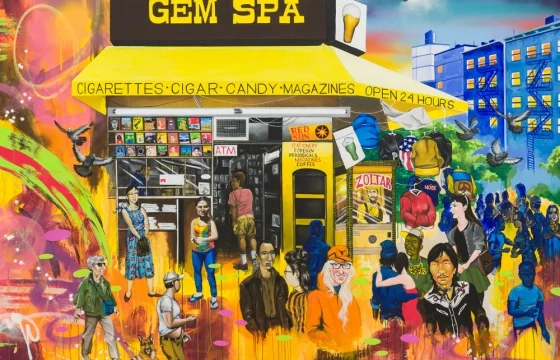
Introduction: A Synthesis of Grit and Grace
New York City has long been a canvas, a crucible, and a character in the grand narrative of American art. Few artists have navigated the transformation of this urban landscape with as much nuance and persistent energy as Chris “Daze” Ellis. In his latest solo exhibition, Orchid Rain on the Underground, currently on view at PPOW through April 25, 2026, Daze presents a masterful synthesis of his career, bridging the gap between the raw, spray-painted spontaneity of 1970s subway graffiti and the disciplined, evocative fine art practice he has refined over the past fifty years.
The exhibition is far more than a retrospective; it is a living, breathing testament to the enduring creative spirit of New York. Through a series of new paintings, a site-specific mural, and an immersive multimedia installation, Daze invites viewers to traverse the boundaries between the city’s industrial past and its vibrant, evolving present. By juxtaposing the tactile, gritty reality of the underground with the delicate, ephemeral beauty of tropical flora, Daze captures the paradox of the city: a place of perpetual destruction and relentless rebirth.
The Foundation: From Brooklyn Streets to the Studio
To understand the gravity of Orchid Rain on the Underground, one must first understand the environment that forged Daze’s artistic identity. Born in Brooklyn in 1962, Daze came of age during a period of profound urban transition. While attending the High School of Art and Design in the mid-1970s, he found himself surrounded by a burgeoning creative movement that was, at the time, largely dismissed by the establishment.
Mentored by the pioneering spirits of the graffiti movement—visionaries like Blade, Lee Quiñones, and PHASE 2—Daze learned early on that the city itself was the ultimate medium. He began by tagging subway cars, a practice that taught him the necessity of speed, composition, and the assertion of individual identity against a monolithic, often decaying public infrastructure. However, as the 1970s bled into the 1980s, Daze began a deliberate migration from the fleeting, illicit nature of transit art to the permanent, contemplative environment of the gallery studio.
This transition was not a rejection of his roots but an expansion of his lexicon. He became a fixture in the nocturnal ecosystem of New York, frequenting legendary haunts such as the Lit Lounge, Danceteria, and the Mudd Club. These venues were not merely places to gather; they were the “nerve centers” of a burgeoning cultural revolution where art, music, fashion, and performance collided. For Daze, these experiences were foundational, providing the social and intellectual fuel that would eventually translate into the complex, layered canvases seen in his current exhibition.
Chronology: The Evolution of a Style
The artistic trajectory of Chris “Daze” Ellis is a masterclass in synthesis. His work serves as a historical bridge between the Ashcan School’s early 20th-century urban realism—championed by artists like John Sloan and Reginald Marsh—and the mid-century lyrical abstraction of titans like Joan Mitchell and Willem de Kooning.
1975–1980: The Formative Years
During these years, Daze’s practice was defined by the urgency of the spray can. The aesthetic was one of rebellion and high-contrast energy. His primary focus was the negotiation of space within the subway system, transforming functional transit into moving, ephemeral art galleries.
1980–2000: The Studio Shift
As Daze moved into the studio, the challenge became translating the “gestural swaths” of graffiti into a permanent medium. He began integrating acrylics, experimenting with color theory, and refining his rendering of urban architecture. This period marked his transition into the global contemporary art market, while never losing the gritty, street-level perspective that defined his early work.
2000–Present: The Synthesis
The current works in Orchid Rain on the Underground represent a maturation of these themes. In pieces like Gem Spa In the 80s (2025), Daze demonstrates a narrative depth that is both deeply personal and historical. By documenting the now-defunct candy store at St. Mark’s Place and Second Avenue, he anchors the exhibition in a specific moment of NYC history, while his inclusion of figures like curator Carlo McCormick and artist Martin Wong adds a layer of community and lineage.
Supporting Data: The Anatomy of the Exhibition
Orchid Rain on the Underground is a multi-sensory experience designed to immerse the viewer in the artist’s psyche. The exhibition space at PPOW has been transformed into a narrative of memory and observation.
The Mural and The Installation
A site-specific mural greets visitors, acting as a transition from the exterior world of the gallery into the interior landscape of the artist’s memories. This serves as a vital acknowledgment of Daze’s roots in the public sphere. Following this is a multimedia installation that functions as a time machine. Featuring authentic subway car seats, a pulsing light-up dance floor, and a curated soundtrack—blending the house, disco, and hip-hop rhythms that defined the nightlife of his youth—the room creates a palpable sense of the “freedom and creative inspiration” that Daze experienced in his formative years.
The Floral Motif
Perhaps the most striking element of the new series is the recurring image of technicolor flora. Daze depicts flowers rising from piles of urban rubble, a powerful metaphor for the city’s resilience. By combining tropical blossoms with local wildflowers from his home in upstate New York, he creates a visual language of grief and hope. These flowers serve as memorials to the people, places, and cultural moments that have been lost to gentrification and time, while simultaneously standing as testaments to the beauty that persists in the cracks of the concrete.
Official Perspectives: The Curator’s View
PPOW’s presentation of Orchid Rain on the Underground underscores the gallery’s commitment to artists who challenge the boundaries of contemporary art. By placing Daze’s work within a historical context that includes 20th-century urban realists, the gallery highlights his importance as a chronicler of the American urban experience.
The gallery notes that while the New York of Daze’s youth may feel like a “bygone era,” the works in this exhibition provide evidence of its enduring legacy. The show is not merely an act of nostalgia; it is an assertion of relevance. Daze reminds the audience that the “creative spirit” of those early figures is the bedrock upon which the current cultural landscape of the city is built.
Implications: The Legacy of the Urban Artist
The implications of this exhibition reach far beyond the walls of PPOW. Daze’s work forces a conversation about the role of the artist in the face of urban change. In a city increasingly defined by hyper-gentrification and the sanitization of public space, Daze’s insistence on documenting the “nerve centers” of the past serves as a radical act of preservation.
His ability to merge the gestural, abstract energy of the graffiti movement with the structured, observational tradition of urban realism suggests a path forward for contemporary artists. He proves that one does not have to choose between the grit of the street and the refinement of the gallery. Instead, the two can exist in a state of productive tension.
Furthermore, Orchid Rain on the Underground emphasizes the importance of community. By populating his paintings with the faces of those who shaped his life—critics, curators, and fellow artists—Daze underscores the reality that art is never a solitary endeavor. It is a dialogue between individuals, a series of interactions that ripple outward to define a culture.
Conclusion: A Vibrant Cultural Heartbeat
As the exhibition continues its run through April 2026, it offers a rare opportunity to engage with an artist who has remained consistently honest to his vision while constantly evolving his practice. Chris “Daze” Ellis has spent five decades listening to the pulse of New York City, and in this show, he translates that pulse into a visual language that is both nostalgic and bracingly new.
Whether through the delicate, hopeful petals of a flower emerging from rubble or the neon-soaked energy of a recreation of 1980s nightlife, Daze captures the essence of the city. He honors the destruction that has defined so much of New York’s history, but he refuses to let that destruction have the final word. Instead, Orchid Rain on the Underground stands as a vibrant testament to the beauty that can be found in the everyday, the enduring power of the creative spirit, and the persistent, unshakeable heartbeat of the city that never stops changing.


 Nana Wu
 Muslim