In the landscape of contemporary independent cinema, few directors possess the ability to transmute trauma into high-concept atmosphere as effectively as Avalon Fast. Her second feature, Camp, arrives not as a standard exercise in genre thrills, but as a liminal, ambiently queer dreamscape that operates on the logic of a fever dream. Set against the backdrop of an Alberta forest—utilizing the skeletal remains of a Tim Horton soccer camp—the film is a masterclass in low-budget ingenuity, signaling Fast’s emergence as a formidable voice in the “post-trauma” horror movement.
While Camp toys with the visual vocabulary of the genre—shadows, isolation, and the weight of secrets—it steadfastly refuses to succumb to the formulaic constraints of the slasher or the traditional supernatural thriller. Instead, it offers a meditation on the process of transubstantiation: how a young woman, crushed by the weight of her own history, can claw her way toward grace by turning her demons into something, if not quite holy, then at least habitable.
The Architecture of a Breakdown: A Chronology of Guilt
The film’s narrative is anchored by the arrival of Emily, portrayed by newcomer Zola Grimmer. Grimmer delivers a performance of startling, raw vulnerability, oscillating between the sharp, cynical archness of a cynical youth and the wide-eyed, harrowing sincerity of someone who has lost their mooring.
The story begins in the aftermath of a catastrophic personal history. Emily’s life is introduced via a “truth-or-dare” sequence at a moribund house party—a setting that serves as the catalyst for her alienation. When pressed to reveal her greatest regret, Emily, perhaps searching for a connection that her peers are ill-equipped to provide, confesses to a past tragedy: the accidental vehicular death of a young child. The reaction is a chilling study in modern social callousness; the guests offer not comfort, but awkward, dismissive repulsion.
The downward spiral continues with the death of her best friend, Charlie, who succumbs to an overdose in the car shortly after they flee the party. These opening minutes are not merely plot points; they are the jagged edges upon which the rest of the film is built. Emily, now a college dropout and a walking vessel of grief, is sent by her father to work at a remote sleepaway camp for troubled youth. It is here that the film sheds its suburban reality, shifting into a surreal, ritualistic space where the forest floor seems to pulse with the energy of a coven.

The Coven in the Clearing: Character Dynamics and Atmosphere
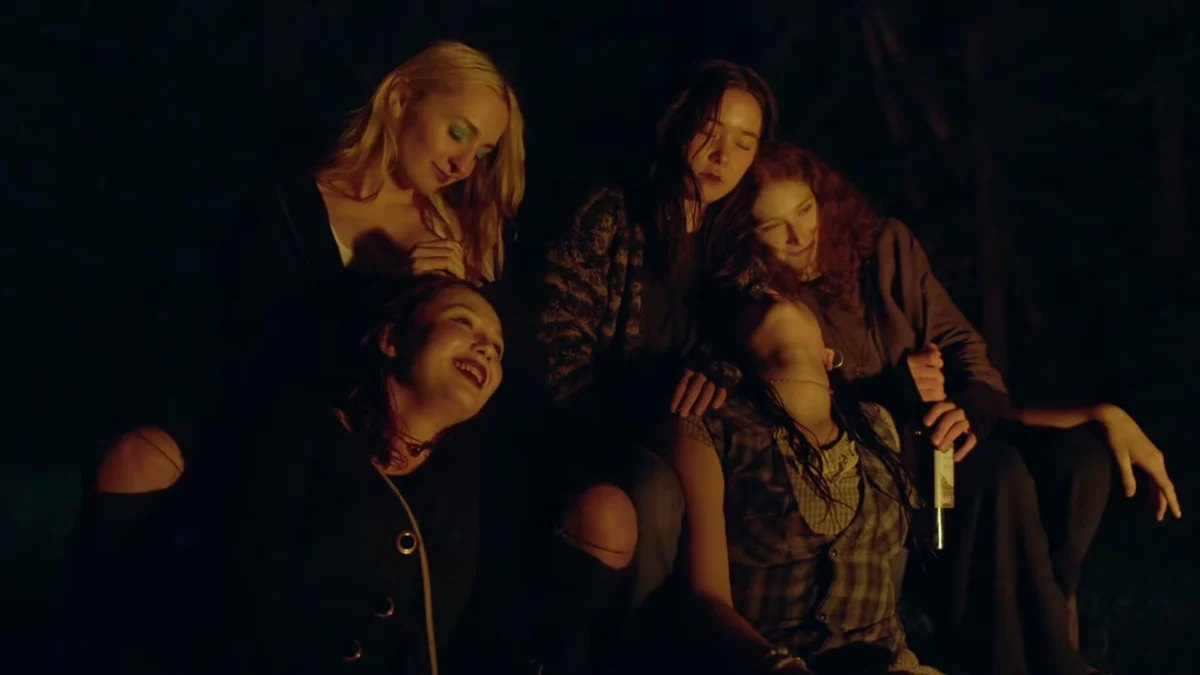
As Emily settles into the rhythm of camp life, the campers themselves—who arguably serve as the film’s "white noise"—drift in and out of the periphery. The true substance of the film is found in the bonds formed between the counselors. This group of “gorgeous weirdos” becomes the emotional center of the narrative.
The ensemble cast includes:
- Rosie (Cherry Moore): Who carries the weight of a lost child with a casual, devastating grace.
- Nev (Lea Rose Sebastianis): Who seeks to offer herself to the darkness through an obsession with the camp’s dogmatically religious leader, Dan (Austyn Van de Kamp).
- Jo (Sophie Bawks-Smith) and Clara (Alice Wordsworth): Who serve as mirrors for Emily’s own fractured identity.
The film’s brilliance lies in its refusal to offer the audience easy answers. Why are these specific counselors here? What is the sinister history of the land? Fast leaves these questions deliberately unanswered, prioritizing the feeling of the experience over the legibility of the plot. There is a palpable, latent sexual tension that permeates the group, yet it is never treated as a titillating trope. It is, instead, a component of their collective survival. They are searching for a way to settle their souls, and they find it not in the conventional structures of therapy or religion, but in the shared, ritualistic intimacy of their sisterhood.
Supporting Data: The Craft of the Low-Budget Masterpiece
Camp is a triumph of technical ambition meeting limited resources. Cinematographer Eily Sprungman provides the visual backbone of the film, expertly managing the transition from the sterile, high-contrast “normality” of Emily’s life to the blurred, enchanted, and hazy aesthetic of the camp.
The sound design, led by Max Robin’s reverb-heavy synth and guitar score, creates a fugue-like state that mirrors the internal journey of the characters. The music does not merely underscore the scenes; it actively shapes the environment, making the air in the woods feel thick, almost tactile. The inclusion of subtle animation and stylized lighting gels serves to heighten the sense of artifice, signaling to the audience that they are witnessing a construction of memory rather than a documentary of events.

Official Responses and Critical Reception
Early critical discourse has highlighted the film’s “drone-like pull.” While some reviewers have noted the occasional clumsiness of the dialogue, it is widely agreed that this “DIY” quality is a stylistic choice. Fast seems to be offering the film’s amateurish edges as a form of blood sacrifice—a way to lower the viewer’s defenses and allow them to succumb to the more intuitive, emotional currents of the film.
The film has been compared to the work of Jane Schoenbrun, particularly the thematic overlaps with Teenage Sex and Death at Camp Miasma. Yet, Camp stands apart for its refusal to engage in the “killing of men” trope often found in contemporary feminist horror. Instead, Fast focuses on the transformative nature of female kinship. The violence in the film is never directed toward reclaiming power; it is an act of communal shedding.
Implications: The Future of "Camp" as a Genre
The implications of Camp for the horror genre are significant. It challenges the industry-wide assumption that “trauma-informed” horror requires a didactic or overly explained narrative. By embracing ambiguity, Fast suggests that the most profound ways to heal—and to depict healing—are often beyond the reach of language.
The film operates on the premise that if a character is broken enough, the path to recovery must be as radical as the pain that preceded it. Whether it is through moonlight rituals or the simple act of existing in a space where one’s failures are not seen as moral deficits, Camp provides a blueprint for a new kind of cinematic catharsis.
As the film prepares for its theatrical release on June 26 via Dark Sky Films, it stands as a reminder that the most compelling stories are often those that refuse to be pinned down. Camp is not just a horror movie; it is a spiritual geography of the teenage experience, a work of “cost-effective witchcraft” that manages to be both deeply personal and universally resonant.

In the final assessment, the film’s success rests on its hypnotic faith in its own trajectory. It trusts that the audience will follow Emily into the dark, and more importantly, it trusts that they will find their way out with her. For those willing to set aside the demand for linear coherence, Camp offers an experience that is as haunting as it is restorative.
Grade: B+
Dark Sky Films will release "Camp" in theaters on Friday, June 26.