

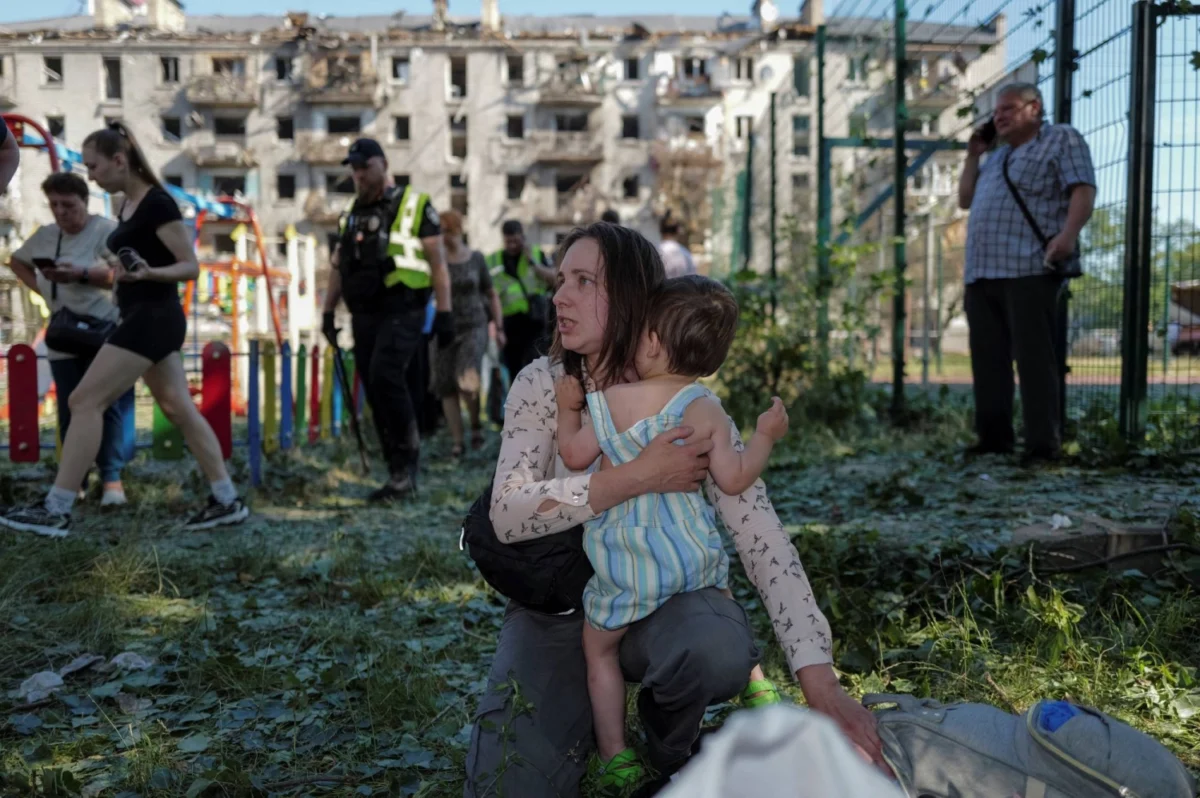
KYIV — The Ukrainian capital awoke to a scene of absolute devastation on Thursday as Russian forces executed what city officials are describing as the most significant, coordinated aerial assault on Kyiv since the onset of the full-scale invasion. The overnight barrage, consisting of a lethal combination of ballistic missiles and swarms of Iranian-designed "Shahed" drones, struck multiple residential districts, reducing apartment complexes to smoldering husks and claiming the lives of at least 17 civilians.
As emergency responders continue to sift through the mangled wreckage of homes, the geopolitical ramifications of the attack are reverberating from Brussels to Washington. While the Kremlin doubles down on its bellicose rhetoric, promising to intensify pressure on the Ukrainian capital, Kyiv is once again calling on its Western allies for an urgent surge in air defense capabilities.
The Anatomy of the Strike: A Night of Terror
The assault began in the early hours of Thursday, catching many residents in their sleep. According to preliminary reports from the Kyiv City Military Administration, the attack was notable not only for its scale but for its complexity. By utilizing a "saturated" tactical approach—deploying waves of low-flying drones to distract and exhaust Ukrainian air defense systems before firing high-precision ballistic missiles—Russian forces managed to overwhelm defensive coverage in several districts.
Eyewitnesses reported a series of deafening explosions that rocked the city center and peripheral residential zones. The blast waves shattered windows for blocks, and the resulting fires caused structural collapses in several high-rise apartment buildings. For the residents of these neighborhoods, the night became a harrowing race for survival, with families huddled in basements and stairwells as debris rained down on their homes.
"The scale is unlike anything we have seen in recent months," said Mayor Vitali Klitschko in a statement delivered from the site of one of the worst-hit apartment blocks. "They are not targeting military installations; they are targeting the heart of our city, the places where families live, where children sleep. This is a clear attempt to break our spirit through sheer, unadulterated terror."
Chronology of the Assault: Hour by Hour
- 02:15 AM: Air raid sirens sound across Kyiv and the surrounding region as initial radar signatures detect movement from Russian long-range bombers and launch sites in the east.
- 02:45 AM: The first wave of Shahed-136 drones enters Ukrainian airspace, triggering localized anti-aircraft fire.
- 03:30 AM: The intensity of the attack increases significantly as ballistic missile trajectories are tracked toward the capital.
- 04:00 AM: Multiple explosions are reported in central and northern districts. The impact on residential high-rises causes immediate power outages and structural fires.
- 05:00 AM – 08:00 AM: Emergency services, including the State Emergency Service of Ukraine, mobilize. Search and rescue operations commence under the threat of secondary strikes.
- 09:00 AM: The confirmed death toll reaches 17, with dozens more hospitalized with shrapnel wounds and blast-related trauma.
- 11:00 AM: The Kremlin releases a brief statement characterizing the strike as a "measured response" to recent battlefield developments, signaling an intent to maintain high-intensity operations.
Supporting Data: The Cost of Defenselessness
The human toll of Thursday’s strike has brought the issue of air defense exhaustion to the forefront of the conflict. Military analysts note that Russia has refined its tactics to exploit gaps in Ukraine’s "layered" air defense network.
Recent data suggests that the depletion of interceptor missiles—specifically for systems like the Patriot and NASAMS—is creating "blind spots" that Russia is increasingly eager to exploit. President Volodymyr Zelenskyy’s request to the United States for licenses to manufacture Patriot interceptors locally is a direct response to this logistical crisis. By producing these critical munitions within Ukraine, the government hopes to decouple its defensive capacity from the political volatility of foreign procurement cycles.
Furthermore, the damage to civil infrastructure is extensive. Preliminary estimates suggest that the cost of repairing the damaged apartment complexes, power substations, and civilian transport hubs will reach hundreds of millions of dollars. The psychological toll, however, is incalculable.

Official Responses: A Divided International Stage
The international community has reacted with swift condemnation, though the geopolitical responses remain polarized.
The Kremlin’s Stance
In Moscow, the official rhetoric remains defiant. Kremlin spokespeople characterized the strikes as "highly precise" and aimed at disabling the infrastructure that sustains the Ukrainian military machine. "The pressure on the Kyiv regime will only increase," a Kremlin official stated, framing the attack as a necessary measure to force Ukraine toward a "compromise" on Moscow’s terms—a position that has been repeatedly rejected by the Ukrainian government.
The European Union’s Pivot
In Brussels, the European Union’s top diplomat, Josep Borrell, signaled that the bloc is preparing a new, more robust package of sanctions against the Russian Federation. "We cannot remain observers to this systematic destruction of a sovereign nation," Borrell said. "These sanctions will target the entities responsible for the supply of drones and missile components, further isolating the Russian defense sector from the global economy."
The Zelenskyy Administration
President Zelenskyy utilized the tragedy to pivot to his core diplomatic objective: sovereignty of production. In his address to the nation, he emphasized that while international aid is welcome, Ukraine must transition toward self-reliance. "We are grateful for every missile provided by our partners, but we need to manufacture our own," Zelenskyy stated. "This is about the survival of our people. We have the expertise; we now need the legal and technological framework from our allies to protect our skies independently."
Implications: A Turning Point in the War
The devastation in Kyiv serves as a grim reminder that the war is far from a stalemate; it is a dynamic, high-stakes confrontation that continues to evolve. Several key implications emerge from this latest escalation:
- The "Attrition" Strategy: Russia is clearly pivoting toward a strategy of exhausting Ukrainian air defenses. By forcing Ukraine to expend expensive interceptors against cheap drones, the Kremlin aims to eventually leave the country vulnerable to heavy missile barrages.
- The Manufacturing Push: The request for Patriot manufacturing licenses marks a shift in how Ukraine views its long-term security. The country is looking to integrate itself into the Western defense-industrial base, ensuring that it is no longer dependent on intermittent aid packages.
- Humanitarian Crisis: The recurring nature of these strikes is leading to a permanent state of emergency in major Ukrainian cities. This has profound impacts on the mental health of the population, the stability of the economy, and the long-term viability of urban living in the country.
- Escalation of Sanctions: The EU’s move suggests that patience is wearing thin. The international community is moving away from symbolic measures toward structural economic warfare, attempting to degrade Russia’s ability to manufacture the very missiles that caused such carnage on Thursday.
As night falls once again on Kyiv, the city remains under a state of high alert. The lights in many apartments remain off—not only to comply with security protocols but because the grid remains fragile. The 17 lives lost on Thursday have become yet another tragic statistic in a war that continues to redefine the boundaries of human endurance.
For the people of Kyiv, the path forward is clear but grueling: rebuild, defend, and survive. As the search for survivors continues, the international community watches with bated breath, knowing that the next strike could determine the trajectory of the entire conflict. The events of this Thursday have not only damaged buildings; they have sharpened the resolve of a nation that refuses to be silenced by the sound of falling missiles.











