Siti Muinah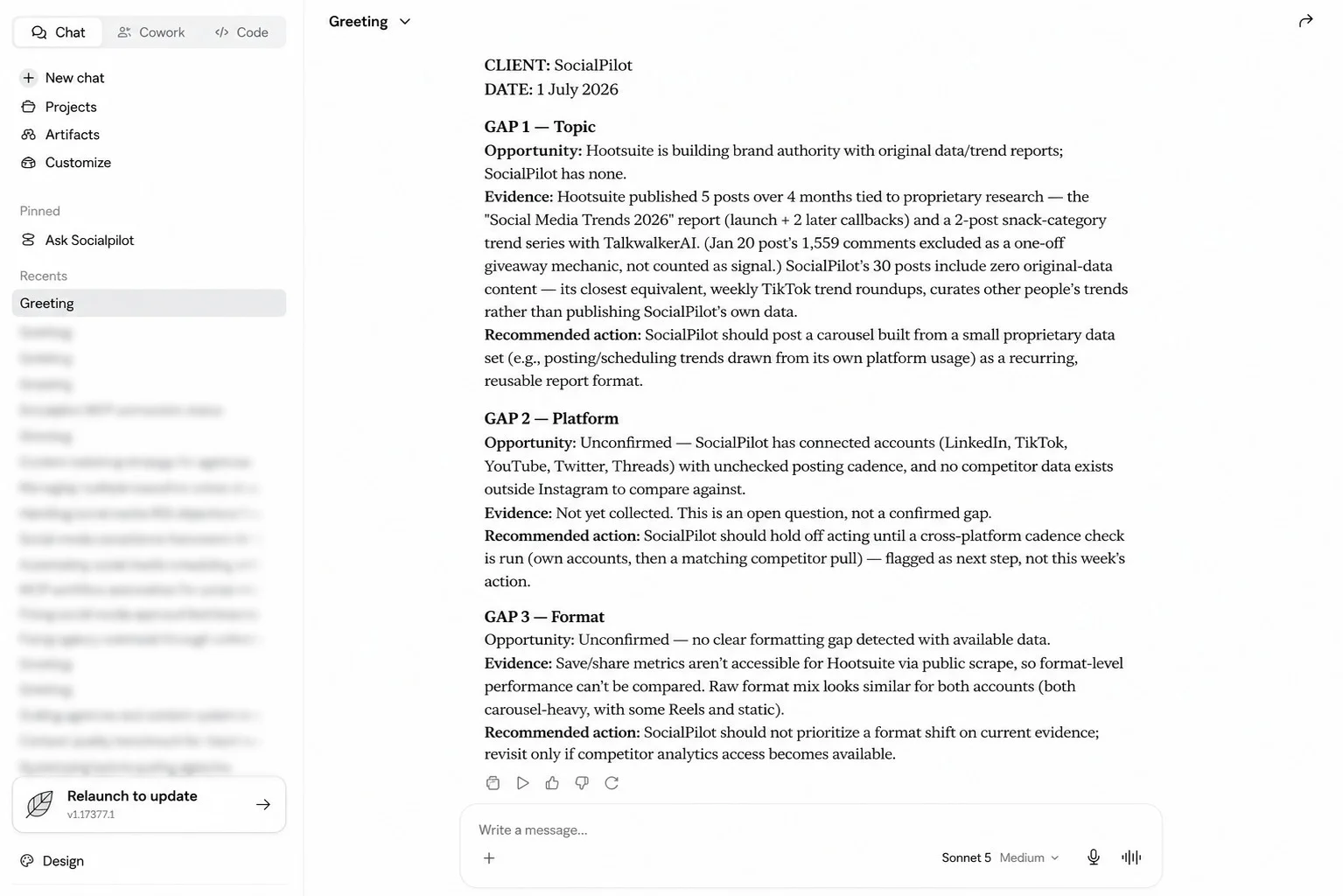
In the modern digital agency landscape, the greatest barrier to success is not a lack of data—it is the erosion of time. Agencies are drowning in information, yet starving for execution. While account managers and social media leads are well aware of what their clients’ competitors are posting, the "visibility-to-action" cycle is often so fragmented that the window of opportunity closes before a draft is even finalized.
For years, the standard agency workflow for competitive analysis has been a manual, labor-intensive gauntlet: collecting metrics, cross-referencing brand pillars, drafting briefs, seeking internal approval, and finally navigating to a publishing tool. This process, often taking hours of manual context switching, renders competitive insights obsolete by the time they reach the content calendar.
However, a new paradigm is emerging. By leveraging Model Context Protocol (MCP) integrations within advanced AI environments like Claude, agencies are collapsing this multi-day process into a singular, cohesive workflow. This article explores how this architecture functions, the implications for agency economics, and why the "research-to-publish" loop is being fundamentally re-engineered.

The Bottleneck: Why Competitive Analysis Fails the Calendar Test
Most agencies operate under a "document-first" culture regarding competitive intelligence. They pull data, aggregate observations into a PDF or slide deck, and share it in a team channel—where it frequently remains unread. Even when the data is digested, the transition from insight to a live, scheduled post is fraught with friction.
The Cost of Context Switching
The primary obstacle is the distance between identifying a gap and populating a content queue. When a social media manager must jump from a browser-based research tool to a spreadsheet for analysis, then to a word processor for drafting, and finally to a third-party social media management platform, the cognitive load is immense.
At a scale of one or two clients, this is a nuisance. At a scale of 10 to 20 clients, it becomes a systemic failure. The complexity of managing unique brand voices, distinct competitor sets, and varying audience sensitivities for each account turns a strategic advantage into a logistical burden. Consequently, most agencies default to quarterly competitive reviews. By then, the data is cold, the market trends have shifted, and the "actionable" insights are largely irrelevant.
The Economics of Efficiency
A connected, AI-driven workflow changes the underlying economics of agency work. When monitoring, gap identification, brief generation, and scheduling occur within a single, continuous conversation, the labor-to-output ratio shifts dramatically. What previously required three hours of manual effort per client per quarter can now be executed in 45 minutes per week. This does not just improve speed; it allows agencies to scale their competitive intelligence operations without increasing headcount or suffering from "tool sprawl."
The Architecture: Three MCPs, Two Phases, One Conversation
The secret to this transformation is the Model Context Protocol (MCP), which allows AI models to "talk" directly to the tools agencies already use. By connecting Apify, SocialPilot, and Slack to Claude, the AI ceases to be a chatbot and becomes an active participant in the production process.
1. Apify MCP: The Data Collection Layer
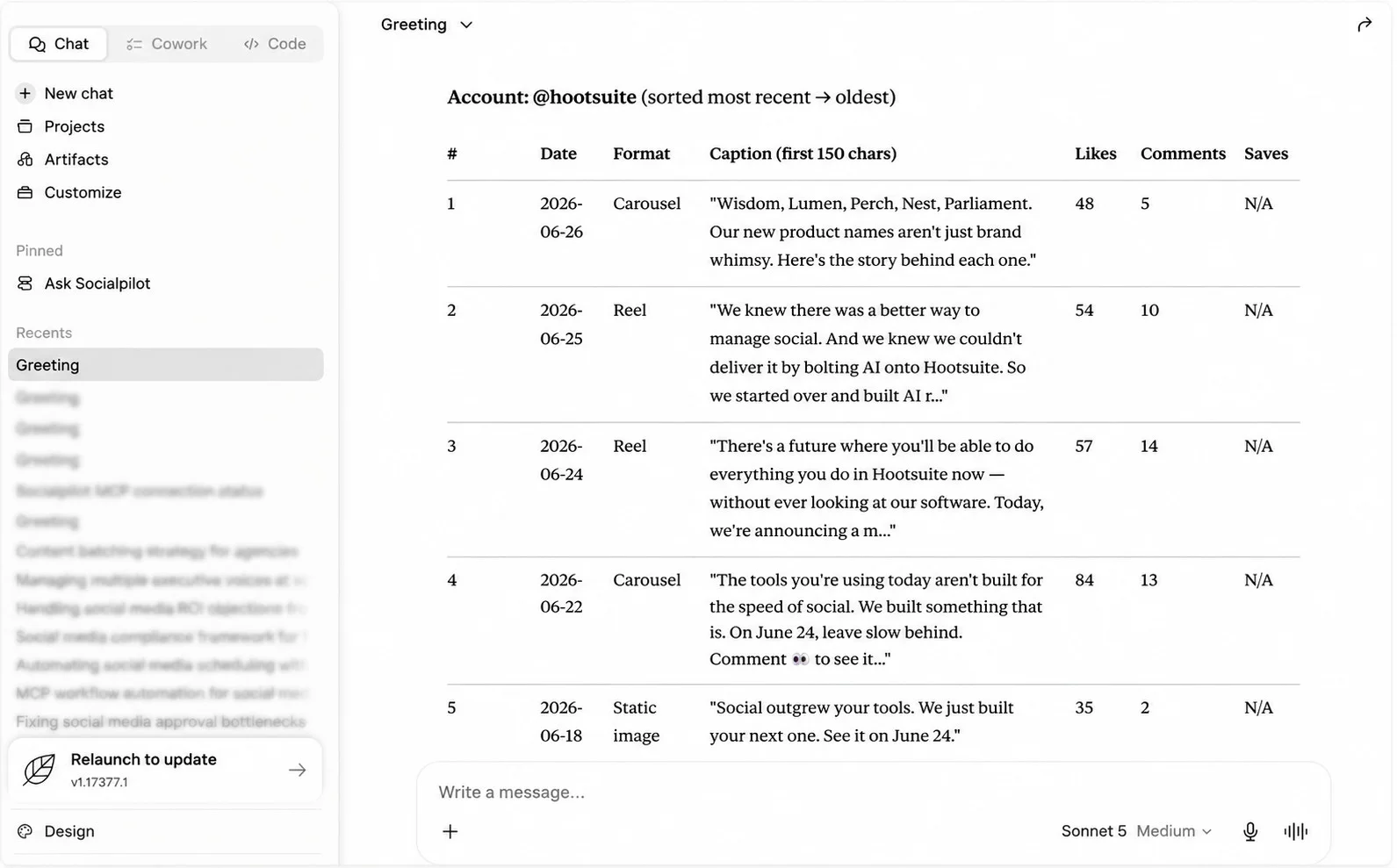
Apify acts as the "eyes" of the operation. By automating the scraping of competitor feeds across Instagram, LinkedIn, and TikTok, it removes the need for manual browsing. It captures the raw data—captions, engagement metrics, and content formats—that serves as the foundation for all subsequent analysis.
2. SocialPilot MCP: The Publishing and Content Layer
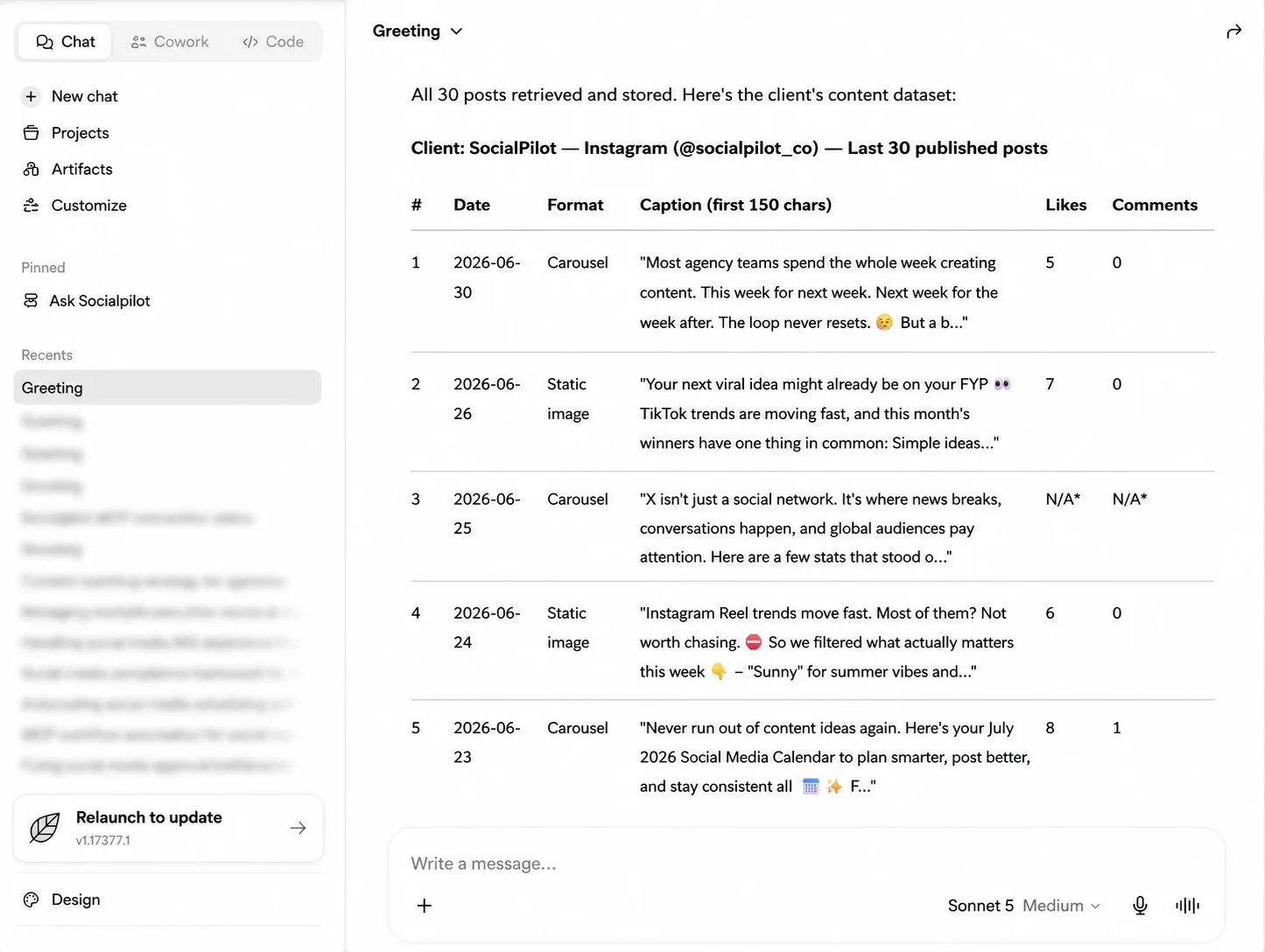
If Apify provides the intelligence, SocialPilot provides the hands. By connecting to the client’s publishing account, Claude can read the client’s historical performance and, crucially, push finished, approved posts directly into the content queue. This closes the loop, moving from observation to execution without the need for manual data entry.
3. Slack MCP: The Communication Layer
While optional, the Slack integration serves as the vital bridge for team collaboration. It allows for automated routing of briefs and drafts to client-facing channels or internal team threads, ensuring that the human element of the process—approval and editorial judgment—is integrated into the flow.
Chronology of an Automated Workflow
To understand the shift, one must look at the step-by-step evolution of a standard work week under this new model.
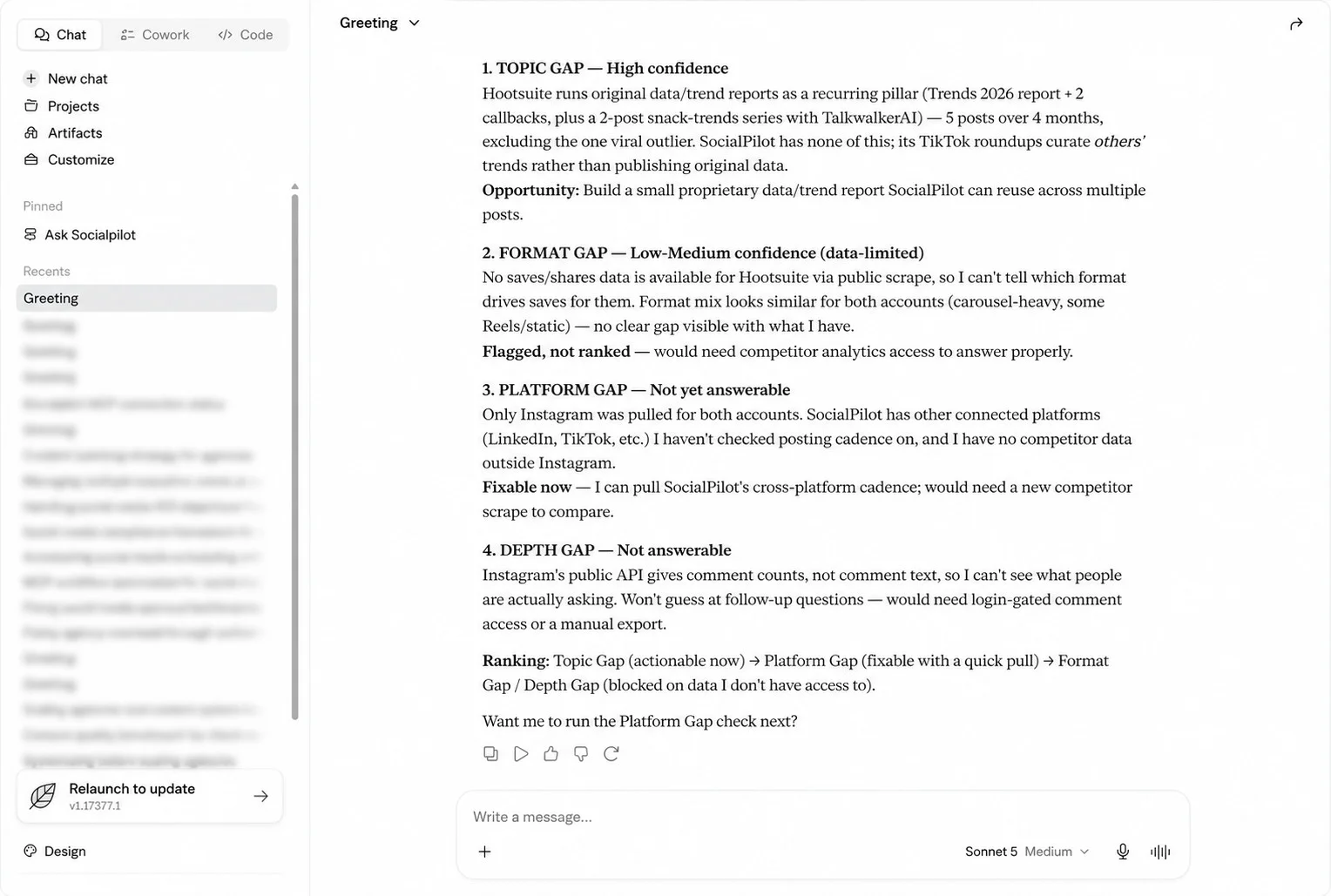
Phase 1: From Competitor Feeds to the Gap Brief
The process begins with the "Client Setup" context, a one-time configuration that defines brand voice, pillars, and forbidden topics. Once established, the workflow follows a precise sequence:
- Data Ingestion: Claude utilizes the Apify MCP to pull the 15 most recent posts from selected competitors. It organizes these by platform, providing a snapshot of the competitive landscape.
- Client Baseline: The system uses the SocialPilot MCP to retrieve the client’s last 30 posts. This creates a "benchmark" that prevents the AI from suggesting content that has already been published.
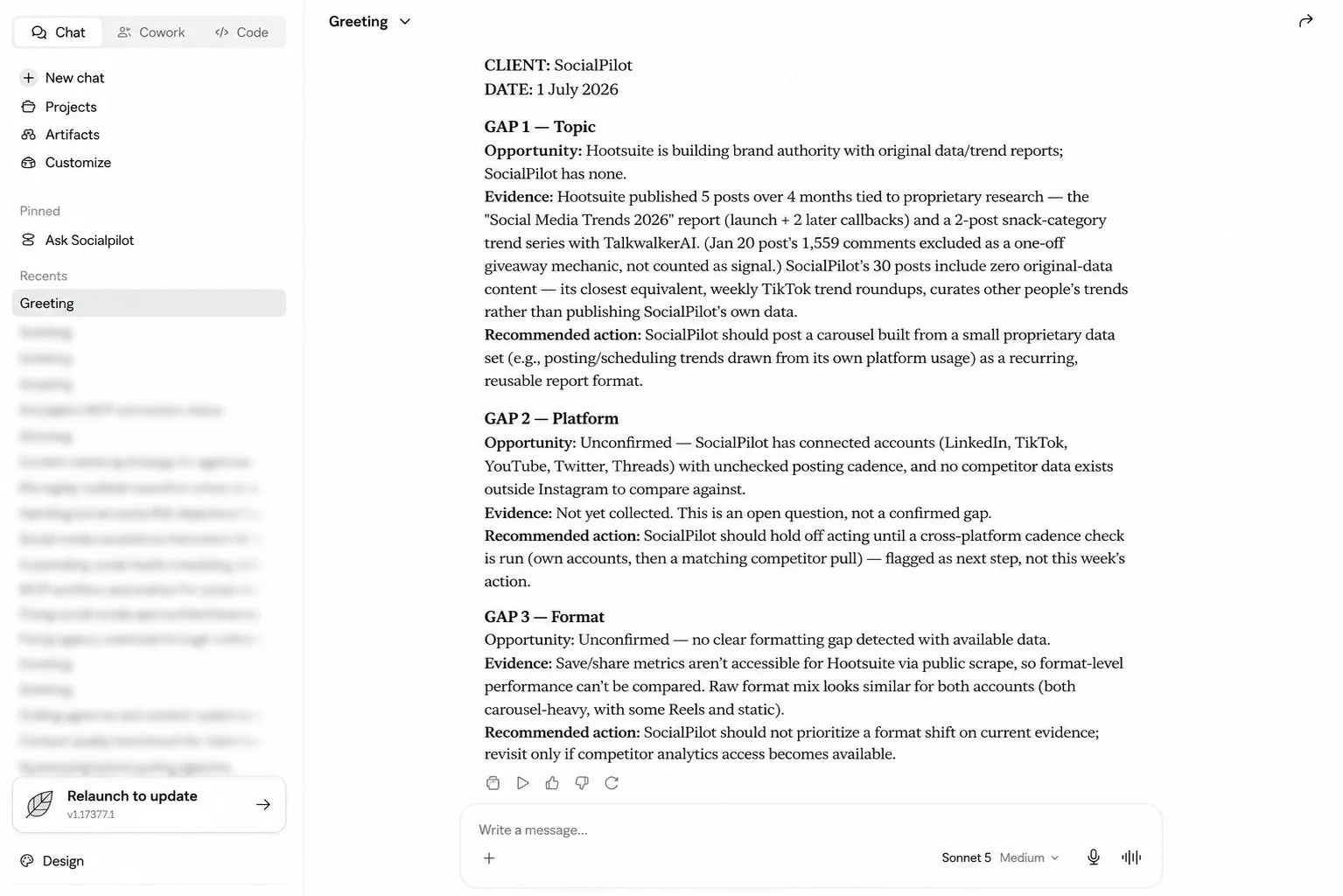
- Gap Analysis: Claude identifies openings across four dimensions:
- Topic Gaps: What subjects are competitors winning on that the client has ignored?
- Format Gaps: Are competitors finding success with Reels or Carousels where the client is lagging?
- Platform Gaps: Are there channels where the client is noticeably absent?
- Depth Gaps: Are competitors posting surface-level content that leaves the audience asking for more?
- Brief Synthesis: The AI generates a structured, ranked brief. This document isn’t just an observation; it is a menu of actionable opportunities.
Phase 2: From Brief to Scheduled Post
Once the agency team reviews the brief and makes a strategic decision on which gap to fill, the workflow accelerates:
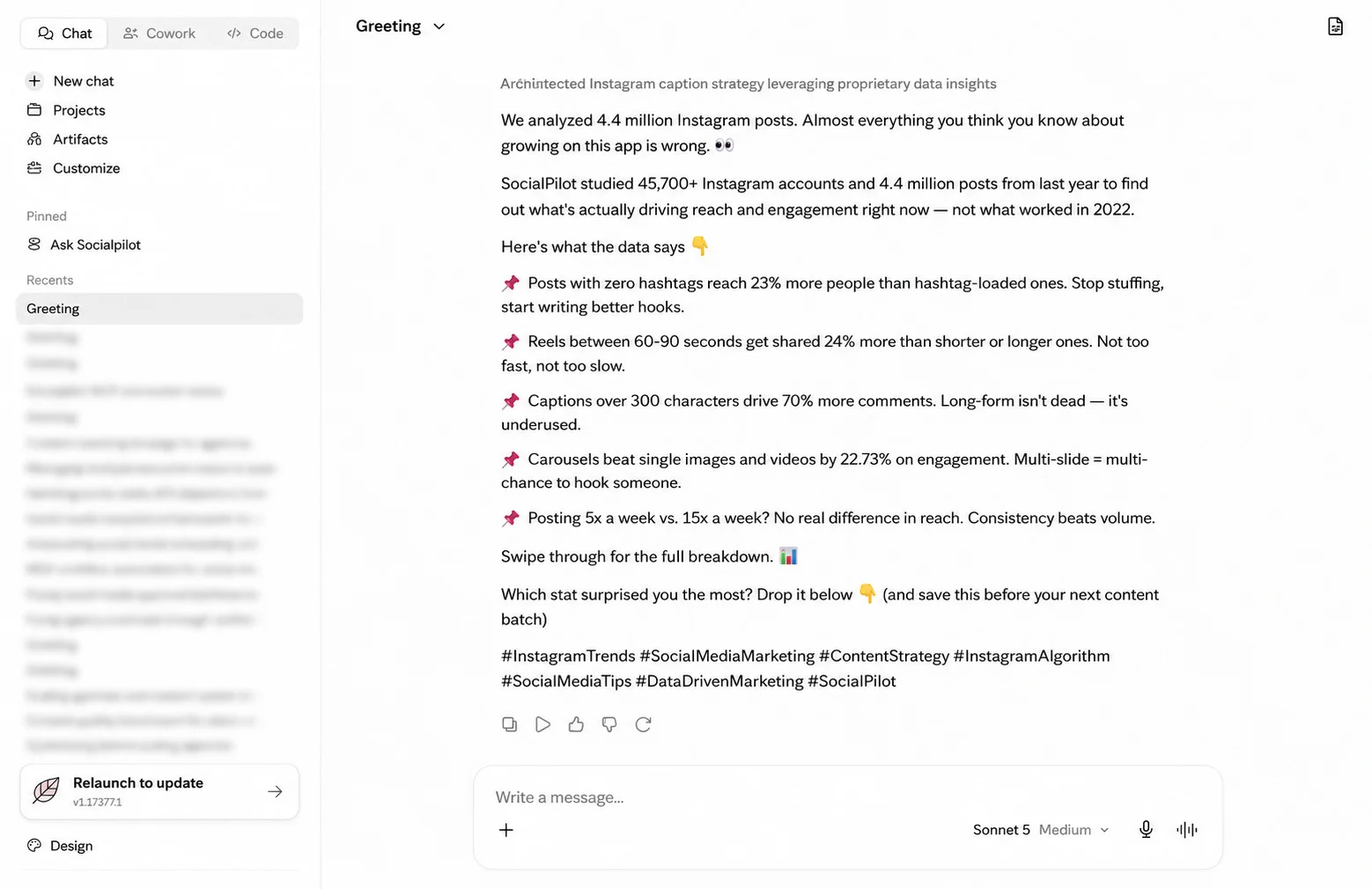
- Drafting: With a simple prompt, Claude drafts a post tailored to the client’s specific voice and format requirements, incorporating the "scroll-stopping" hook and appropriate CTAs.
- Review and Routing: If the agency requires client sign-off, the Slack MCP pushes the draft to the appropriate stakeholder.
- Scheduling: Upon receiving approval, the final prompt uses the SocialPilot MCP to push the content directly into the queue.
Implications for Agency Operations
The adoption of this workflow has significant implications for how agencies define value.
Human Judgment as the Primary Value Add
By automating the "mechanical" tasks—data collection, formatting, and scheduling—agencies can refocus their human talent on high-level strategy. The AI does not replace the Social Media Manager; it elevates them from a "content creator" to a "content director." The manager’s role is reduced to the two most critical points: deciding which gaps matter and ensuring the final creative output aligns with the brand.
Scalability and "Reusable Skills"
The true power of this system lies in the ability to package the entire workflow as a "Skill." By saving the instruction set as a reusable template, agencies can initiate a complex competitive analysis for any client with a single command (e.g., /competitor-gap [client-name]). This standardizes the quality of output across the entire agency roster, ensuring that a junior account manager can perform at the same level as a senior strategist.
The "Speed to Market" Advantage
The most immediate benefit is the reduction in elapsed time. When the gap identification and the scheduling happen in the same conversation, the time from "spotted" to "scheduled" drops from days to minutes. In the volatile world of social media, where trends can rise and fall in a 48-hour cycle, this speed is the difference between being a trend-setter and a trend-chaser.
Conclusion: The Future of Competitive Intelligence
The shift toward connected, AI-driven workflows is not merely a technical upgrade; it is a necessary evolution for the agency model. Agencies that continue to rely on manual, disconnected processes will find themselves priced out or out-paced by those who can convert intelligence into content at the speed of the algorithm.
By leveraging MCPs to connect research, analysis, and publishing, agencies can finally solve the "visibility problem." The goal is no longer to watch what competitors are doing—it is to out-execute them, consistently and at scale. As this technology becomes the industry standard, the agencies that thrive will be those that view their AI not as a tool, but as the connective tissue of their entire operational framework.


 Basiran