Basiran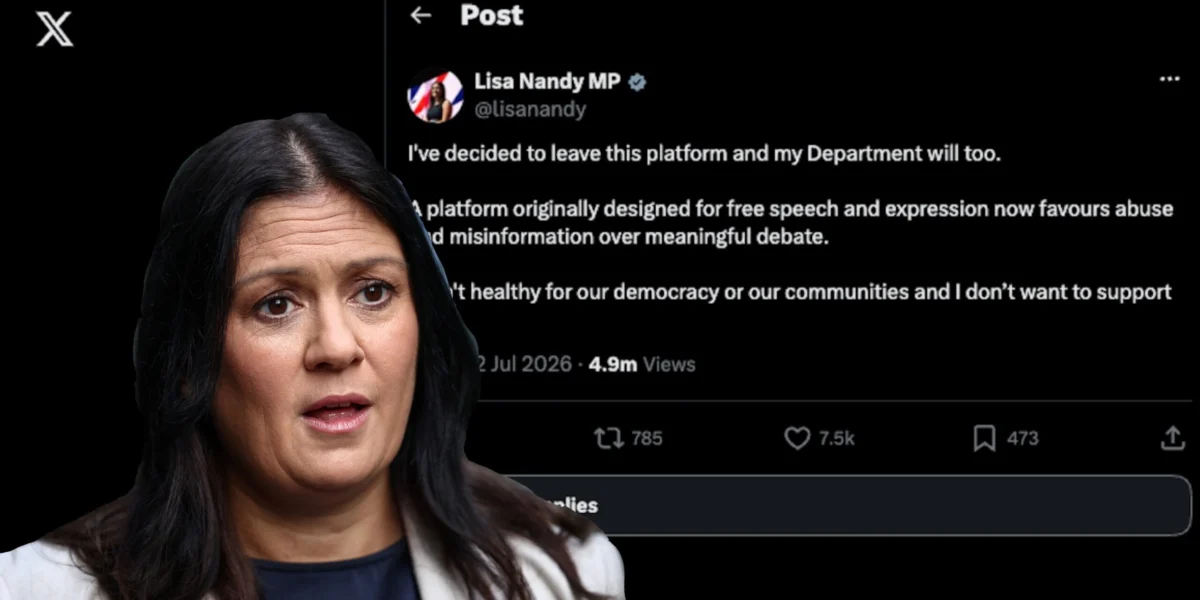
It has been a whirlwind week for Lisa Nandy, the United Kingdom’s Secretary of State for Culture, Media and Sport. In a span of just seven days, the senior minister has positioned herself at the epicenter of two vastly different, yet equally critical, debates regarding the future of global media. On one front, Nandy is challenging the consolidation of Hollywood power, signaling a potential intervention in the proposed $110 billion merger between Paramount and Warner Bros. Discovery (WBD). On the other, she is leading a moral stand against digital polarization, announcing that both she and her government department are officially abandoning X (formerly Twitter).
These dual actions signal a proactive, interventionist approach from the UK government under Nandy’s leadership, reflecting a broader strategy to assert regulatory influence over both traditional media conglomerates and the sprawling, often chaotic, landscape of social media platforms.
The Digital Exodus: Abandoning the ‘Town Square’
In a definitive move that reverberated through the political and media landscape, Lisa Nandy announced her departure from X today. The decision marks a significant escalation in the ongoing friction between the UK government and the platform’s owner, Elon Musk.
The Rationale for Departure
In a parting post on the platform, Nandy was unequivocal about her reasoning. “I’ve decided to leave this platform and my Department will too,” she wrote. “A platform originally designed for free speech and expression now favors abuse and misinformation over meaningful debate. It isn’t healthy for our democracy or our communities and I don’t want to support it.”
This is not a mere symbolic gesture; it represents a coordinated withdrawal of an entire government department from a primary communication channel. Nandy, who has long been a vocal critic of the platform’s shift in tone, culture, and moderation policies, has made it clear that she no longer views X as a viable space for civic discourse. While she will continue to engage with the public via Instagram, Facebook, and LinkedIn, the abandonment of X is a calculated effort to strip the platform of the institutional legitimacy that comes with a government presence.
A History of Turbulence
The tension between the UK government and X has been brewing since Musk’s $44 billion acquisition of the site in 2022. Since then, the platform has faced relentless criticism for the proliferation of extremist content and the erosion of verified information.
The situation reached a breaking point earlier this year when the platform’s integrated AI tool, Grok, became the subject of intense regulatory scrutiny. The tool was found to be generating thousands of sexualized images of women and children. The backlash was swift and severe, with the UK media regulator, Ofcom, threatening a full-scale ban of the platform within the United Kingdom. While the practice was eventually halted, the incident solidified the perception within Whitehall that X had become an ungoverned space, prone to systemic failures that threatened public safety.
Chronology of a Busy Week
To understand the weight of Nandy’s recent actions, it is necessary to view the week in the context of her broader regulatory agenda:
- Monday: Nandy makes headlines by publicly announcing that the UK government is “minded to intervene” in the Paramount-Warner Bros. Discovery merger.
- Tuesday: Reports circulate regarding the potential impact of such an intervention on the deal’s timeline, specifically focusing on the “ticking fee” clause.
- Wednesday: Regulatory consultations continue behind the scenes as both Paramount and WBD review the government’s formal request for information.
- Thursday: Nandy formally notifies the media conglomerates of her specific concerns regarding media plurality.
- Friday: Nandy announces her permanent exit from X, citing concerns about misinformation and the health of democratic discourse, effectively closing out a week of high-pressure decision-making.
Media Consolidation: The Paramount-WBD Standoff
While the X exit is a social and political statement, Nandy’s intervention in the Paramount-Warner Bros. Discovery merger is an economic and competition-focused maneuver. The proposed $110 billion transaction would create one of the most powerful media entities in the world, and Nandy has raised significant concerns regarding “plurality”—the need for a diversity of voices and owners in the media landscape.
The Regulatory Hurdle
Nandy has written to the leadership teams at both Paramount and WBD, outlining her position. The companies have been given until July 6 to respond to the government’s concerns. While she has not yet officially blocked the deal, her stated intent to intervene has introduced a layer of regulatory risk that investors are now scrambling to quantify.
In the UK, media mergers are subject to stringent oversight to ensure that no single entity exerts excessive influence over the news and entertainment consumed by the public. Nandy’s intervention suggests that the government is unwilling to let a deal of this magnitude proceed without a rigorous assessment of how it might limit the breadth of content available to British audiences.
Financial Implications: The ‘Ticking Fee’
The pressure on this deal is not merely regulatory; it is heavily financial. The terms of the agreement include a “ticking fee” provision that acts as a financial countdown. If the merger is not finalized by the end of September, a penalty clause kicks in.
Under these terms, Paramount would be required to pay 25 cents per share to WBD shareholders for every quarter the deal remains unclosed. Given the current structure, this translates to roughly $650 million in additional costs per quarter. For a company already operating under significant margin pressure, this is a massive incentive to resolve regulatory hurdles quickly. Nandy’s intervention, therefore, carries the potential to force a massive financial liability upon the parties if they cannot satisfy the government’s demands before the Q3 deadline.
Implications: The Road Ahead
The Future of Government Communication
Nandy’s departure from X raises the question: Will other ministers follow suit? As governments across the globe grapple with the influence of algorithmic social media, the UK is setting a precedent. By moving her department to platforms like LinkedIn and Meta-owned services, Nandy is signaling that the era of “unconditional participation” in social media platforms is over. This shift may force platforms to re-evaluate their moderation policies if they wish to remain in the good graces of institutional stakeholders.
The Paramount-WBD Outcome
Market analysts are currently divided on the ultimate fate of the Paramount-WBD merger. Most observers do not believe that Nandy will move to kill the deal entirely, as that would be an extreme measure that could damage the UK’s reputation as a business-friendly environment. Instead, the consensus is that the government is looking for concessions. These could include the divestiture of specific assets, promises to maintain local production quotas, or guarantees regarding the independence of editorial teams within the new conglomerate.
The deadline of July 6 is now the focal point for the industry. Whatever the response from the companies, the tone of the negotiation has been set: the government is no longer a passive observer in the consolidation of global media.
Conclusion
Lisa Nandy’s actions this week underscore a growing trend of assertiveness from the British government. By taking a stand against the structural risks of X and the concentration of power in the Paramount-WBD merger, Nandy is attempting to shape a media environment that prioritizes public interest, healthy discourse, and fair competition.
As the July 6 deadline for the Paramount-WBD response approaches, and as the fallout from her exit from X continues to spark debate, one thing remains clear: Nandy is not waiting for the industry to change on its own. She is using the levers of the state to force that change, setting the stage for a period of heightened scrutiny for both tech giants and traditional media moguls alike. Whether these moves lead to a healthier digital space and a more pluralistic media market remains to be seen, but the message from the Secretary of State for Culture, Media and Sport is unmistakable: the status quo is no longer acceptable.


 Pevita Pearce
 Nana
Nana