By João Silva
Published: July 2026
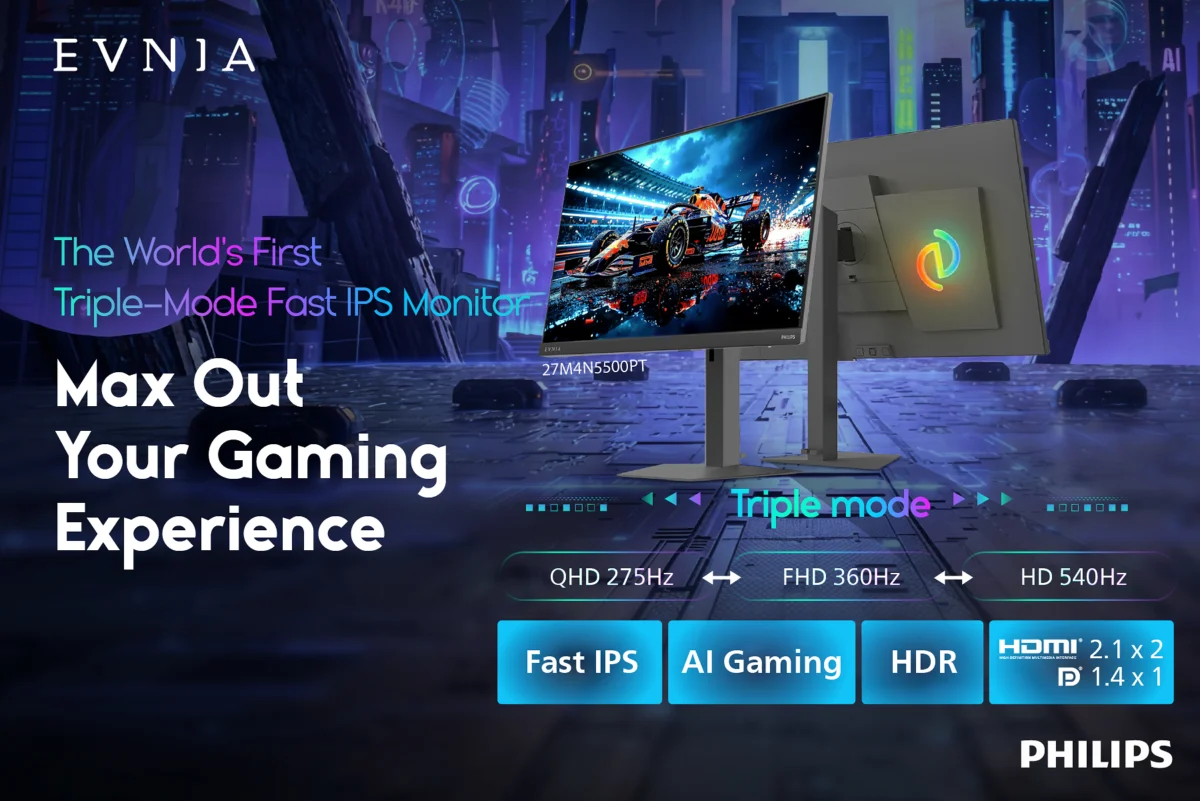
In an era where gaming demands are increasingly polarized between cinematic, high-fidelity visual experiences and hyper-competitive, low-latency performance, monitor manufacturers have historically forced gamers to make a binary choice. You either prioritize the crisp, immersive detail of a 1440p panel or the blinding speed of a 1080p esports display. Today, Philips Evnia is aiming to bridge that divide with the introduction of their new M4 gaming monitor lineup: the 27M4N3500PT and the 27M4N5500PT. By integrating a groundbreaking "triple-mode" resolution and refresh-rate toggle, Philips is promising a future where a single display can be everything to every gamer.
The Core Innovation: Triple-Mode Performance
At the heart of the new M4 series lies a sophisticated Fast IPS panel that effectively acts as three monitors in one. While traditional monitors are locked into their native resolution and maximum refresh rate, the M4 series allows users to toggle between three distinct configurations directly through the On-Screen Display (OSD) menu, eliminating the need for tedious manual adjustments in Windows settings or GPU control panels.
The versatility of this system is designed to accommodate the specific requirements of different gaming genres:
- High-Fidelity Mode: Operates at a native QHD resolution (2560 x 1440) with an overclocked refresh rate of 275Hz, ideal for open-world RPGs or narrative-driven titles where visual fidelity is paramount.
- Competitive Esports Mode: Drops the resolution to Full HD (1920 x 1080) while boosting the refresh rate to 360Hz, providing the frame-pacing advantage required for tactical shooters like VALORANT or Counter-Strike 2.
- Ultra-High Speed Mode: Reduces the resolution to HD (1280 x 720) to reach a staggering 540Hz refresh rate, a mode specifically engineered for professional-level competitive play where every millisecond of input latency matters.
This instant toggling capability represents a significant shift in how peripheral manufacturers are approaching the "one-size-fits-all" hardware dilemma. By offloading the scaling and refresh rate management to the monitor’s internal controller, Philips ensures that the transition is seamless, instantaneous, and OS-agnostic.
Technical Specifications and Visual Fidelity
Beyond the innovative switching mechanism, the M4 series maintains the high standards expected from the Evnia brand. The displays feature an anti-glare coating with 25% haze, specifically chosen to minimize reflections in brightly lit environments without compromising color clarity.
With a peak brightness of 350 nits, the monitors are well-suited for standard indoor gaming setups. While not pushing the boundaries of HDR performance, the focus here is clearly on responsiveness and motion clarity. The Fast IPS technology employed provides the necessary color accuracy and wide viewing angles that TN panels—the traditional choice for high-refresh-rate gaming—often lack.
For users concerned about long-term eye health, Philips has integrated a suite of "SoftBlue" and flicker-free technologies. These features work to reduce high-energy blue light emissions, which are often cited as a cause for digital eye strain during marathon gaming sessions. The inclusion of these protective measures underscores Philips’ commitment to the "health-conscious gamer" demographic.
Connectivity and AI-Driven Gameplay
The M4 lineup is future-proofed with robust connectivity options, featuring HDMI 2.1 and DisplayPort 1.4. These ports are essential for supporting the bandwidth requirements of the 275Hz, 360Hz, and 540Hz modes, ensuring that users aren’t bottlenecked by outdated cable standards.
Furthermore, Philips has leaned heavily into AI-enhanced software features to elevate the user experience:
- Stark Shadow Boost: Automatically brightens dark areas of an image without washing out the rest of the scene, giving players an edge in games with high contrast lighting.
- Smart Crosshair: Offers a customizable, AI-stabilized reticle that remains visible regardless of the game’s own HUD settings.
- Smart Sniper: A specialized zoom feature for long-range engagements.
- Smart MBR Sync: A Motion Blur Reduction feature that synchronizes with the refresh rate to ensure that even the fastest-moving images remain sharp and ghost-free.
Design Differentiation: The 27M4N5500PT Advantage
While both the 27M4N3500PT and 27M4N5500PT share the same underlying panel technology and core features, the 27M4N5500PT stands as the premium iteration. The defining difference is the inclusion of the "SmartErgoBase."
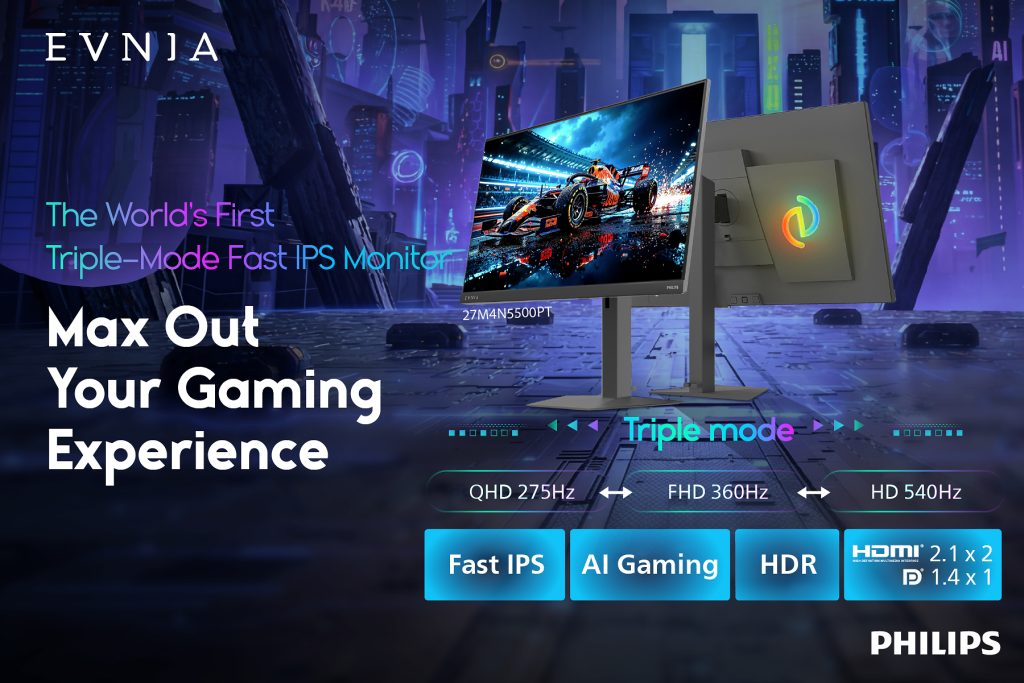
This stand is a masterclass in industrial design, offering extensive height, tilt, and swivel adjustments. Crucially for streamers and productivity-focused gamers, it allows for a 90-degree vertical pivot, making the monitor highly adaptable for multi-screen, portrait-oriented layouts. The geometric cut of the base, combined with the new Evnia AI gaming icon light system, gives the 27M4N5500PT an aggressive yet sophisticated aesthetic that fits well within modern "battle station" setups.
Implications for the Display Market
The introduction of the M4 lineup signals a broader trend in the peripherals market: the move toward software-defined hardware. As gaming titles continue to grow in size and complexity, the hardware that displays them must become more flexible.
By allowing a monitor to shift its native resolution, Philips is effectively challenging the dominance of traditional 4K/60Hz or 1440p/144Hz monitors. If this technology proves successful and the image quality at lower resolutions (when upscaled or mapped to the native panel) remains acceptable to the discerning eye, we may see a wave of "adaptive resolution" displays hitting the market.
However, the primary hurdle remains the visual interpolation of a 720p image on a 1440p physical panel. While the 540Hz mode is technically impressive, users will need to determine if the clarity loss associated with dropping to 720p is a trade-off they are willing to make for the raw speed.
Chronology of Development
The Evnia brand has been on an aggressive trajectory since its inception, positioning itself as a lifestyle-oriented gaming brand under the Philips umbrella.
- Q1 2026: Initial rumors regarding a high-refresh-rate "variable resolution" display began circulating within tech forums.
- May 2026: Philips files patents related to OSD-level scaling for high-speed IPS panels.
- July 2026: Official unveiling of the M4 lineup, confirming the 275Hz/360Hz/540Hz triple-mode functionality.
- August 2026: Anticipated global retail availability for both the 27M4N3500PT and 27M4N5500PT.
Official Stance and Consumer Feedback
In a brief statement accompanying the launch, a Philips representative noted, "The M4 series is our answer to the ‘compromise’ of modern PC gaming. We no longer believe a gamer should have to choose between the cinematic beauty of high-resolution gaming and the competitive edge of ultra-fast refresh rates. With our triple-mode technology, we provide the best of all worlds in a single, elegant package."
Industry analysts are optimistic but cautious. "The technical achievement here is undeniable," says monitor consultant Sarah Jenkins. "The challenge for Philips will be consumer education. Gamers are used to native resolutions. Teaching the average user that dropping to 720p is a valid competitive strategy—and that the monitor will handle the scaling cleanly—will be the key to the M4 series’ long-term success."
Conclusion: A New Standard?
The Philips Evnia M4 series is more than just a pair of new monitors; it is a proof-of-concept for the future of display versatility. By empowering the user to change the monitor’s performance characteristics on the fly, Philips has addressed a genuine pain point for the multifaceted gamer.
Whether you are a casual player enjoying the latest high-fidelity titles or a dedicated esports athlete chasing the 540Hz dream, the M4 series offers a compelling value proposition. The coming months will be telling as the displays hit the market and real-world testing validates whether the triple-mode feature is a genuine game-changer or merely an ambitious experiment. For now, Philips Evnia has certainly captured the attention of the industry, proving once again that the battle for the desktop is far from over.
Would you take advantage of this feature? Does the ability to jump between 1440p fidelity and 720p speed satisfy your gaming needs, or do you prefer a dedicated, single-purpose display? Let us know in the comments below.