Asep Darmawan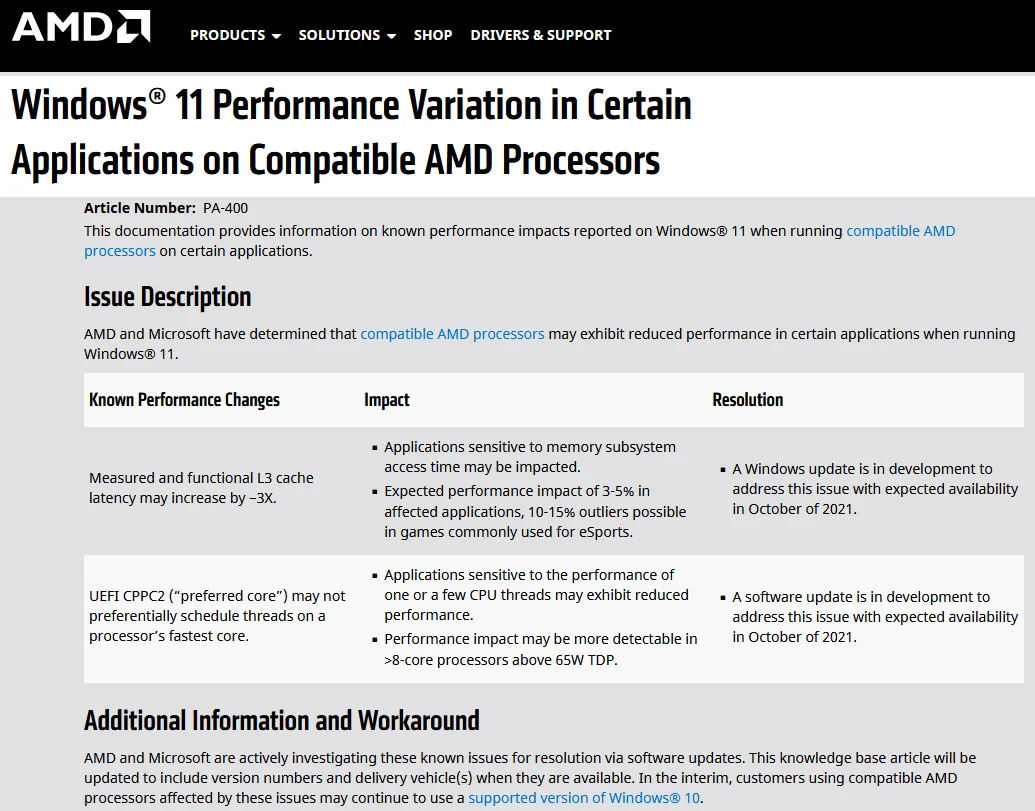
The highly anticipated rollout of Microsoft’s Windows 11 has been met with a mixture of excitement and frustration. While the new operating system offers a refined interface and enhanced productivity features, early adopters—particularly those utilizing AMD Ryzen hardware—have encountered unexpected performance degradation. Following a wave of user reports detailing erratic system behavior and reduced frame rates, AMD has officially acknowledged that specific processor configurations are suffering from incompatibility issues with the new OS.
The Core of the Conflict: Main Facts
At the heart of the issue are two distinct technical conflicts between the Windows 11 kernel and AMD’s architecture. The first involves the L3 cache, where latency has been observed to increase by as much as three times the expected duration. The second issue pertains to the UEFI CPPC2 (Collaborative Processor Performance Control) protocol, commonly known as "preferred core" technology.
In a standard, healthy environment, CPPC2 ensures that the operating system intelligently routes the most demanding tasks to the processor’s fastest available cores. Under Windows 11, this scheduling mechanism is failing to trigger correctly, leading to sub-optimal thread distribution. This is particularly problematic for high-core-count processors, where the performance delta between the "fastest" and "slowest" cores is most pronounced.
Chronology of the Disruption
The emergence of these issues followed a timeline consistent with the broad, staggered release of Windows 11, which officially began its global deployment earlier this week.
- October 4-5, 2021: As the Windows 11 rollout commenced, early adopters and power users began flooding community forums and technical support channels with benchmarks showing uncharacteristic dips in performance compared to Windows 10.
- October 6, 2021: AMD officially acknowledged the mounting evidence. The company published a formal support article (PA-400) confirming that its processors were experiencing performance variations in certain applications.
- Present Day: AMD and Microsoft have entered a state of rapid collaborative development. AMD has committed to delivering a software patch via Windows Update, with a projected timeline for resolution set for later this month.
Supporting Data: Quantifying the Performance Hit
The technical impact of these two bugs is not uniform; it varies significantly depending on the application workload and the specific CPU architecture.
The L3 Cache Latency Crisis
The L3 cache latency issue is arguably the most severe, as it directly impacts memory-intensive operations. AMD’s internal testing suggests that applications highly sensitive to memory latency will suffer the most. On average, standard productivity software and general applications can expect a performance degradation of approximately 3% to 5%.
However, the gaming community faces a much steeper climb. Competitive eSports titles, which often rely heavily on high frame rates and low-latency memory access to maintain fluid input, are experiencing performance dips ranging from 10% to 15%. For gamers who have invested in high-end Ryzen 5000-series processors to maintain competitive advantages, this drop is significant enough to be perceptible in real-time play.
The CPPC2 Scheduling Bug
While the L3 cache issue is broad, the CPPC2 "preferred core" failure is more nuanced. AMD notes that this bug is most impactful on processors with more than eight cores and a TDP (Thermal Design Power) exceeding 65W.
The logic behind this is straightforward: in chips with high core counts, there is a wider performance spectrum between the silicon "winners" (the fastest, most efficient cores) and the "losers" (the cores meant for background tasks). When Windows 11 fails to identify the preferred cores, the OS may task a heavy, single-threaded application to a slower core, while leaving the high-performance cores idling. AMD has yet to release a percentage estimate for this specific bug, likely because it is highly dependent on the specific mix of tasks running in the background at any given time.
Official Responses and Strategic Collaboration
The synergy between Microsoft and AMD is currently the primary focus for those affected. AMD has been transparent in its communications, emphasizing that the resolution does not require end-users to navigate the complexities of BIOS updates or motherboard firmware flashing.
According to official statements, the upcoming patch will be distributed exclusively through the Windows Update service. This is a critical point for the consumer base, as it mitigates the risks associated with manual hardware intervention. For those who cannot afford to wait for the mid-October patch, AMD has offered the "nuclear option": rolling back the system to Windows 10. While effective, this is a cumbersome process that requires a clean installation, effectively erasing the benefits of the Windows 11 upgrade for those who choose this path.
Implications for the Ecosystem
The current situation serves as a stark reminder of the complexities involved in modern hardware-software orchestration. As operating systems become more tightly integrated with the underlying silicon, the margin for error narrows.
Impact on Hardware Adoption
These performance variations may temporarily stall the adoption rate of Windows 11 among the enthusiast and professional demographics. AMD Ryzen CPUs have enjoyed massive popularity in recent years, often outperforming Intel in efficiency and multi-core throughput. If the platform that gave these CPUs their competitive edge is compromised by the OS, it creates a lack of consumer confidence that both AMD and Microsoft are eager to rectify.
The Future of OS-Processor Interaction
This incident highlights the growing importance of the CPPC2 protocol and similar "hardware-aware" scheduling mechanisms. In the past, OS schedulers were relatively generic. Today, they must be "silicon-aware." The fact that Windows 11 mismanaged these core assignments suggests that the abstraction layer between the OS and the processor firmware requires more rigorous testing across diverse hardware configurations before broad release.
User Advice: Patience vs. Action
For the average user, the best course of action remains patience. The performance degradation, while frustrating, is not catastrophic in the sense that it does not risk hardware damage or data corruption. It is a temporary inefficiency.
Users are advised to keep an eye on the Windows Update dashboard over the coming weeks. Once the patch is released, it should theoretically restore performance to the baseline expected on Windows 10. Until then, users may want to avoid mission-critical, latency-sensitive competitive gaming on Windows 11 if they are running high-TDP Ryzen processors.
Conclusion
The path to a new operating system launch is rarely without friction, but the AMD/Windows 11 conflict represents a significant hurdle for a large segment of the PC market. By openly acknowledging the issues with L3 cache latency and core scheduling, AMD has managed to control the narrative and provide a clear, albeit temporary, roadmap for users.
As the industry moves toward the October patch release, the focus will remain on whether these fixes can fully restore performance parity or if there will be residual latency issues that require further refinement. For now, the hardware-software partnership between Microsoft and AMD is being put to the test, and the outcome will likely shape how future OS scheduling updates are deployed to ensure that the "fastest cores" are always working as intended.
For the millions of users who rely on the synergy between AMD’s architecture and Microsoft’s software, the message is clear: the fix is coming, and in the meantime, the stability of the platform remains intact, even if its peak performance potential is temporarily on hold.

 Siti Muinah
 Reynand Wu