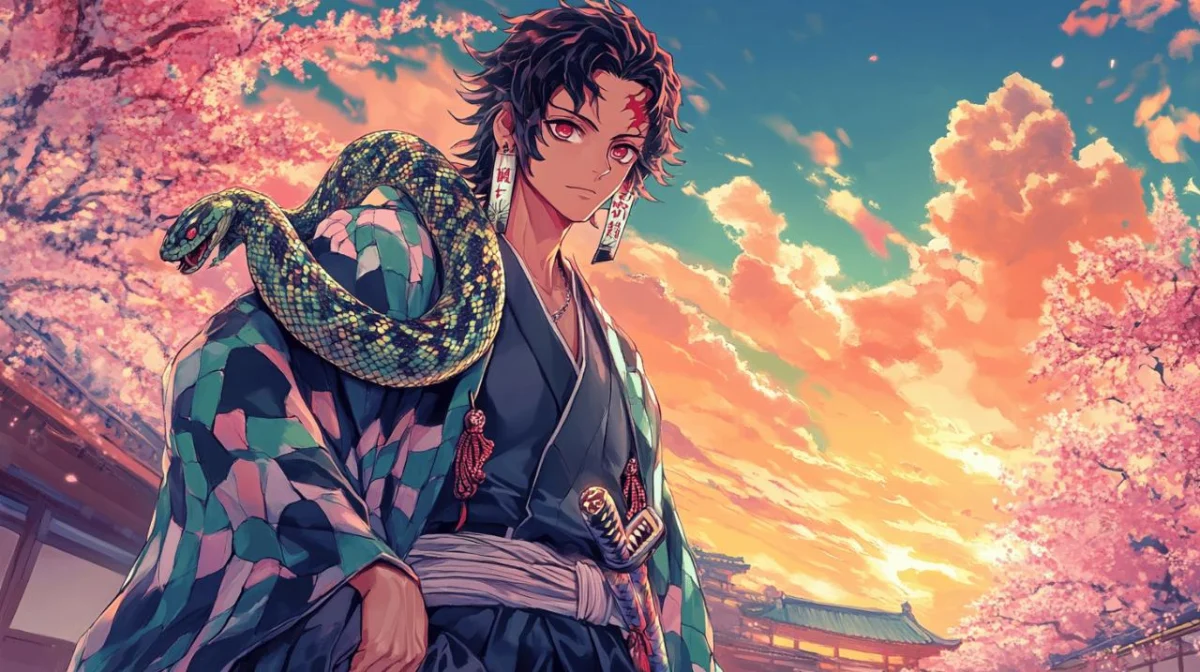
In the expansive and often brutal world of Demon Slayer: Kimetsu no Yaiba, few characters possess a narrative arc as haunting or as poignant as Obanai Iguro, the Serpent Hashira. Beneath his stoic, bandage-covered exterior lies a life defined by systemic trauma, a relentless pursuit of redemption, and a capacity for love that defies his jagged origins. As one of the most skilled combatants in the Demon Slayer Corps, Iguro’s journey from the depths of a depraved clan to the pinnacle of swordsmanship serves as a cornerstone of the series’ emotional and tactical landscape.
Main Facts: The Anatomy of a Hashira
Obanai Iguro is defined by his duality: a man of extreme discipline and lethal efficiency, yet burdened by a past that stripped him of his innocence before he could even speak.
- Identity: The Serpent Hashira of the Demon Slayer Corps.
- Combat Style: Breath of the Serpent, a derivative of Breath of Water.
- Distinguishing Features: Heterochromia (gold and turquoise eyes), a bandaged mouth hiding a snake-like scar, and his constant companion, the white snake Kaburamaru.
- Tactical Prowess: Despite having a physically slender frame, Iguro possesses extraordinary agility, high-level sword mastery, and the rare ability to enter the "Transparent World."
- Signature Weapon: A curved, serpentine Nichirin blade that turns crimson during high-stakes combat, combined with an unparalleled synergy with his pet snake.
Chronology: From Captivity to the Final Dawn
The story of Obanai Iguro is not merely one of martial development; it is a chronicle of liberation.
The Cursed Lineage (Early Years)
Born into a family of thieves who worshipped a serpentine demon, Iguro’s existence was a tragedy from birth. As the first male born into his clan in over 370 years, he was treated as a prized possession, imprisoned in a gilded cage. The clan’s depravity culminated in a ritualistic mutilation: his mouth was sliced open to mimic the appearance of a snake, a permanent reminder of his subjugation to the demon they served. His escape from this environment—aided by the sacrifice of his cousin and the intervention of the Flame Hashira, Shinjuro Rengoku—served as the catalyst for his enlistment in the Corps.
Rise within the Corps
Iguro joined the Demon Slayer Corps not merely to fight, but to purge his own bloodline’s stains. His training was grueling; forced to develop a style that relied on fluidity and deception rather than brute strength, he mastered the Breath of the Serpent. Over the years, his rapport with Kaburamaru grew, allowing the duo to anticipate enemy movements with near-precognitive speed.
The Final Conflict
The "Infinity Castle" and "Sunrise Countdown" arcs represent the climax of Iguro’s life. During the final battle against Muzan Kibutsuji, Obanai’s contribution was pivotal. He was one of the few Hashira to awaken his Demon Slayer Mark, achieve the crimson blade, and access the Transparent World simultaneously. His sacrifice, shielding Tanjiro Kamado and fighting long past the point of physical exhaustion, cemented his legacy as a warrior who transcended his cursed origins to become a protector of humanity.
Supporting Data: Martial Efficacy and Tactical Analysis
When analyzing the power scaling of the Hashira, Iguro occupies a unique space. While he lacks the sheer physical brute force of Gyomei Himejima or the explosive speed of Tengen Uzui, his tactical intelligence is arguably unmatched.
The Mechanics of Serpent Breathing
Breath of the Serpent is designed for irregular combat. By utilizing a blade that functions almost like a whip, Iguro can strike from blind spots and angles that are physically impossible for standard swordsmen to predict. This style is complemented by Kaburamaru; the snake possesses a heightened sense of vibration and heat, acting as a secondary sensory system for Iguro. This is particularly crucial given Iguro’s partial blindness, which would be a debilitating handicap for any other warrior.
The Crimson Nichirin Blade
In the final arc, the activation of the crimson blade—achieved through the intense friction and heat generated by crushing one’s blade against an opponent’s or another sword—demonstrates the extreme physiological toll Iguro was willing to endure. This state is essential for hindering the regenerative abilities of Upper-Rank demons and, eventually, Muzan himself.
Official Records: The Dynamics of the Hashira
The Demon Slayer Corps’ internal logs provide insight into the relationships that shaped Obanai’s psyche. His most significant bond was with Mitsuri Kanroji, the Love Hashira.
The Bond of Redemption
Initially, Iguro’s cold demeanor toward his peers was a self-imposed barrier, a defense mechanism born from his belief that he was inherently "unclean" due to his lineage. His interaction with Mitsuri, who accepted him without reservation, provided the emotional anchor he had lacked his entire life. Their relationship was not a simple romance; it was a mutual acknowledgment of shared trauma and the realization that their lives had meaning beyond the blade.
The Corps’ records indicate that Iguro’s intensity during the final battle was fueled in large part by his vow to keep Mitsuri safe, a promise that transformed his defensive cynicism into an offensive fervor that shocked even the Progenitor of Demons.
Implications: The Legacy of a Serpent
The life of Obanai Iguro leaves a profound imprint on the history of the Demon Slayer Corps and the broader lore of the series.
The Philosophy of the "Dirty Blood"
Iguro’s arc forces a philosophical re-examination of the series’ themes. Does bloodline define the person? Obanai is a living rebuttal to his clan’s ideology. He turned the very physical markers of his oppression—the mouth scars and the connection to snakes—into the tools of his salvation. He proves that while one cannot choose their origins, they are the absolute architect of their destiny.
The Cost of Peace
The strategic implications of Iguro’s sacrifice during the final battle are clear: without his ability to see the "Transparent World" and his coordination with Tanjiro, the survival of the remaining members of the Corps would have been statistically impossible. He represents the "bridge" generation—the fighters who took the foundations laid by their predecessors and pushed their bodies to the absolute limit to ensure a future they would not personally inhabit.
A Cultural Icon
In the broader Demon Slayer fandom, Iguro has emerged as a symbol of the "misunderstood warrior." His popularity stems from the intersection of his tragic backstory and his unwavering, if quiet, moral compass. His legacy is one of transformation; he transitioned from a victim of a demonic ritual to a man who, in his final moments, felt worthy of a peaceful existence.
Conclusion
Obanai Iguro’s journey is a quintessential narrative of Demon Slayer. It balances the grotesque realities of a world overrun by demons with the indomitable spirit of those who fight in the shadows. From his birth as a cursed child in a den of thieves to his final, heroic stand as the Serpent Hashira, Iguro’s life was a testament to the idea that even the most scarred souls can find light. As the history of the Demon Slayer Corps is written, his name remains etched not just for his lethal skill with a blade, but for his capacity to rise above the darkness that once sought to consume him.