Basiran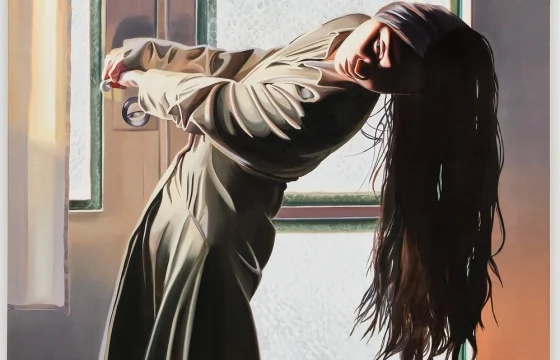
Introduction: A Vernal Awakening
On the vernal equinox—a date traditionally marking the perfect, fleeting equilibrium between day and night—the New York art world turned its attention to the Maspeth neighborhood of Queens. It was here, at the Mrs. gallery’s 6040 56th Drive location, that Los Angeles-based artist Molly Bounds unveiled her highly anticipated New York solo debut, The Light That Loses, The Night That Wins.
The exhibition, which remains on view through May 2, 2026, serves as a poignant continuation of Bounds’ trajectory in the contemporary art scene. Following a successful showing at The Armory Show in September 2025, The Light That Loses, The Night That Wins represents a maturation of the artist’s thematic preoccupation with the thresholds of human experience. Through a series of psychologically charged paintings, Bounds investigates the tension between interior repose and external urgency, utilizing light not merely as a formal element, but as the primary protagonist of her narrative.
The Chronology of an Artistic Evolution
To understand the gravity of this exhibition, one must look at the recent timeline of Bounds’ career. The artist has spent the last several years refining a visual language that balances the tactile reality of the physical body with the ephemeral nature of the psyche.
- September 2025: Bounds garnered significant critical attention during The Armory Show. Her presence at the fair functioned as a prelude, establishing her ability to capture the "liminal moment"—that suspended state where stillness threatens to collapse into motion.
- March 20, 2026: The official opening of The Light That Loses, The Night That Wins aligns with the vernal equinox. This synchronization is deliberate; it mirrors the thematic duality of the exhibition, which oscillates between the optimism of renewal and the inevitable encroaching of shadows.
- March – May 2026: The exhibition window provides a seasonal container for the work, allowing viewers to experience the transition from winter’s austerity to the lushness of spring, a progression echoed in the works on display.
Thematic Analysis: Light as Protagonist
In the exhibition, Bounds posits that light is a dynamic, rather than static, force. It acts as an agent of revelation and concealment. In her view, the way light enters a room or falls upon a figure dictates the narrative of the painting as much as the posture of the subject herself.
The Psychological Interior
Bounds’ interior scenes are marked by a sense of deep, sometimes disquieting, solitude. The figures are often captured in states of "slumped and draping" repose. However, these are not scenes of peaceful rest. Instead, they are portraits of psychological endurance.
In The Armchair, one of the show’s anchor pieces, Bounds masterfully plays with thermal and color contrast. The warmth of a fireplace is juxtaposed against the cold, clinical blue of an early evening sky visible through a window. The viewer is invited into an intimate space where the subject’s vacant stare suggests a mind preoccupied with internal schematics—planning, scheming, or drifting into an indeterminate bliss. The unraveling of the upholstery seams in the painting serves as a subtle metaphor for the subject’s fraying composure.
The Vanitas Tradition
Bounds draws clear inspiration from the history of art, particularly the mastery of chiaroscuro found in the works of Georges de La Tour. In Privacy Glass, the artist explores the boundaries of the self. The subject is isolated, illuminated by a beam of light that is simultaneously obstructed and diffused by glass. This interplay creates a visual tension that obscures the subject’s identity while accentuating the texture of her clothing.
In this, Bounds invokes the vanitas tradition—a reminder of the fleeting nature of life and the inevitability of darkness. The light in Privacy Glass does not merely illuminate; it highlights the precariousness of the subject’s position in space and time.
Supporting Data: The Duality of Renewal and Decay
The exhibition is bifurcated into two distinct emotional registers: the heavy, contemplative interiors and the expansive, buoyant landscapes.
The Escape into the Bucolic
Contrast is the engine of the exhibition. While the interior paintings dwell on the weight of the psyche, works such as It Sings in Me and Among of Green, Again offer a radical shift in tone. These paintings depict figures moving freely through sun-drenched, rolling hills.
For the viewer, the question arises: Is this landscape real, or is it a projection of the subject’s desire for transcendence? Bounds suggests that the veracity of the scene is secondary to its function. These landscapes are exercises in optimism. They represent the "spring" of the human spirit—a necessary counterpoint to the "winter" of the interior portraits. By contrasting the pensive with the celebratory, Bounds creates a holistic view of the human experience, one where the urgency of living eventually triumphs over the stasis of reflection.
Official Responses and Curatorial Intent
The Mrs. gallery has positioned this exhibition as a cornerstone of their 2026 programming. In statements accompanying the exhibition, the gallery emphasizes that Bounds’ work is uniquely suited to our current era of transition.
"Molly Bounds captures the exact moment of transformation," the gallery noted in the exhibition press kit. "Her work acknowledges that we are all, at various points, on the threshold of something new. By focusing on the ‘liminal,’ she provides a space for the viewer to recognize their own moments of quiet, unease, and eventual renewal."
Critics who have previewed the show have noted the technical rigor of her brushwork. The way Bounds renders light—not as a flat application of color, but as a textured, tactile entity—has drawn comparisons to the psychological depth of Lucian Freud, albeit with a softer, more contemporary color palette that leans into the ethereal.
Implications for Contemporary Figurative Painting
The success and reception of The Light That Loses, The Night That Wins underscore a broader trend in contemporary art: the return to a sophisticated, psychologically complex figurative tradition.
- The Reclamation of the Interior: In a digital age where the "interior" is often exposed, Bounds’ work suggests that there remains a private, unreachable space within the human psyche. Her subjects are physically present but mentally elsewhere, a sentiment that resonates with a global audience navigating the constant noise of the modern world.
- Environmental Allegory: The use of seasons as a metaphor for the human condition provides a bridge between the personal and the universal. The implication is that, like the vernal equinox, our lives are cycles of light and dark, and that "spring" is an active choice—a belief in rebirth that must be cultivated against the backdrop of inevitable shadow.
- Market Trajectory: Following the Armory Show in 2025, Bounds has transitioned from a promising emerging talent to a fixture of the mid-career gallery circuit. The current solo exhibition solidifies her place among a generation of painters who are successfully blending classical technique with contemporary existential themes.
Conclusion: The Persistence of the Light
Molly Bounds’ The Light That Loses, The Night That Wins is more than an exhibition; it is an invitation to inhabit the threshold. As we navigate a world that feels increasingly fragmented, the stillness in her paintings acts as a necessary anchor.
Whether in the quiet, unraveling seams of an armchair or the bright, impossible green of an imagined hillside, Bounds asks us to consider what happens when the light fades and the night takes hold. She suggests that the transition is not a loss, but a shift—a necessary movement toward the inevitable renewal that follows every winter.
For those visiting the Mrs. gallery in Maspeth before May 2, 2026, the exhibition offers a rare opportunity to witness an artist in full command of her craft, documenting the quiet, profound ways in which we are all, constantly, becoming.

 Asro
Asro
 Nana Wu