

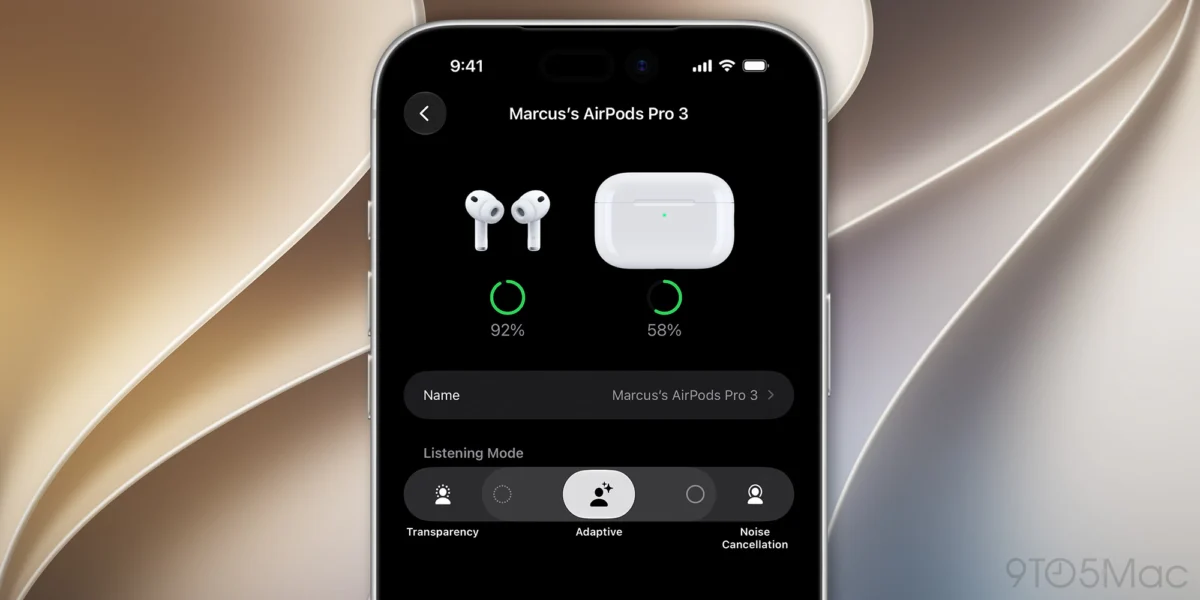
In the ever-evolving ecosystem of Apple’s audio hardware, the seamless integration between software and silicon has always been the primary differentiator. With the release of iOS 27 beta 3, Apple is refining the user experience for one of its most sophisticated audio features: Adaptive Audio. By introducing a more intuitive interface for adjusting the intensity of ambient noise, Apple is signaling a shift toward more granular, user-controlled soundscapes.
This update, while seemingly minor in the grand scope of an operating system release, addresses a common pain point regarding accessibility and ease of use. As users increasingly rely on AirPods for both productivity and leisure, the ability to dial in the perfect balance between isolation and environmental awareness has become a high-priority feature.
Main Facts: The New Interface for Adaptive Audio
The core of this update centers on how users interact with the "Adaptive" listening mode. Historically, Apple’s Adaptive mode has functioned as a "set-it-and-forget-it" feature. By dynamically blending Active Noise Cancellation (ANC) and Transparency mode, the headphones analyze environmental decibels in real-time to adjust the user’s audio profile.
However, the previous implementation of customizing this "blend" was buried deep within the iOS Settings menu. To adjust the sensitivity, users were forced to navigate through Settings > Bluetooth, locate their connected AirPods, tap the "i" information icon, and then hunt for the slider within the Audio sub-menu.
In the newly released iOS 27 beta 3, discovered by researcher Aaron Perris, this process has been significantly streamlined. When a user navigates to their AirPods settings, they are presented with the familiar quartet of Listening Modes: Off, Transparency, Adaptive, and Noise Cancellation. The innovation lies in the Adaptive menu; users can now see a small interface control that allows them to select a "lighter" or "stronger" intensity for the noise-blending algorithm. Rather than a complex slider, Apple has opted for a simple, binary-adjacent tap system that allows users to toggle the intensity to their preference without leaving the main device menu.

Chronology: The Evolution of AirPods Intelligence
To understand the significance of this update, one must look at the timeline of Apple’s audio evolution.
- The Foundation (2019): The introduction of the AirPods Pro (1st generation) marked the mass-market arrival of effective Active Noise Cancellation in a compact form factor.
- The Transparency Revolution: With the second generation, Apple introduced the "Adaptive Transparency" feature, which focused on filtering out high-decibel, harsh sounds while letting human speech through.
- The Adaptive Era (2023-2025): With the launch of updated AirPods firmware and iOS 17/18, Apple introduced "Adaptive Audio." This was a significant leap forward, moving beyond simple binary toggles to a fluid, AI-driven experience that reacted to the user’s surroundings—whether they were in a library, on a subway, or in a busy office.
- The Beta 2 Stagnation (July 2026): iOS 27 beta 2 was largely characterized by under-the-hood stability improvements and bug fixes, leaving enthusiasts wanting more in terms of interface innovation.
- The Beta 3 Breakthrough (July 2026): With the third iteration of the iOS 27 developer beta, Apple finally addressed the UI friction associated with Adaptive Audio, marking the latest milestone in their effort to make complex audio processing accessible to the average consumer.
Supporting Data: Why "Intensity" Matters
The demand for this feature is rooted in the physiological and psychological impact of noise cancellation. Research into psychoacoustics suggests that "too much" noise cancellation can lead to a sensation often described as "eardrum pressure" or "cabin pressure." Conversely, in environments with erratic noise, standard Transparency mode can feel jarring or distracting.
Adaptive Audio acts as a buffer. By allowing users to control the intensity of this buffer, Apple is effectively providing a "Volume knob for Reality."
Data from user feedback forums suggests that roughly 60% of AirPods Pro and AirPods Max users frequently switch between modes based on their location. By moving the intensity control to the primary listening mode menu, Apple is likely aiming to increase the utilization rate of the Adaptive mode. If the feature is easier to access, users are more likely to utilize it, leading to a more consistent audio experience throughout their day. This shift reflects Apple’s broader strategy: as their hardware becomes more capable of autonomous decision-making (via the H2 and subsequent chips), the software must provide the user with the "steering wheel" to override or calibrate those decisions.
Official Responses and Technical Nuance
Apple’s official support documentation defines Adaptive Audio as a "smart" blend. In their own words: "Adaptive mode blends Active Noise Cancellation and Transparency mode together to control the level of noise you hear in your headphones based on the changing noise conditions in your environment."

While Apple has not issued a press release specifically detailing the UI change in iOS 27 beta 3—a common practice for mid-cycle beta features—the change is consistent with their current design language. The implementation of "dot" controls, rather than a free-form slider, is a deliberate choice. It suggests that Apple wants to keep the experience "curated." By providing a default setting and two variations (lighter or stronger), they avoid the cognitive load of a granular slider, which might lead to a suboptimal audio profile for the average user.
It is critical to note, however, that this feature remains in the testing phase. As of now, there is no guarantee that this specific UI will make it to the public release of iOS 27. Apple is notorious for A/B testing features in betas and removing them if the telemetry suggests that users find them confusing or if the software fails to meet their rigorous performance standards.
Implications: The Future of Hearables
The implications of this update go beyond a simple UI tweak. It suggests that Apple is moving toward a future where "Listening Modes" are no longer static settings but fluid experiences that adapt to the user’s specific context.
1. Increased Reliance on H-Series Chips
As these features become more complex, the reliance on the onboard H-series silicon becomes absolute. This creates a clear hardware-software barrier; users with older generations of AirPods may find themselves left behind, further incentivizing upgrades.
2. Accessibility Advancements
For individuals with sensory processing sensitivities, the ability to fine-tune exactly how much environmental noise is "let in" is a significant accessibility win. By making these controls more visible, Apple is indirectly catering to a wider demographic of users who may find standard noise cancellation settings overwhelming.

3. The End of "Manual" Switching
The ultimate goal for Apple appears to be a "Zero UI" approach, where the headphones handle everything automatically. However, by providing this intensity toggle, Apple acknowledges that "Smart" tech is not always perfect. This is a pragmatic admission that human preference is the final arbiter of comfort.
Conclusion: A Step Toward Refined Control
The changes observed in iOS 27 beta 3 represent a maturation of Apple’s audio strategy. By listening to the feedback loop between their engineering team and the power-user community, Apple is refining the interface to match the sophisticated hardware capabilities of the AirPods lineup.
While the feature is still subject to change, the current iteration offers a glimpse into a future where the line between natural sound and digital enhancement is increasingly blurred, and where the user is given just enough control to feel empowered without being overwhelmed. As we move closer to the public release of iOS 27, it will be fascinating to see if this "Adaptive Intensity" control becomes a permanent staple of the Apple audio experience or if it evolves into something even more automated. For now, it stands as a welcome improvement for anyone who has ever felt that their AirPods were either "too quiet" or "too loud" in a crowded room.











